EZ-Ar-VC: A Robust Speech Anonymization Model for Arabic

EZ-Ar-VC trains a voice conversion model for Arabic, improving pronunciation preservation and robustness in anonymization.
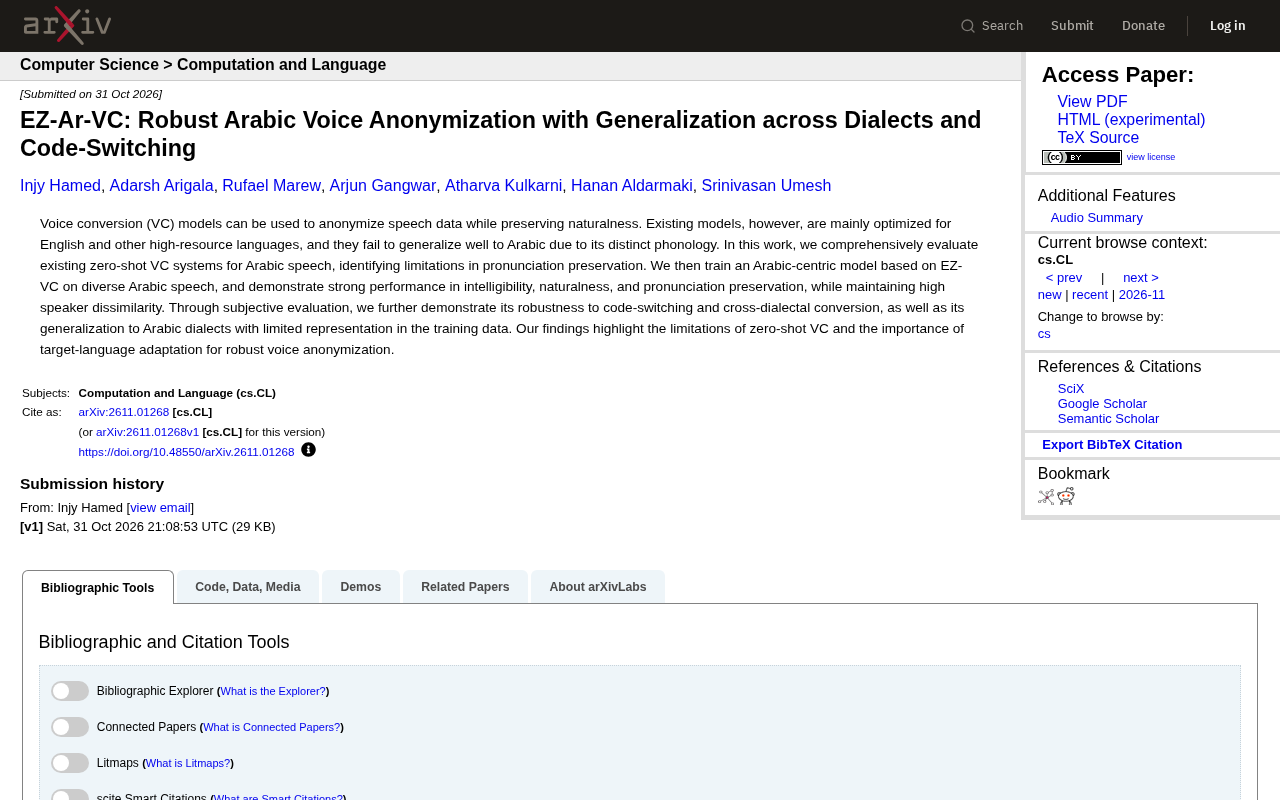
This article introduces EZ-Ar-VC, a study on Arabic speech anonymization. The research first evaluates existing zero-shot voice conversion systems on Arabic and finds that, because Arabic's unique consonant system, vowel length, and stress patterns differ significantly from English, these systems maintain speaker similarity but fall notably short in intelligibility and pronunciation accuracy. To address this, the team built on the EZ-VC architecture and trained an Arabic-centric model, EZ-Ar-VC, using diverse Arabic data; it performs strongly in intelligibility, naturalness, and pronunciation preservation while maintaining high speaker dissimilarity. Subjective evaluations further verify the model's robustness to code-switching and cross-dialect conversion. The study emphasizes the necessity of target-language adaptation and provides a reference for speech anonymization in other low-resource languages.
Voice Conversion (VC) models can anonymize speech data while preserving its naturalness. However, existing models are primarily optimized for high-resource languages such as English, and due to the unique phonological features of Arabic, these models generalize poorly to Arabic. This article introduces a study on Arabic speech anonymization—EZ-Ar-VC—which systematically evaluates the performance of existing zero-shot VC systems on Arabic and proposes targeted improvements.
Limitations of Zero-Shot VC on Arabic
The research team first conducted a comprehensive evaluation of existing zero-shot VC systems and found that these systems have clear deficiencies in preserving pronunciation in Arabic speech. Zero-shot VC systems are typically trained on large-scale multilingual data, but the Arabic consonant system, vowel length distinctions, and stress patterns differ significantly from English, causing converted speech to maintain speaker similarity while suffering substantial degradation in intelligibility and pronunciation accuracy. This finding reveals the fragility of "one-size-fits-all" multilingual models on specific languages.
Zero-shot Voice Conversion refers to a model's ability to convert speech into the timbre of a specified speaker even when it has never seen that target speaker's data during training, without retraining for that speaker. Its core lies in disentangling speech content (linguistic information) from speaker identity (timbre, prosody, etc.), typically by using a speaker encoder to extract timbre embeddings and then recombining them with content features to generate the target speech. Zero-shot capability enables the system to generalize to any unseen speaker and is a key technology for scenarios such as speech anonymization and personalized speech synthesis. However, the generalization ability of zero-shot VC depends heavily on the language coverage of the training data. When the target language (such as Arabic) is underrepresented or absent in the training set, the model's modeling of specific phonological features is insufficient, making pronunciation errors or reduced intelligibility likely.
Construction and Core Capabilities of EZ-Ar-VC
To address the above issues, the research team built on the EZ-VC architecture and trained an Arabic-centric model—EZ-Ar-VC—using diverse Arabic speech data. The model demonstrates strong performance in intelligibility, naturalness, and pronunciation preservation while maintaining high speaker dissimilarity, which is precisely the core goal of speech anonymization: preventing others from identifying the original speaker while keeping the speech content clear and intelligible.
Balancing Pronunciation Preservation and Naturalness
The key improvement of EZ-Ar-VC lies in its adaptation to Arabic phonological features. Through targeted training data design, the model can more accurately preserve pronunciation details specific to Arabic, such as emphatic consonants and long vowels, thereby anonymizing speech without sacrificing speech quality. Subjective evaluations show that the converted speech is close to the original in naturalness, with significantly fewer pronunciation errors.
Speaker Dissimilarity is a core evaluation metric in speech anonymization, measuring the degree of difference between converted speech and the original speaker's speech in identity features such as timbre and prosody. The higher the dissimilarity, the harder it is to associate the anonymized speech with the original speaker through listening perception or automatic speaker recognition systems, and the better the privacy protection effect. It is typically quantified by extracting identity features using speaker embedding models (such as x-vector or ECAPA-TDNN) and computing cosine distance or equal error rate (EER). In speech anonymization tasks, it is necessary to improve speaker dissimilarity while maintaining speech intelligibility and naturalness, and there is a trade-off among the three. EZ-Ar-VC balances intelligibility and naturalness while maintaining high speaker dissimilarity, reflecting optimization under this trade-off.
Emphatic Consonants are a consonant class specific to Semitic languages such as Arabic, such as /sˤ/, /dˤ/, /tˤ/, and /ðˤ/, pronounced with retracted tongue root and constricted pharynx, accompanied by pitch lowering and formant changes. These consonants serve a meaning-distinguishing function in Arabic and form minimal pairs with their plain counterparts (such as /s/ and /sˤ/). In addition, Arabic distinguishes short vowels from long vowels, and vowel length also carries meaning. These phonological features do not exist or behave differently in English, making multilingual VC models trained primarily on English prone to modeling errors, with pronunciation errors such as weakened emphatic consonants and shortened long vowels after conversion, directly affecting intelligibility. EZ-Ar-VC is trained on Arabic data precisely to preserve these language-specific pronunciation details.
Robustness to Code-Switching and Cross-Dialect Speech
The Arabic-speaking world has numerous dialects, and code-switching—mixing Arabic with languages such as English and French—is common in everyday communication. Through subjective evaluation, the study further verified the robustness of EZ-Ar-VC to code-switching and cross-dialect conversion. The model not only performs well on Modern Standard Arabic but also handles dialects with limited representation in the training data, demonstrating generalization ability across Arabic dialects. This is crucial for speech anonymization applications in real-world scenarios, because users' speech often contains dialectal and foreign-language vocabulary.
Code-switching refers to the phenomenon in which speakers alternate between two or more languages within the same utterance, which is especially common in the Arabic-speaking world, where English and French vocabulary are often mixed in everyday communication. For speech conversion systems, code-switching brings dual challenges: the model must handle the phonological rules of multiple languages simultaneously, and speakers' prosody and pronunciation may change subtly when switching languages. If a model is optimized for only a single language, it is prone to pronunciation errors or unnatural conversion when encountering speech mixed with foreign-language vocabulary. Trained on diverse Arabic data, EZ-Ar-VC demonstrates robustness to code-switching in subjective evaluations, which is crucial for speech anonymization applications in real-world scenarios, because users' speech is often not purely monolingual standard language.
Research Implications: The Importance of Target-Language Adaptation
The findings of this study highlight the limitations of zero-shot VC systems and the necessity of adaptation to the target language. For languages with unique phonology such as Arabic, directly applying English-optimized models makes reliable speech anonymization difficult. The success of EZ-Ar-VC shows that training or fine-tuning on target-language data is an effective path to improving anonymization robustness. This conclusion also has reference value for other low-resource languages, suggesting that the research community should pay attention to language specificity when building speech privacy protection tools.
As speech data is increasingly used in AI training and communication, the demand for anonymization technology continues to grow. EZ-Ar-VC provides a practical solution for Arabic speech privacy protection and points out directions for future research on multilingual speech anonymization.
Related articles

Glasshand: Giving AI Agents a Real iPhone and Mac
Glasshand lets AI agents rent real iPhones and Macs, supporting Claude Code, Codex, and more to post, book services, and test iOS apps on real devices. This article explains how it works, its use cases, and potential boundaries.

ChatGPT Images 2.6 Released: GIF Generation, Reference Image Reuse, and 50% Speed Boost
ChatGPT Images 2.6 released: prompt-to-GIF animation with frame-by-frame editing, reusable reference images for yourself, pets, or characters, 50% faster generation, plus Flare and Sunburst API model variants and SVG export for developers.

Rerun: Turn Your AI Subscription into an AI Coworker Team
Rerun, #3 on Product Hunt, turns your ChatGPT or Claude subscription into a team of AI coworkers that run on schedules or triggers, each with tools, a computer, and a shared workspace. It asks before risky actions, is open source (AGPL v3), and supports self-hosting.