Fabbit Review: How a Unified Growth Intelligence Platform Turns Data Into Action Items
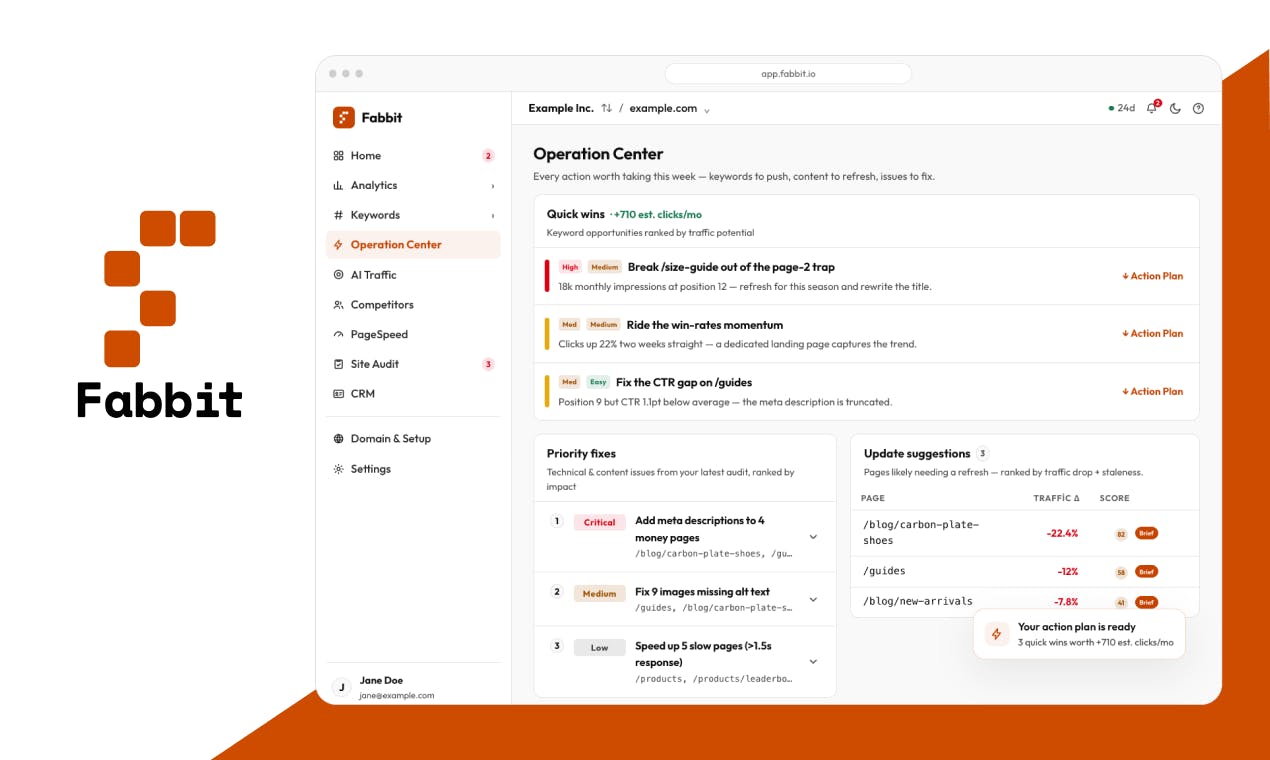
Fabbit consolidates growth data from SEO, analytics, and CRM into AI-driven daily action items.
Fabbit positions itself as a unified growth intelligence platform that integrates SEO, traffic analysis, competitive monitoring, CRM, and site auditing into a single hub. Its core differentiator is moving beyond data visualization to prescriptive analytics — generating specific daily action recommendations rather than leaving interpretation to users. While still early-stage, Fabbit represents a broader industry shift toward AI-powered decision agents in SaaS tools.
The Pain Point of Growth Tools: Too Much Data, Too Little Action
For marketers, growth leads, and entrepreneurs, there's a familiar predicament: the more tools you have, the more fragmented your data becomes. SEO analysis lives on one platform, website traffic in Google Analytics, competitive tracking in yet another tool, and customer relationship management in a standalone CRM system. When it's time to make decisions, you're forced to switch between multiple dashboards, piecing together fragmented numbers into a complete picture.
This predicament has a professional term in the industry — "Data Silo." It refers to data across different systems, departments, or tools that cannot flow freely or interoperate, forming isolated "islands" of information. In growth marketing, this problem is particularly acute: a typical mid-sized company uses 6-10 MarTech tools on average, each with its own data model, API interface, and export format. According to Gartner, the fragmentation of marketing technology stacks causes companies to waste an average of 26% of their marketing budget on repetitive data integration work. This also explains why "unified platform" products have continued to attract both capital and users in recent years.
Fabbit, which recently launched on Product Hunt, targets exactly this pain point. It positions itself as a "unified growth intelligence platform," consolidating SEO, data analytics, competitive monitoring, CRM, and site auditing into a single hub, with an ambitious tagline — "All your growth data. One next move."
Fabbit's Core Differentiator: From Displaying Data to Generating Action Items
One core differentiator that the Fabbit team repeatedly emphasizes deserves attention: Most tools "display data," while Fabbit displays data and tells you what action to take — fast.
This might sound like marketing speak, but it points to a long-standing structural problem in the growth analytics tool industry. Traditional analytics platforms excel at visualization — they can draw beautiful line charts, stacked bar charts, and heatmaps — but they leave the two critical decision-making steps of "what does this data mean" and "what should I do next" entirely to the human user.
From a technology evolution perspective, this corresponds to different levels of analytical capability. Traditional Business Intelligence (BI) tools like Tableau and Power BI operate on a core paradigm of "data visualization" — transforming raw data into human-readable charts, which falls under Descriptive Analytics. The industry then developed Diagnostic Analytics (explaining why something happened) and Predictive Analytics (forecasting what might happen), but these still remain at the stage of "telling you what happened" and "what might happen." What Fabbit attempts to reach is the highest level of analytical capability — Prescriptive Analytics — which directly tells users what action to take. This level was previously found mainly in customized systems for large enterprises; the emergence of large language models is democratizing it, enabling small and mid-sized businesses to access similar decision support.
In other words, the vast majority of tools solve the "perception" problem, while Fabbit tries to solve the "decision" problem. It promises to distill scattered data into a "daily actionable next step." This shift from "viewing data" to "providing recommendations" is a typical direction for AI capabilities being embedded into SaaS products today.
From Passive Dashboards to Proactive Decision Agents
If Fabbit can truly deliver on its promise, its product logic is essentially that of a "Decision Agent" rather than a "data dashboard."
The concept of a "Decision Agent" originates from the Agent architecture in artificial intelligence. In classical AI theory, an Agent is an autonomous entity capable of perceiving its environment, making decisions, and executing actions. In recent years, with the development of LLM (Large Language Model) technology, AI Agents are moving from academic concepts to commercial applications. In the SaaS domain, a decision agent means the product is no longer a passive tool waiting for user queries, but an "intelligent assistant" that proactively analyzes context, synthesizes multi-dimensional data, and generates specific action recommendations. The fundamental difference from traditional dashboards is: dashboards use "pull" interaction where users actively seek information; decision agents use "push" interaction where the system proactively provides optimal action paths.
When users open the product, they no longer see a dozen metrics requiring self-interpretation, but rather clear directives like "The most worthwhile thing to do today is..." This design lowers the barrier to entry and is particularly appealing to small businesses and independent entrepreneurs who lack dedicated data teams.
The Value of All-in-One Integration: Breaking Down SEO, Analytics, and CRM Data Silos
Fabbit covers a remarkably broad range of functional modules: SEO optimization, traffic analysis, competitive intelligence, CRM customer management, and site auditing. Aggregating these capabilities — which traditionally belong to different product categories — offers obvious benefits: reduced tool-switching costs, elimination of data silos, and cross-dimensional correlated insights.
For example, when SEO data, traffic data, and competitive data coexist within the same system, the platform can theoretically discover correlations that no single tool could detect — such as "a competitor recently published content that captured keywords where you previously ranked well, causing traffic to related landing pages to decline" — and then generate targeted recommendations.
However, being "broad and comprehensive" also presents significant challenges. Each vertical domain (SEO, CRM, analytics) already has mature, specialized market leaders. The competitive landscape Fabbit faces is quite intense: in SEO, there's Ahrefs, SEMrush, and Moz, which have been deeply specialized for over a decade; in traffic analytics, there's Google Analytics, Mixpanel, and Amplitude; and the CRM space is dominated by Salesforce and HubSpot. Recent consolidation trends are worth noting — HubSpot has expanded from CRM into a full-stack platform covering marketing, sales, and services; SEMrush has also been continuously expanding its functional boundaries. But most of these integrations are "physical integrations" achieved through acquisitions or feature stacking, rather than "chemical integrations" with AI at the core. Fabbit's differentiation opportunity may lie precisely in this: it was architected from the start with AI-driven decision-making at its core, rather than building tools first and layering AI on top afterward.
For an integrated tool to be "good enough" in each module is already challenging — let alone generating high-quality action recommendations that require accuracy and consistency of cross-module data as their foundation. The depth of data integration and the reliability of recommendations will be key determinants of whether Fabbit can truly deliver on its value proposition.
Fabbit's Current Status and Target User Analysis
Based on currently available public information, Fabbit was built by Şahin Solmaz and received 6 upvotes on its Product Hunt launch day, ranking #20, categorized under Analytics, Marketing, and SEO.
Some industry context helps interpret these numbers. Product Hunt is one of the world's primary new product launch platforms, with 20-40 products going live daily. Receiving 6 votes and ranking #20 represents a below-average first-day performance — products in the top 5 for the day typically receive hundreds of votes. However, it's important to note that Product Hunt vote counts are highly dependent on a founder's existing social network and pre-launch strategy, and don't fully reflect product quality or market potential. Many products that later became successful (such as early versions of Notion) also had quite modest debut performances on Product Hunt. For an early-stage product like Fabbit, what matters more is subsequent user retention and word-of-mouth growth.
These numbers indicate it's still in its early stages, without significant market traction. As an early-stage product, Fabbit's direction is clear: in the wave of growth tools becoming increasingly "AI-powered," it aims to capture mindshare at the "action recommendation layer." Its target user profile is also relatively well-defined — growth teams and entrepreneurs weighed down by tool stacks who want someone to simply tell them "what to do next."
Questions Worth Monitoring
For readers following products like this, several dimensions are worth validating going forward:
- Quality of action recommendations: Are they generic platitudes or truly precise insights based on data? The difficulty of prescriptive analytics lies in the fact that models need not only to understand data patterns but also possess domain expertise to evaluate the feasibility and expected returns of different action plans.
- Depth of module integration: Is it shallow aggregation (similar to displaying data from multiple tools on the same interface) or deep interconnection (where data forms genuine causal reasoning and correlation analysis)?
- Competitive assessment: Compared to existing specialized tools, does it offer advantages in cost-effectiveness and migration costs? Are users willing to abandon professional tools they're already familiar with in favor of a platform that's "versatile but potentially not deep enough in any single area"?
The Evolution of Growth Tools in the AI Era
Fabbit itself is still small in scale, but the product philosophy it represents is highly representative. As large model capabilities mature, an increasing number of SaaS tools are evolving from "presenting information" to "generating decisions." Users are no longer satisfied with a pile of charts requiring self-interpretation — they expect tools to proactively and quickly tell them what to do.
The technical foundation of this trend lies in the fact that large language models now have the ability to combine unstructured and structured data for cross-domain reasoning. Previously, bridging the gap "from data to recommendations" required dedicated data science teams to write rules and build models; now, LLMs can serve to some extent as a "general reasoning engine," synthesizing signals from different data sources into actionable suggestions. Of course, this also introduces new challenges — whether AI-generated recommendations are reliable, whether they might produce "hallucinations," and how users can verify the reasonableness of suggestions — these are all questions the industry needs to continuously address.
Regardless of how far Fabbit ultimately goes, the tagline "All your growth data. One next move." precisely captures the core proposition of next-generation growth tools: In an era of data overload, what's truly scarce isn't information — it's a clear direction for action.
Key Takeaways
Related articles

Chain of Thought Isn't Just for AI: How Humans Can Use CoT to Improve Thinking Quality
Chain of Thought isn't just a prompt trick for large models. Starting from a Hacker News discussion, this article analyzes why CoT works for human thinking too, breaks down actionable ways to transfer it, and highlights the key differences between human CoT and machine CoT.
Cloudflare Teams Up with OpenAI: Closi…
Cloudflare Teams Up with OpenAI: Closing the Loop from Vulnerability Discovery to Defense with AI
Cloudflare uses OpenAI Daybreak to investigate security vulnerabilities and generate reviewable remediation plans, while developers use Codex to boost coding efficiency and quality.

Orca Multi-Agent Orchestration in Practice: A Guide to Parallel Collaboration with Claude and Codex
Orca is Stable AI's free open-source agent workbench supporting 34 agents like Claude Code and Codex in parallel. Learn its Git worktree isolation, multi-model orchestration, and mobile management.