Fable 5.1 Real-World Test: The Truth About Generating a Medieval 3D Town in 5.5 Hours — Results and Costs
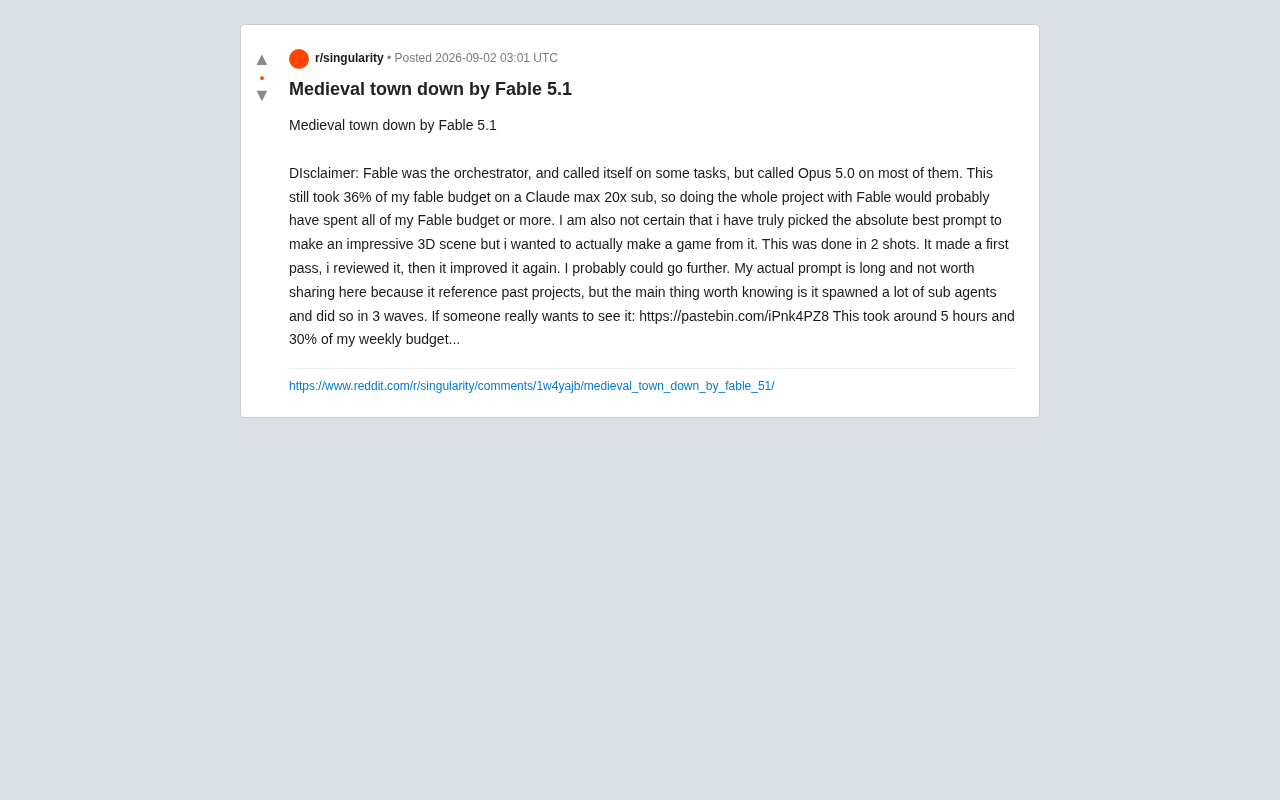
Fable 5.1 generates a medieval 3D town in 5.5 hours, but burns 30% of a weekly Claude Max budget.
A Reddit developer tested Fable 5.1 to generate a complete medieval 3D town scene, revealing its multi-wave sub-agent orchestration mechanism that delegates most tasks to Opus 5.0. While the results are impressive, the project consumed 5.5 hours and 30% of a weekly Claude Max 20x budget, highlighting the significant cost gap between AI capability demos and practical, economical adoption.
AI Coding Tools Enter a New Arena: From Code to 3D Scenes
In the AI-assisted programming space, tools are constantly pushing the boundaries of what's possible. Recently, a Reddit user shared a hands-on case study of using Fable 5.1 to generate a complete medieval 3D town scene, sparking widespread community interest. The case not only showcased the generative capabilities of next-generation AI coding tools but also exposed the real-world challenges of cost and efficiency.
Unlike traditional code completion tools, Fable played the role of an "orchestrator" in this case. Rather than simply writing a few lines of code, it decomposed tasks, dispatched sub-agents, and coordinated the construction of a complete interactive 3D scene. This "AI directing AI" workflow is emerging as a new paradigm for automating complex projects.
Fable 5.1's Technical Highlight: Multi-Wave Sub-Agent Coordination
According to the original poster, the most noteworthy technical detail of this project was Fable's task orchestration mechanism. The author noted that Fable "spawned a large number of sub-agents and executed them in 3 waves."
Sub-Agents and Multi-Agent Coordination: Technical Background
Sub-agents are a core concept in Multi-Agent Systems. In AI programming, sub-agents refer to specialized AI instances dynamically created and dispatched by a master orchestrator, each assigned a specific task scope and context window. This architecture borrows from the microservices philosophy in software engineering — breaking a monolithic application into multiple independent services, each handling specific responsibilities. In Fable's implementation, the master agent understands the user's high-level intent, decomposes it into executable subtasks, and creates dedicated sub-agents for each one. These sub-agents can execute independent tasks in parallel (such as modeling different buildings simultaneously) or handle dependent tasks sequentially (such as completing building models before applying textures). The wave-based execution is essentially a pipeline scheduling strategy, where each wave's output serves as input for the next, enabling progressive project construction.
How Layered Scheduling Works
This wave-based sub-agent scheduling is fundamentally a task decomposition strategy. A large goal like "build a medieval town" gets broken down into subtasks such as building modeling, scene layout, texture mapping, and interaction logic, which are then handled by different agents in parallel or sequence. This architecture offers several key advantages:
- Modular processing: Each sub-agent focuses on a specific task, reducing the complexity of any single context
- Iterative optimization: The entire process was completed in "2 shots" — a first version was generated, reviewed by the human, and then improved by AI in a second round
- Human-AI collaboration loop: AI handles generation while humans handle review and direction
You might have missed this detail: although Fable handled the orchestration itself, it "called Opus 5.0 for most tasks" and only self-invoked for some. This reveals that complex AI projects today often require multi-model collaboration, with different models handling different tiers of work.
The Division of Labor Between Opus and Fable
In Anthropic's product lineup, Opus and Fable represent different model tiers. Opus is Anthropic's flagship reasoning model, offering the strongest complex task handling and long-chain reasoning capabilities — but at the highest computational cost. Fable is positioned as a model with advanced orchestration capabilities, excelling at task decomposition and multi-step project management. In practice, Fable can serve as the "project manager," delegating execution tasks like code writing and resource generation to Opus or other models. This tiered model invocation pattern mirrors corporate management structures — leadership handles strategic planning and task allocation while execution teams handle implementation. The strategy of having Fable orchestrate and Opus execute is essentially about finding the optimal balance between model capability and cost.
The Cost Reality: 5.5 Hours Consuming 30% of a Weekly Budget
If the generated results showcase AI's capability ceiling, the cost data reveals the real-world barriers to practical adoption.
Specific Resource Consumption Data
The author candidly shared the staggering resource consumption for this medieval town project:
- Took approximately 5.5 hours
- Consumed 36% of the Fable budget (under a Claude Max 20x subscription)
- Also used about 30% of the total weekly budget
The Economics of Token Consumption
Claude Max is Anthropic's premium subscription plan, where 20x means users get 20 times the standard token allocation. Tokens are the fundamental unit of measurement for large language model text processing — one English word typically corresponds to 1-2 tokens, while each Chinese character maps to roughly 1.5-2 tokens. Every model input (prompt + context) and output (generated content) consumes tokens, and the per-token cost varies significantly across models. Based on current market pricing, flagship models like Opus typically cost 5-10x more per token than mid-tier models. When AI tools engage in multi-turn dialogues and multi-agent coordination, token consumption grows multiplicatively — each sub-agent requires its own context window, and communication between the orchestrator and sub-agents generates additional overhead. This explains why a 5.5-hour project can consume 30% of a weekly budget: token consumption rates during multi-agent parallel execution far exceed those of single-conversation scenarios.
More critically, the author judged that if the entire project had been done exclusively with Fable, it would likely have exhausted the entire Fable budget — or more. It was precisely this cost consideration that led the author to have Fable delegate most tasks to the relatively more economical Opus 5.0.
This data carries a warning for the entire AI programming industry. Current AI coding tools exhibit non-linear cost growth when handling complex, long-chain tasks. Behind every impressive demo lies substantial token consumption. For individual developers and small teams, this cost structure means: AI-generated complete projects are technically feasible, but economically, they still require careful budgeting.
From 3D Scene Demo to Actual Game: How Big Is the Usability Gap?
The author revealed an important ambition — they weren't satisfied with just generating a "nice-looking 3D scene" but wanted to "actually make a game."
Technical Pathways for 3D Scene Procedural Generation
AI-generated 3D scenes typically combine Procedural Generation with code-driven modeling. In this case, the AI didn't directly output 3D model files but instead generated the code needed to build the scene — including geometry definitions, material parameters, Scene Graph layouts, lighting setups, and interaction logic. Common tech stacks include Three.js (a WebGL-based browser 3D engine), Babylon.js, or scripting code for Unity/Unreal Engine. The core advantage of procedural generation lies in parameterization and reproducibility: different building styles, terrains, and town layouts can be generated by adjusting parameters. However, a significant quality gap still exists between procedurally generated 3D scenes and handcrafted game assets, especially in detail richness, animation smoothness, and performance optimization.
The Uncertainty Challenge of Prompt Engineering
The author maintained a commendable level of self-awareness: "I'm not sure I actually found the best prompt to generate the most stunning 3D scene." This statement highlights a core pain point in current AI generation workflows — the high uncertainty of prompt engineering.
The same tool with different prompts can produce vastly different results. The author's prompt was long and referenced context from previous projects, leading them to conclude that sharing it in isolation wouldn't be very meaningful (though they still provided the full version on Pastebin for reference). This also reflects that high-quality AI output often depends on carefully accumulated context and experience, not a single simple instruction.
From Prompt Engineering to Context Engineering
Prompt Engineering has evolved from simple early-stage instructions into a complex practical discipline. Advanced prompts typically include multiple layers: system-level instructions (defining AI roles and behavioral constraints), task descriptions (specifying goals and deliverables), contextual references (past project experience, codebase information), and output format requirements. The original poster mentioned that their prompt referenced context from past projects, touching on a deeper concept — Context Engineering. Unlike one-off prompts, context engineering emphasizes cross-project, cross-session knowledge accumulation and reuse. Developers maintain project documentation, code conventions, architectural decision records, and other materials to build a "knowledge base" for AI reference. This accumulation ensures that each AI interaction builds upon prior experience, significantly improving output quality. However, it also means that prompt effectiveness is highly dependent on personal accumulation and difficult to simply copy or transfer.
From "generating a scene" to "making a game," there's still a vast gap filled with interaction logic, game mechanics, performance optimization, resource management, and other engineering challenges. How much of this AI can cover remains an open question.
Industry Insights from the Fable 5.1 Real-World Test
This hands-on case from the Reddit community, while just one developer's personal experience, reflects several key trends in AI coding tool development:
Orchestration capability is becoming a core competitive advantage. AI tools are evolving from "writing code" to "managing AI teams" — whoever can decompose and dispatch tasks more efficiently can handle more complex projects.
Multi-model collaboration is the pragmatic choice. Premium models handle decision-making and orchestration while economical models handle execution — this cost-conscious division of labor is becoming mainstream practice.
Compute cost remains the biggest constraint. The data showing 30% of a weekly budget consumed in 5.5 hours reminds us that the democratization of AI's large-scale generation capabilities is still constrained by the hard limit of compute costs.
For developers following AI programming, Fable 5.1's demonstration is both encouraging and sobering — the technical ceiling is rising rapidly, but on the road to practical adoption, cost and controllability remain unavoidable challenges.
Key Takeaways
Related articles

Workbuddy for Absolute Beginners: How a Desktop AI Agent Fits Into Real Workflows
A beginner's guide to the Workbuddy desktop AI agent: installation, claiming credits, file management, and building automated workflows—compared with CodeX for fit and cost, helping professionals shift from AI question-askers to AI managers.

OpenAI's New Agent Stack: Computer Use, Decisions API, and Ultra-Fast Workflows
OpenAI Dev Day unveiled a new agent stack: Computer Use outperforms humans, Decisions API delivers ultra-low-latency classification via Luna, Agents API opens the same Computer Use capabilities, and GPT-6.1 Sol costs only one-seventh of Astra. Core updates, benchmark data, and developer insights.

Liang Wenfeng Open-Sources DeepInfo Inference Framework, Takes On U.S. Ban
DeepSeek open-sources its DeepInfo inference framework after its models, featuring GPU/CPU cross-pipelining, small-model prediction with large-model verification, and full Huawei Ascend and NVIDIA chip support—facing the U.S. federal ban head-on. This article analyzes its significance for AI deployment and open-source strategy.