Fable 5.2 vs. Opus 5.5: The Cost Showdown — Lower Cost per Task

Fable 5.2 costs 2x per token but only ~half per task vs. Opus 5.5—choose by total cost.
The article examines the pricing debate between Fable 5.2 and Opus 5.5, noting a higher per-token price doesn't mean higher actual cost. Official data shows Fable 5.2 at high effort matches Opus 5.5 at maximum effort while costing about half per task. Cost per task depends on efficiency and success rate, better reflecting real expenses than unit price. Developers should run small-scale tests on their own tasks, focusing on quality, rounds, and total tokens.
When Better Performance Meets Doubled Cost: The Apparent Contradiction
Recently, the AI model community has been discussing the pricing of Fable 5.2 and Opus 5.5. According to official comparison data presented in a YouTube video, Fable 5.2 is priced at twice the per-token rate of Opus 5.5. Looking at that number alone, it's easy to conclude that it's "better performance but more expensive" — and to some extent, that's correct.
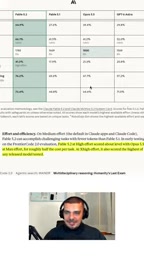
However, per-token cost is only one dimension of a model's economics. For actual users, the more critical metric is often how much it costs to complete a specific task. On this point, the official data tells a very different story.
Cost per Task: The Overlooked Efficiency Metric
The video explicitly states that the comparison is not based on cost per token, but on cost per task. This is an important distinction. Even if a model has a higher per-token price, as long as it can complete tasks with fewer tokens or faster speed, its final per-task expense may be lower.

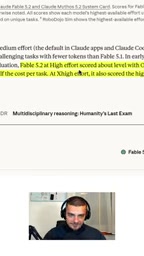
Fable 5.2 demonstrates exactly this possibility. Officially, at the "high" effort level, Fable 5.2 scores comparably to Opus 5.5 at its "maximum" effort level, while costing only about half as much per task. This means that for tasks requiring high-quality output, choosing Fable 5.2 may deliver both better performance and lower cost.
Effort Level is an inference control parameter introduced by some large-model providers, typically divided into tiers such as low, medium, high, and maximum. Its mechanism adjusts the model's "thinking" budget before generating a response — for example, the number of internal reasoning steps allowed, sampling width, or number of tool calls — to trade off between quality and expense. The higher the effort level, the more the model tends to engage in multi-round self-checking and exploration; output quality may improve, but token consumption and latency increase accordingly. Therefore, when comparing different models, effort levels must be aligned: one model's performance at the "high" tier may correspond to another model's "maximum" tier — which is exactly the key premise in the Fable 5.2 vs. Opus 5.5 comparison.
Cost per Task refers to the total expense required to complete an end-to-end task, calculated as the total number of tokens consumed by the task (including input, output, and intermediate reasoning tokens) multiplied by the unit price. Unlike per-token pricing, it factors in the model's efficiency: if a model can complete a task with fewer rounds, more concise intermediate steps, or a higher first-pass success rate, its total expense may be lower even at a higher unit price. This metric is closer to developers' actual bills, but it depends on the specific task distribution and varies considerably across different task types.
Official Claim: High Effort Matches Maximum Effort
The core basis for this conclusion comes from the official comparison page. According to the video, Fable 5.2 at the high effort setting already reaches the level of Opus 5.5 at its maximum effort setting, at significantly lower cost.

It should be noted that the source material does not elaborate on which specific benchmark the "score" refers to or how task types are defined. Therefore, this conclusion should be understood as an official claim under specific test conditions, not as an absolute rule that necessarily holds in all scenarios.
Benchmark refers to standardized test sets for measuring model capabilities, such as MMLU, HumanEval, and GSM8K, typically consisting of fixed questions and scoring rules. The claim of "comparable scores" in official comparisons must be understood in the context of the specific benchmark: different benchmarks assess different capability dimensions (knowledge Q&A, code generation, mathematical reasoning, etc.), and a model's relative advantage may reverse across benchmarks. In addition, benchmark questions may be covered by model training data, leading to inflated scores. Therefore, when seeing "comparable scores," one should ask which benchmark, whether it is public, and whether it matches real task distributions, in order to judge the transferability of the conclusion.
How to Understand the Cost-per-Task Advantage
The cost-per-task advantage can be understood from two angles. The first is efficiency: the model may complete tasks through fewer interaction rounds or more concise intermediate steps. The second is success rate: if the model completes the task correctly on the first attempt, avoiding the extra expense of retries, overall cost naturally decreases. The analysis in the video emphasizes precisely that Fable 5.2's efficiency performance makes it cheaper at the task level despite a higher unit price.
For developers and teams, this means that when selecting a model, comparing the numbers on the API price list is not enough. A more reasonable approach is to evaluate the model's actual completion efficiency and success rate for your own task types, and then calculate the comprehensive cost.
First-pass Success Rate refers to the proportion of tasks a model completes on the first attempt without human correction or retries. In multi-turn interaction scenarios, failed retries multiply token consumption and latency, so first-pass success rate may have a greater impact on cost per task than unit price differences. A model with a slightly higher unit price that gets things right the first time often has a lower comprehensive cost than a cheaper model that frequently makes errors. When evaluating, you can run small-scale tests to measure first-pass rates and convert retry costs into expected overhead, enabling a more accurate comparison of different models' true economics.
Selection Advice and Open Questions
Based on the available information, Fable 5.2 shows an attractive positioning in terms of cost-effectiveness: achieving performance comparable to a competitor's maximum effort level at high effort, while reducing per-task spending. But several questions deserve further observation: the specific evaluation sets and task distributions underlying the official data are not explained in the source material, and the range of cost-per-task variation across different task complexities is unknown.
When making actual decisions, it is recommended to first run small-scale comparative tests using representative tasks, focusing on completion quality, number of rounds required, and total token consumption — not just unit price. Only then can you determine whether Fable 5.2's cost-per-task advantage applies to your specific scenario.
One-line Summary
Although Fable 5.2's unit price is twice that of Opus 5.5, its cost per task is only about half — model selection should consider comprehensive cost.
Paragraph Summary
The article explores the pricing debate between Fable 5.2 and Opus 5.5, noting that a higher per-token price does not mean higher actual usage cost. Official data shows that Fable 5.2 at high effort scores comparably to Opus 5.5 at maximum effort, while costing only about half as much per task. Cost per task is influenced by model efficiency and success rate, and reflects real expenses better than unit price. The article advises developers to run small-scale comparative tests with specific tasks when selecting models, focusing on completion quality, rounds required, and total token consumption rather than just price-list numbers. It also notes that official evaluation conditions and task distributions remain unclear, so conclusions should be verified with real-world testing.
Related articles

The Kindle Page Turner Can Do What? Remote Camera Shutter and Manual TikTok Scrolling
Amazon's Kindle Click page-turn button was mocked as pointless, but in practice it's surprisingly useful — The Vergecast found it works as a camera remote shutter and a manual TikTok scroller.

GPT-6 Cyber Unearths 948 Linux Kernel Vulnerabilities: A New Era in AI Security Offense and Defense
GPT-6 Cyber and a custom vulnerability research pipeline analyzed the Linux kernel and confirmed 948 exploitable vulnerabilities. This article explains how the AI vulnerability discovery pipeline works, the risks of kernel vulnerabilities, and how the security community can respond collaboratively.

Jensen Huang Returns to Nvidia HQ to Hero's Welcome from Employees
Nvidia CEO Jensen Huang returned to headquarters to a hero's welcome and said he would "do better the second time as CEO." This article analyzes the leadership iteration signal and its impact on the AI industry.