Fable 5 vs Opus 5: A Hands-On Comparison of AI-Generated 2D Sprites

Fable 5 delivers minimal viable sprites; Opus 5 delivers near-production-ready asset packs at 2.3x cost.
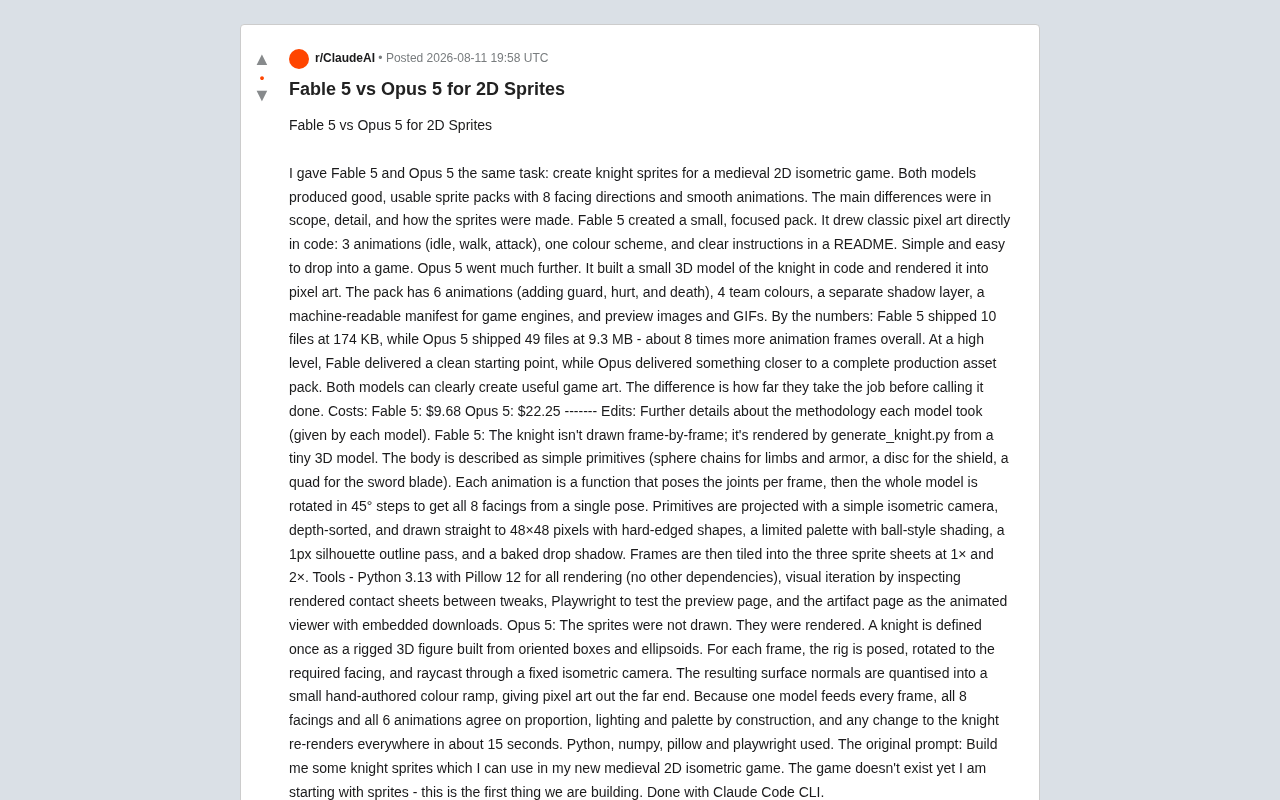
A developer tested Claude's Fable 5 and Opus 5 models with the same prompt to generate 2D isometric knight sprites. Both models built procedural 3D-to-2D pipelines in code, but differed dramatically in scope: Fable 5 delivered 10 files with 3 animations for $9.68, while Opus 5 produced 49 files with 6 animations, 4 color schemes, shadow layers, and engine manifests for $22.25. The comparison reveals that the key differentiator between AI models isn't capability but their definition of "done."
In game development, creating 2D sprites often requires artists to invest enormous amounts of time. But can AI coding assistants handle this job today? One developer used Claude Code CLI to pit Fable 5 against Opus 5 with the exact same task, and the results revealed striking differences in their depth of task understanding and delivery standards.
Same Prompt, Vastly Different Ambitions
The tester gave both models the same prompt: "Make me a batch of knight sprites for a medieval 2D isometric game I'm developing. The game doesn't exist yet, I'm starting with the sprites — this is the first thing we're going to build."
Isometric is a projection method originating from architectural drafting that views the game world from a fixed tilted angle (typically 30° or 45°) without perspective scaling, keeping objects at the same proportions regardless of distance. Classic titles like Diablo II, Baldur's Gate, and more recently Hades all use this perspective. In isometric games, character sprites face a unique production challenge: since players can observe characters from multiple directions, a single character typically requires full animation sets for 8 facings (north, northeast, east, southeast, south, southwest, west, northwest), with each animation potentially containing 4–12 frames. This means a character with 6 animation sets, 8 facings, and 8 frames per set needs a total of 384 individual images. Traditionally, these frames are either hand-drawn frame-by-frame by pixel artists or modeled by 3D artists and batch-rendered — the latter being exactly the path the AI models in this article chose.
Here's an interesting detail: neither model opted for the traditional frame-by-frame pixel art approach. Instead, both chose a smarter technical path: building 3D models in code, then rendering them as pixel art. This alone demonstrates AI's maturity in engineering thinking — they understood that to ensure consistent proportions, lighting, and color palettes across all 8 facings of a knight, the most reliable method is to generate everything from a single model source rather than drawing each frame independently.
This "procedural 3D-to-2D" pipeline has a long history in indie game development. As far back as the 1990s, the sprites in StarCraft and Age of Empires were first modeled in 3D Studio Max and then rendered as 2D bitmaps. The AI models replicated the same approach here, but replaced 3D modeling software entirely with code. The core workflow is: first, describe geometric shapes (spheres, ellipsoids, boxes, etc.) using mathematical functions to compose the character's body parts; then define joint hierarchies through a skeletal rigging system; next, adjust bone pose angles for each animation frame; and finally, map 3D coordinates onto a 2D pixel grid through orthographic projection. The biggest advantage of this method is "single source, multiple outputs" — modifying the model once automatically regenerates all frames across all facings and animations, ensuring visual consistency while dramatically reducing the manual effort of frame-by-frame verification.
However, the two models had vastly different definitions of "done." Fable 5 delivered a lean, focused starter pack, while Opus 5 delivered what amounted to a near-production-ready complete asset package.
Fable 5 Output: A Clean, Minimal Viable Starting Point
Fable 5's output embodied a philosophy of restrained sufficiency. It delivered 10 files totaling 174 KB, containing 3 animation sets (idle, walk, attack), a single color scheme, and a clear README with usage instructions. The entire package was simple and straightforward, easily embeddable into a game project.
From a technical implementation standpoint, Fable 5 rendered the knight from a minimalist 3D model via a single generate_knight.py script: the body was described using basic geometric shapes (sphere chains for limbs and armor, discs for the shield, quads for the sword blade). Each animation was a function responsible for adjusting joint poses frame by frame, then rotating the entire model in 45° increments to generate all 8 facings from a single pose.
The rendering pipeline included: projecting geometry with a simple isometric camera, depth sorting, drawing directly onto a 48×48 pixel canvas, using a limited palette with sphere-style shading, 1-pixel outline strokes, and baked drop shadows. The tech stack was also extremely lightweight — only Python 3.13 + Pillow 12, with no other dependencies. This means users can run the script with zero configuration in virtually any Python environment, reflecting Fable 5's prioritization of deployment convenience.
Opus 5 Output: A Near-Production-Ready Complete Asset Delivery
Opus 5 pushed the task to an entirely different level. It delivered 49 files totaling 9.3 MB, with roughly 8 times the total animation frames of Fable 5.
Specifically, it included:
- 6 animation sets: idle, walk, and attack plus block, hurt, and death
- 4 team color schemes: supporting multi-faction gameplay
- Separate shadow layers
- A machine-readable manifest: directly parseable by game engines
- Preview images and animated GIFs: for quick visual review
Technically, Opus 5 defined the knight as a rigged skeletal 3D model built from oriented bounding boxes and ellipsoids. Skeletal rigging is a standard technique in 3D animation that attaches a character's geometry to a hierarchical bone structure. Each bone controls a group of geometric parts around it — when a bone rotates, the corresponding model parts move accordingly. In Opus 5's implementation, oriented bounding boxes (arbitrarily rotatable rectangular prisms) and ellipsoids made up the knight's torso, limbs, helmet, and other parts. The bone hierarchy typically follows: root bone (pelvis) → spine → chest → branching into arms and head, while the root bone also branches downward into legs. This architecture enabled Opus 5 to express vastly different actions — idle, walk, attack, block, hurt, death — within a unified code framework.
For each frame, bones were posed, rotated to the desired facing, and then raycast through a fixed isometric camera. Raycasting is a classic computer graphics technique: from the virtual camera, a ray is cast for each pixel on the screen to check whether it intersects with any geometry in the scene. If it hits an object's surface, the lighting intensity is calculated based on the surface normal (the direction vector perpendicular to the surface) at the intersection point. Opus 5 made a crucial artistic decision: it "quantized" the continuous lighting values into a limited number of tiers, each mapped to a color in hand-authored color ramps. This quantization essentially simulates the pixel artist's practice of working with limited palettes — typically using only 3–5 color steps per hue. This is why the final output looks like hand-drawn pixel art rather than a smooth 3D render.
The elegance of this approach lies in the fact that since all frames originate from the same model, the 8 facings and 6 animation sets are "inherently consistent" in proportion, lighting, and palette. Any modification to the knight model can be re-rendered across all frames in about 15 seconds.
The separate shadow layer output demonstrates a deep understanding of game engineering practices. In 2D games, a character's drop shadow typically needs to be stored separately from the character sprite: different ground materials (grass, stone, water) may require different shadow blend modes and opacity; when characters stand on platforms at different elevations, shadows need to be offset independently from the character; and some game scenes may need to dynamically change the light source direction, in which case an independent shadow layer can adapt through simple transformations. The machine-readable manifest file (typically JSON or XML format) records metadata such as file paths, frame dimensions, animation frame rates, and collision box offsets for each sprite, allowing game engines like Unity and Godot to automatically import and configure all assets via script — eliminating the tedious work of manually setting parameters for hundreds of images.
The tech stack was Python + numpy + Pillow + Playwright. The inclusion of numpy allowed the heavy vector computations in raycasting to leverage underlying C-level acceleration, which provides significant performance gains for large-batch tasks requiring hundreds of frames to render. Playwright (a browser automation tool) was used to generate preview pages or animated GIFs. Compared to Fable 5's minimalist dependencies, Opus 5 opted for a richer tech stack to support its much larger output volume.
Fable 5 vs Opus 5: Data and Cost Comparison
| Dimension | Fable 5 | Opus 5 |
|---|---|---|
| Files | 10 | 49 |
| Total Size | 174 KB | 9.3 MB |
| Animation Sets | 3 | 6 |
| Color Schemes | 1 | 4 |
| Engine Manifest | No | Yes |
| Cost | $9.68 | $22.25 |
Interestingly, the cost difference (roughly 2.3x) closely tracks the difference in delivery richness. Opus 5 consumed more compute and tokens, and indeed produced more comprehensive assets. From a cost-efficiency perspective, both models demonstrate AI coding's enormous potential in game art asset production — even the more expensive Opus 5 at $22.25 is far cheaper than hiring a pixel artist for equivalent work (a complete character sprite sheet typically costs hundreds to thousands of dollars when outsourced).
Key Insight: The Real Difference Lies in "Definition of Done"
The most thought-provoking takeaway from this comparison is: both models are fully capable of generating usable game art. The real divide is how far they push the work before "declaring the task complete."
Fable 5 delivered a "clean starting point," ideal for developers who want to validate quickly and expand on their own. Opus 5 delivered a "near-finished asset package" that could almost go straight into production. This actually reflects different models' strategies for inferring user intent: Fable 5 adhered strictly to the literal request, while Opus 5 proactively anticipated the full chain of game development needs (multiple factions, hurt/death states, engine integration, etc.).
This difference maps to a well-known tension in software engineering — the "YAGNI" (You Aren't Gonna Need It) principle versus "anticipatory design." YAGNI advocates implementing only what's explicitly needed right now to avoid over-engineering, while anticipatory design emphasizes considering foreseeable expansion needs to reduce future rework costs. Fable 5 followed YAGNI; Opus 5 leaned toward anticipatory design. In actual game development, both strategies have their place: the minimal delivery approach suits early prototyping and validation phases, while delivering complete assets in one pass is often more efficient once you enter full production.
For developers, this yields a practical insight: when choosing AI coding tools, you can't just look at "can it do the job" — you also need to consider whether its understanding of task boundaries aligns with your expectations. If you want precise, controllable minimal delivery, Fable 5's restraint is a better fit. If you want the AI to go all-in and proactively fill in the gaps, Opus 5's "over-delivery" can actually save you multiple iteration rounds — even if it costs more.
As AI coding capabilities become more widespread, this kind of "definition of done" philosophy may well become an important dimension for evaluating models in the future.
Related articles

DeepCell: One-Click AI Generation of Documents, Spreadsheets, and Slides
DeepCell tops Product Hunt with one-click generation of documents, spreadsheets, and slides, using the .deepcell format for linked updates, designed for System 2 tasks like modeling and sales reviews.

Doneas: 15-Minute Daily Accountability Calls That Keep Indie Developers From Procrastinating
Doneas is a daily accountability tool for indie developers: plan tasks on Monday, join a 15-minute call with five builders each day, and log deliveries on a public progress page. This article analyzes its core mechanics, effectiveness, and potential issues around retention and matching.

Fastlane 2.0: Fully Automated AI Ad Campaigns, From Creative to Optimization
Fastlane 2.0 is an AI ad automation tool: enter your website and it learns your brand, generates video and image ads, and runs and optimizes them on Meta, TikTok, Instagram, and YouTube.