Facade Pattern: How to Stop Third-Party APIs from Polluting Your Code

A facade's real job isn't simplifying calls — it's creating a boundary that keeps third-party details out of your domain.
Using Stripe integration as an example, this article reveals a pervasive problem: third-party API implementation details (object types, error classes, field names) quietly seep into business logic, creating tight coupling. The author argues that many developers mistake the Facade Pattern for a simple call-simplification tool — but a facade's more important role is acting as a boundary that controls what data structures, errors, and operations are allowed into the domain layer. The right approach is to define your own protocols and return types (like PaymentResult), fully encapsulating Stripe's details inside the implementation layer. This also makes testing dramatically easier. The article covers three common pitfalls — pass-through wrappers, God Facades, and hiding important behavior — and clarifies the fundamental difference between Facade and Adapter.
When integrating third-party APIs like Stripe or OpenAI, developers often let the external system's design quietly seep into their own business logic. It's only when they need to swap providers or upgrade versions that they discover third-party implementation details scattered everywhere in their codebase — making refactoring enormously costly. This article focuses on one of the simplest yet most commonly misused design patterns — the Facade Pattern — and explains how to use it to build a proper boundary in your code.
The Root of the Problem: Third-Party Details Everywhere
Imagine you're integrating Stripe payments into your application. If you ask an AI to generate the code, you'll likely end up with a pay_for_order function that takes a Stripe instance, an order, and a payment method — it looks up a customer, creates one if none exists, then creates a Payment Intent (Stripe's payment flow object), and branches on various error types.
The code works, but the problem is this: if every place that handles payments has to contain this kind of Stripe-specific logic, the codebase quickly becomes a tangled mess. Worse, every part of the system that touches payments is forced to understand Stripe's implementation details — what a customer looks like, what a payment intent is, what fields it has, which error classes to catch.
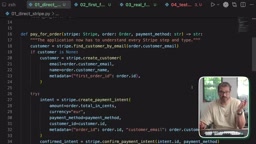
This is classic tight coupling. Your design is being driven by Stripe's design. The moment you want to swap out Stripe or upgrade to a new version, you're looking at a large-scale refactoring effort.
Step One: Use the Facade Pattern to Simplify Calls
The core idea behind the Facade Pattern is to build a simplified interface on top of a complex system, so business logic no longer has to deal directly with that complexity.
The practical approach is to introduce a PaymentService facade class — a wrapper around the Stripe billing flow — that exposes only a single pay method to the outside world. All the logic for creating customers, creating Payment Intents, and so on gets pulled inside this service. pay_for_order no longer receives a Stripe object directly; instead, it receives this service as a parameter.
This does make the business code cleaner — no more repeated customer lookups, no more creating intents, no more needing to understand what those concepts even mean. A lot of people reach this point and say: "We've implemented the Facade Pattern, we're done!"
But that's precisely the most common mistake.
The Facade Pattern is one of the 23 classic design patterns catalogued by the Gang of Four in their 1994 book Design Patterns, and it belongs to the structural pattern category. Its name comes from the architectural concept of a "façade" — no matter how complex a building's interior structure is, what it presents to the outside world is a clean front face. In software engineering, the Facade Pattern typically takes the form of a single class that encapsulates a sequence of calls to multiple subsystems, so callers only need to interact with that one class rather than coordinate all the underlying details themselves. This pattern is especially well-suited for layered architectures that need a clear entry point for each layer, legacy systems that need to shield new code from complexity, and situations where you're integrating external libraries or services and need to isolate third-party dependencies. Worth noting: a facade doesn't prevent callers who need to from bypassing it and accessing the subsystem directly — it provides convenience, not forced encapsulation. This is exactly why, in third-party integration scenarios, simply achieving "simplification" isn't enough — you have to consciously manage the boundary as well.
The Critical Mistake: A Facade Is a "Boundary," Not Just a "Simplification"
Look closely at the pay method's signature and you'll notice it still returns a Payment Intent object. That means every caller still receives a Stripe-specific object, still has to inspect that object's fields, and still has to understand the implementation details of a payment intent. Worse, Stripe errors (like card errors) still propagate up into the higher-level logic.
In other words, even though the flow appears simplified on the surface, the Stripe coupling is still there.

What you need to truly understand is this: a facade should work like a boundary. Simplification is only part of it — more importantly, the facade decides which information is allowed to cross that boundary into your application.
The improved approach is to define a Payments protocol, whose pay method accepts an order and a payment method and returns a completely custom PaymentResult object. This object has nothing to do with Stripe — it only contains the payment information your domain actually cares about. Business logic depends on this protocol, with no knowledge of the underlying implementation.
Under the hood, a StripeGateway (or payment service) implements this protocol: it creates the customer, creates the payment intent, catches errors, and converts the result into a PaymentResult to return. At this point, Stripe is completely hidden inside the service, forming a clean boundary. This is the true value of the Facade Pattern.
The "Protocol" mentioned here refers to Python's (especially the typing.Protocol introduced in Python 3.8) mechanism for structural subtyping — sometimes called "statically-typed duck typing." Unlike traditional abstract base classes (ABCs), a class implementing a Protocol doesn't need to explicitly declare inheritance; as long as it has the required method signatures, it's considered compatible. This is very similar to how interfaces work in Go. In the context of this article, defining Payments as a Protocol rather than a concrete class means that business logic only depends on the contract "can call a pay method and get back a PaymentResult" — concrete implementations like StripeGateway and FakeStripe can be swapped at any time, and incompatibilities are caught at compile time (or during type checking). This design is especially powerful in dependency injection scenarios, and it's the technical foundation that makes it easy to substitute a fake implementation during testing.
This Problem Is Everywhere
The author emphasizes that Stripe is just one example — the same problem surfaces in any similar facade scenario:
- Weather APIs: Don't pass the raw API response around everywhere. Return an object you created yourself.
- Graphics engines (like Pygame): Don't let engine-specific vector and rectangle objects bleed into your domain model.
- ORMs (like SQLAlchemy): Don't pass SQLAlchemy model objects all the way through your business layer.
- AI APIs: OpenAI or Anthropic response objects shouldn't leak into other parts of your application — extract the data you need somewhere and wrap it in a domain-friendly object.

To put it simply: whenever another system's objects proliferate through your codebase, you're letting that system shape your architecture and introducing a large amount of coupling.
A Bonus Benefit: Testing Becomes Easy
If a facade is implemented properly — not just simplifying behavior, but also carefully handling errors and response objects — testing becomes much easier. In tests, you can replace the entire facade with a mock object.
The author demonstrates creating a FakeStripe that implements the same interface, then running a few test classes against this fake, and having PyTest pass with almost no effort. Without this boundary in place, asking an AI to generate those tests would be a much heavier lift.
Three Pitfalls to Avoid When Implementing a Facade
First, don't build a pure pass-through wrapper. If the methods in your facade are create_payment_intent, confirm_payment_intent, and cancel_payment_intent, those are still highly Stripe-flavored. A facade should genuinely simplify — expose only business-meaningful methods like pay or refund_order.
Second, don't create a "God Facade." Don't cram payments, invoices, subscriptions, customers, and coupons all into one giant Stripe facade object. Split it into several cohesive, independent services or classes.
Third, don't hide important behavior. For example, don't pretend that payments are always synchronous. If callers genuinely need to know that customer authentication is required, expose that concept rather than hiding it.

Facade vs. Adapter: What's the Difference?
People often confuse the Facade Pattern with the Adapter Pattern. Both are design patterns, both "wrap" something, but they solve different problems. An Adapter's goal is to make interfaces compatible; a Facade's goal is to simplify access to a complex subsystem, so you don't have to face that complexity in every corner of your application.
Beyond Facade and Adapter, there are a few other design patterns related to "wrapping something" that are easy to mix up. The Decorator also wraps an object, but its purpose is to dynamically add responsibilities without changing the interface — callers and the decorated object see the same interface. The Proxy shares an interface with its target object and is used to control access, enable lazy initialization, or add caching and other cross-cutting concerns. The Bridge separates abstraction from implementation so the two can evolve independently, focusing on dimensional extensibility rather than encapsulating complexity. Understanding these distinctions helps you choose the right pattern in real projects: if the goal is "make an existing interface reusable," reach for Adapter; if the goal is "hide subsystem complexity from callers and establish a domain boundary," reach for Facade; if the goal is "dynamically layer on behavior at runtime," reach for Decorator.
Closing Thoughts
The Facade is one of the simplest design patterns you'll encounter, but it's also one of the easiest to get wrong. A well-designed facade protects your application from other people's design decisions — it decides which operations cross the boundary, which data structures cross the boundary, which errors you're exposed to, and even which "vocabulary" is allowed into your domain. It's precisely these boundaries that keep your domain model and business logic clean as software grows ever more complex.
Related articles

Felix Rieseberg Personal Homepage
Felix Rieseberg's personal homepage sparks attention on Hacker News. This article covers the Slack engineer's technical background, the rise and fall of nativefier, and the value of a developer homepage as a tech calling card.

@ai-sdk/vue 3.0.306 Patch Release Syncs with [email protected] Update
@ai-sdk/vue 3.0.306 released, synced with [email protected]. A routine patch release for the Vercel AI SDK ecosystem with no public API changes; the Vue adapter layer stays version-aligned with the core package.

Gemini 4 Argon API Launches: The Era of Million-Token Output Begins
Google launches Gemini 4 Argon with sparse MoE architecture, up to 1M output tokens, and a 68.90% Vals Index score, available across API, AI Studio, and the Gemini app.