Facebook Launches Your Algorithm: Users Can Now Customize Their Recommendation Algorithm

Meta extends Instagram's Your Algorithm feature to Facebook, letting users influence feed recommendations while the platform retains underlying control.
Meta announced it is expanding the "Your Algorithm" feature from Instagram to Facebook, allowing users to exert greater influence over feed recommendation algorithms. This is part of the social platform algorithm transparency trend, driven by regulatory pressure from the EU's DSA, user fatigue with black-box algorithms, and competition from TikTok. However, users only gain "influence" rather than "control" — the platform retains underlying control. Whether the feature truly empowers users depends on how much control Meta cedes and whether users actually use it.
Meta is handing algorithm control back to users. According to RSS sources, Facebook announced on Tuesday the launch of a new feature called "Your Algorithm," which allows users to exert greater influence over the recommendation algorithm that determines their feed content. The feature was previously rolled out on Instagram and is now officially expanding to the Facebook platform.
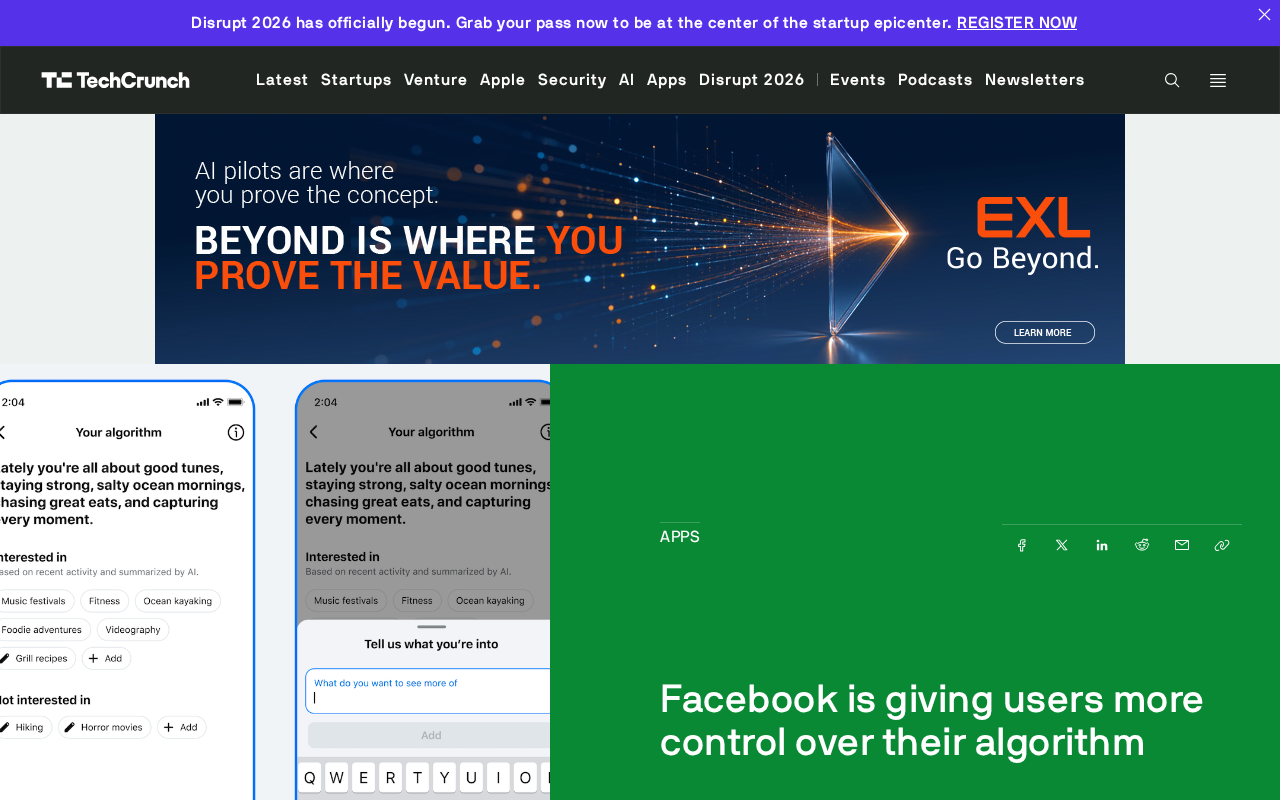
From Instagram to Facebook: Extending Algorithm Transparency
The core idea behind "Your Algorithm" isn't complicated: let users tell the platform what they want to see. Meta first tested this feature on Instagram and is now bringing it to Facebook, which has a much larger user base. This means users are no longer just passively accepting algorithmic recommendations — they can actively adjust the logic that shapes their feed.
Viewed against the broader industry backdrop, this move is far from isolated. In recent years, major social platforms worldwide have faced growing regulatory pressure and user demands for greater algorithm transparency and controllability. Facebook's timing here is less about proactive innovation and more about responding to a trend.
Where Are the Boundaries of User Control?
"Your Algorithm" allows users to influence feed content, but Meta hasn't entirely given up its dominance over recommendation outcomes. What users can adjust is "influence," not "control" — the algorithm still operates in the background; users simply gain an intervention point.
This design has its practical considerations: fully opening up algorithm weights could lead to a loss of control over feed quality, while keeping everything closed off would invite user backlash. Meta has chosen a middle path — responding to calls for algorithm transparency while retaining underlying control over content distribution.
Why Platforms Are Opening Up Algorithm Control
Several forces are pushing social platforms to cede some algorithm control.
On the regulatory front, laws like the EU's Digital Services Act set explicit requirements for recommendation system transparency. On the user front, fatigue from being fed content by "black-box algorithms" has been building for years. On the competitive front, platforms like TikTok with differentiated algorithm experiences are forcing Meta to adjust.
Meta porting a feature validated on Instagram to Facebook suggests the model has received acceptable feedback on the user side. But Facebook's user base is more diverse and its use cases more complex — whether the same feature can achieve the expected results remains to be seen.
The EU's Digital Services Act (DSA) is the key backdrop for understanding this wave of algorithm transparency. Passed in 2022 and fully applicable in 2024, the regulation imposes mandatory requirements on "very large online platforms" (those with over 45 million monthly active users): they must disclose the main parameters of their recommendation systems, offer at least one recommendation option not based on user profiling, and allow users to modify or reset the basis for personalized recommendations. Non-compliant platforms could face fines of up to 6% of their global annual turnover. The DSA's logic isn't about requiring platforms to disclose algorithm source code — it's about giving users the right to know and choose "why am I seeing this content." Meta, TikTok, YouTube and others have all rolled out recommendation preference settings under compliance pressure. Understanding this regulatory framework helps determine whether "Your Algorithm" is a genuine product innovation or a compliance-driven reactive adjustment — based on the timeline and feature design, the latter seems clearly dominant.
The Real Challenge of Algorithm Controllability
Letting users "control the algorithm" sounds great, but there's an inherent contradiction in practice. Most users don't understand how the algorithm works, nor do they know what specific consequences their adjustments will produce. Providing a control panel is easy; getting users to truly understand and effectively use it is another matter.
A more fundamental question: when users adjust the algorithm and their experience doesn't noticeably improve, who takes responsibility? Will platforms attribute the decline in recommendation quality to users' own choices? The answers to these questions will determine whether "Your Algorithm" genuinely empowers users or is merely a token gesture.
Meta has not yet disclosed the specific interaction details or granularity of adjustments for this feature. Based on Instagram's existing implementation, users can set certain preferences for recommended content, but it's still a long way from "full control over the feed."
"Black-box algorithm" refers to the decision-making process of recommendation systems that is difficult to fully explain to users or even to the platforms themselves. Modern feed ranking typically relies on deep learning models with hundreds or even thousands of input features (dwell time, clicks, shares, negative feedback, etc.), and the output ranking cannot be reconstructed through simple rules. This is the fundamental obstacle to user control: platforms can offer preference toggles, but it's hard to help users understand what chain reactions "turning up a certain preference" will trigger inside the model. Academia calls this the "algorithm explainability" problem and distinguishes between "transparency" (disclosing how the system works) and "explainability" (providing human-understandable explanations for specific recommendation results). What mainstream platforms currently offer is mostly the former, and quite limited at that. Therefore, features like "Your Algorithm" are closer to a psychological sense of empowerment than genuine control over algorithmic mechanisms.
What It Means for Users
For ordinary Facebook users, "Your Algorithm" offers an option that didn't previously exist: actively participating in shaping their feed. Even if that participation is limited, it at least breaks the default state of "invisible, unadjustable algorithms."
For the industry, Meta's move could trigger a chain reaction. When a leading platform starts ceding algorithm control to users, the pressure on other platforms will rise accordingly. Algorithm transparency may be shifting from a "bonus" to a "must-have."
Whether this feature can truly change the relationship between users and algorithms depends on how much control Meta is willing to give up and whether users are willing to spend time using it.
The industry trend toward algorithm transparency isn't unique to Meta. TikTok launched a "Manage Your Feed" feature as early as 2023, allowing users to block content by keyword; YouTube offers feedback options like "Not interested" and "Don't recommend this channel," and published recommendation system documentation under DSA requirements. Beyond the EU's DSA, the US has also seen multiple algorithm accountability bill proposals — though none passed at the federal level, California, New York and other jurisdictions have enacted related legislation. For platforms, proactively opening limited control is a "retreat to advance" strategy: it can ease regulatory pressure and improve public image while avoiding mandates for more thorough disclosure. For users, the real change depends on whether these tools are "available" or "easy to use" — most users won't proactively dig into settings panels to fine-tune recommendation preferences, and usage rates often fall far below the PR value conveyed by the feature's mere existence.
One-line Summary
Meta extends Instagram's "Your Algorithm" feature to Facebook, letting users influence feed recommendations while the platform retains underlying control.
Paragraph Summary
Meta announced it is expanding the "Your Algorithm" feature previously launched on Instagram to Facebook, allowing users to exert greater influence over the recommendation algorithm that determines their feed content. This move is part of the social platform algorithm transparency trend, driven by regulatory pressure from the EU's Digital Services Act, user fatigue with black-box algorithms, and competition from platforms like TikTok. However, users only gain "influence" rather than "control" — the algorithm still operates in the background, and the platform retains underlying control. The article notes an inherent contradiction between users understanding algorithms and effectively using control tools; whether the feature truly empowers users or is merely a token gesture depends on how much control Meta is willing to cede and whether users are willing to use it. This move by a leading platform could trigger an industry chain reaction, pushing algorithm transparency from a bonus to a must-have.
Related articles

Felix Rieseberg Personal Homepage
Felix Rieseberg's personal homepage sparks attention on Hacker News. This article covers the Slack engineer's technical background, the rise and fall of nativefier, and the value of a developer homepage as a tech calling card.

@ai-sdk/vue 3.0.306 Patch Release Syncs with [email protected] Update
@ai-sdk/vue 3.0.306 released, synced with [email protected]. A routine patch release for the Vercel AI SDK ecosystem with no public API changes; the Vue adapter layer stays version-aligned with the core package.

Gemini 4 Argon API Launches: The Era of Million-Token Output Begins
Google launches Gemini 4 Argon with sparse MoE architecture, up to 1M output tokens, and a 68.90% Vals Index score, available across API, AI Studio, and the Gemini app.