Facebook to Charge for Link Posts: The End of Free Social Media?

Facebook has been reported to charge for more than two links per month, triggering creator anxiety about the shrinking free distribution dividend of platforms.
A leak from Mastodon claims that Facebook has started charging for posting more than two links per month; the news gained 277 points and 192 comments on Hacker News. The core disagreement in the discussion is whether this is an anti-abuse measure or a general charge, and there is currently no official policy document to confirm it. The article points out that from downranking external links to direct charging, platform control over links has escalated from soft suppression to a hard threshold, consistent with the industry trend of X tightening its API and Reddit charging third-party clients. Independent developers and small content teams are most affected, with rising distribution costs and limited scale of alternative channels. The way to respond lies in strengthening email lists, RSS, and owned websites, and adopting a multi-platform presence to reduce dependence on a single platform.
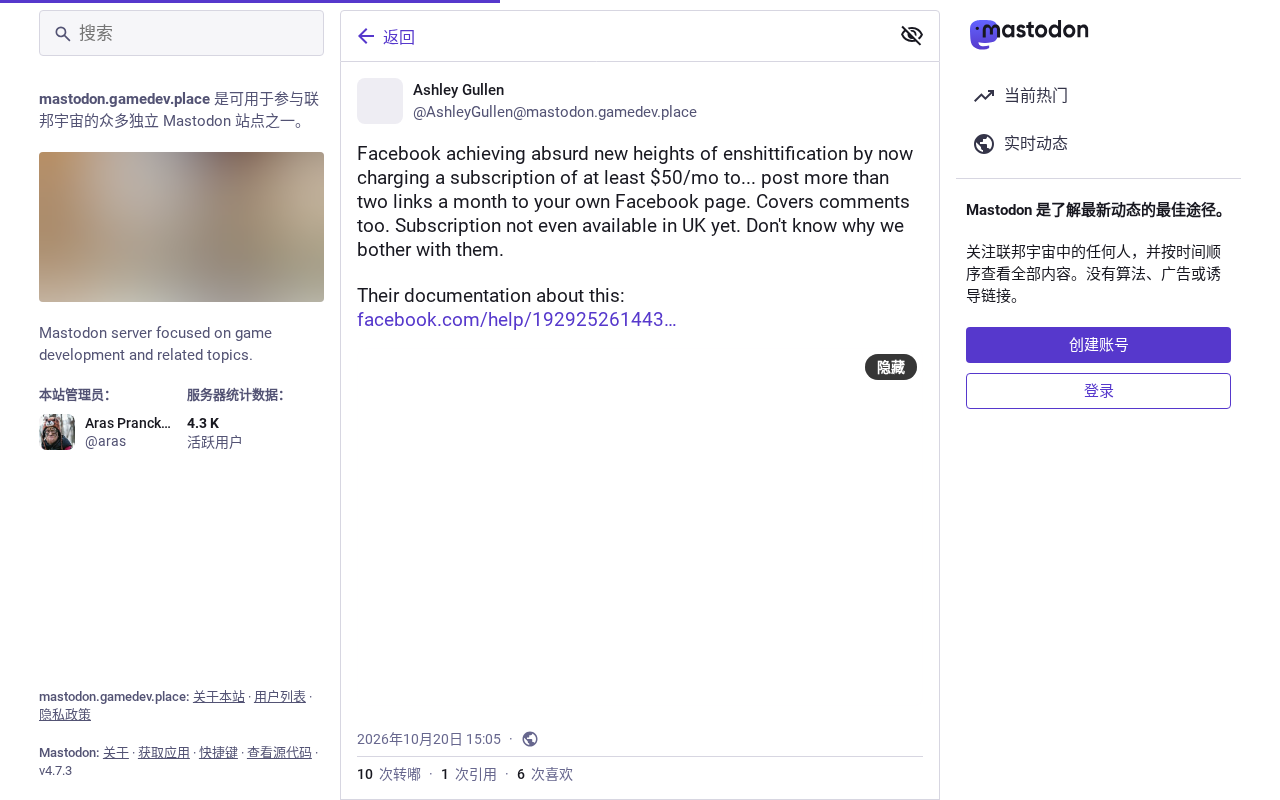
A post from Mastodon sparked fierce discussion on Hacker News, generating nearly 300 points and close to 200 comments: Facebook has started charging for posting more than two links per month. The source of the news is game developer Ashley Gullen's statement on mastodon.gamedev.place, which was subsequently reposted to HN, quickly igniting another round of anxiety among developers and content creators about platform monetization.
Reconstructing the Event: From Mastodon Leak to HN Buzz
The original information isn't complicated: Ashley Gullen pointed out on Mastodon that Facebook is charging for posts exceeding the quota of two links per month. The HN discussion thread received 277 points and 192 comments, indicating that this topic precisely hit the pain points of creators and developers.
It should be noted that this information currently comes mainly from a single-source social media leak, and no detailed official policy document from Facebook has been seen yet. However, judging from the direction of HN comments, many users stated that they have already encountered similar restriction prompts in actual operation, which provides a certain degree of cross-corroboration for the leak.
Mastodon is a decentralized open-source social network that uses the ActivityPub protocol and consists of countless independent servers (instances), where users can follow each other across instances. Its fundamental difference from centralized platforms like Facebook is that no single company controls content distribution rules; instance administrators each set their own community guidelines. The mastodon.gamedev.place instance where Ashley Gullen is located is a themed instance for game developers. Because of this, such leaks often ferment first in vertical communities and are then amplified through aggregation sites like Hacker News and Reddit. Hacker News is operated by Y Combinator and is primarily composed of the tech startup community; its "points" reflect post popularity and voting weight, and the comment section often becomes a public forum for policy discussion, which is why this topic was able to quickly gain nearly 300 points.
Why the Number "Two Links" Is So Jarring
A free quota of two links per month appears extremely harsh in any常规 usage scenario on any social platform. A normally operated creator page could share far more links than that in a single week.
What this reflects is the platform's re-pricing of the value of "external links." Links mean users leave Facebook's walled garden, meaning the platform cannot fully monetize that segment of attention. For Facebook, external links have always been the content format with the lowest ROI; for creators, however, external links are the infrastructure for driving traffic, citing sources, and building a personal brand. The interests of the two sides directly conflict here.
One core disagreement in the HN comment section is whether this is an anti-abuse measure targeting spam accounts or a general charge for all users. If it's the former, the impact is manageable; if it's the latter, it means ordinary users sharing links to news, blogs, and works will face substantial restrictions. Based on the current information, both interpretations have supporters, and there is no conclusion yet.
"Walled garden" refers to a platform enclosing user behavior and content within its own ecosystem and restricting jumps to external websites, so as to monopolize user attention and advertising revenue. External links cause users to leave the platform, making it impossible for the platform to track subsequent behavior and difficult to display its own ads, so external links have a relatively low ROI for the platform. ROI (return on investment) here measures the advertising revenue the platform can generate per unit of traffic. Facebook has long used algorithms to reduce the organic reach of posts containing external links, i.e., "downranking," guiding creators to publish native content. From downranking to direct charging means the platform no longer regulates only through algorithms but directly limits the supply of external links through a pricing mechanism, which in essence transfers the opportunity cost of "users leaving the platform" to publishers with an explicit price tag.
The Platform Walls Are Getting Higher: This Is Not the First Time
Facebook's restrictions on external links did not begin today. Previously, the platform repeatedly adjusted the weight of external links, reducing the recommended exposure of posts containing external links. From downranking to direct charging, this is a qualitative change from "soft suppression" to a "hard threshold."
This trend is not isolated across the industry. X (formerly Twitter) tightening its API and raising subscription thresholds, and Reddit charging third-party clients and triggering large-scale protests, all point in the same direction: after growth peaks, social platforms are turning formerly free traffic gateways one by one into paid items. Content creators are at the end of the chain, with the weakest bargaining power, yet they bear the most cost pass-through.
API (Application Programming Interface) is the channel through which platforms open data and functions to third-party developers. In 2023, Reddit sharply raised API call prices, causing third-party clients such as Apollo and RIF to shut down due to excessive costs and triggering brief closures and protests in thousands of subreddits; in the same year, X (formerly Twitter) tightened free API quotas and launched paid subscriptions, restricting third-party clients and automation tools. These events share the same logic as Facebook's external link charging: after user growth peaks, the platform re-prices formerly free traffic gateways and interface capabilities to increase average revenue per user. For developers who rely on APIs or external link distribution, platform rules change from "infrastructure" to "variable costs," with extremely weak bargaining power.
Real Impact on Developers and Creators
For independent developers and small content teams, the impact of such policies is structural. Game developers, tech bloggers, and open-source project maintainers often rely on social platforms for low-cost distribution. Once the link quota becomes a paid item, distribution costs will rise directly, and although alternative channels (Mastodon, Bluesky, email lists) exist, their user scale is not on the same order of magnitude as Facebook.
Another dimension worth attention is the fairness of information circulation. When sharing links becomes a paid behavior, commercial accounts with ample funds will gain more exposure opportunities than individual creators, and the diversity of platform content may further narrow.
How to Respond Amid Uncertainty
At present, the policy details remain unclear, but adjusting distribution strategies in advance is a rational choice. Making email lists, RSS, and owned websites the core positions while treating social platforms only as incremental channels is a general solution for reducing platform dependence. At the same time, a multi-platform presence—Mastodon, Bluesky, LinkedIn—can provide a buffer when a single platform's policy changes.
For creators who indeed need to distribute links on Facebook, following official follow-up announcements and confirming the specific calculation method of the free quota (whether personal profiles and public pages are distinguished) are the most practical next actions.
RSS (Really Simple Syndication) is an open content subscription format in which users directly subscribe to website updates through a reader without relying on social platform algorithm recommendations. Email lists, meanwhile, let creators directly own subscribers' addresses, and open rates and delivery rates are not affected by platform throttling. Together they constitute "owned channels," whose core value lies in the fact that content assets and user relationships belong to the creator, and migration costs are extremely low when platform policies change. In contrast, social platforms are "rented channels," with large reach but rules unilaterally set by the platform. A multi-platform presence (Mastodon, Bluesky, LinkedIn) can diversify the policy risk of a single platform, but note that each platform's user profile and interaction logic differ, so content needs targeted adjustment rather than simple synchronization.
Conclusion
The leak that Facebook is charging for posting links, regardless of the final policy details, sends a clear signal: the free distribution dividend of social platforms is systematically shrinking. What creators can do is reduce dependence on a single platform and keep content assets in their own hands. Behind the clamor of 192 comments on HN is the same anxiety—when platforms are no longer free, who will pay for creators' reach.
Related articles

Cursor Can Now Control Your Computer: AI Agents Can Drive Desktop Apps for Testing
Cursor adds desktop control: AI agents can drive desktop apps like the iOS Simulator to test their own features. We analyze the impact on dev workflows, possible technical approaches, and reliability concerns.

Vibecoding a Custom Inference Engine: High Hopes, Harsh Reality
A Reddit developer shares the real experience of vibecoding a custom inference engine: running GGUF Q4 models in the browser with WebGL2 and GLSL, only to fall into tokenizer debugging hell. This article analyzes the engineering challenges of browser-side LLM inference and why cloning llama.cpp is the more rational choice.

How High Are Anthropic's Early Investor Paper Returns Ahead of IPO?
Anthropic's early investor paper returns draw attention ahead of IPO. This article analyzes sources of book gains, capital structure, pre-IPO games and risks, and implications for the AI startup ecosystem.