Fack'd: Real-Time Fact-Checking as You Watch YouTube Videos

Fack'd is a Chrome extension that fact-checks speakers in real time during YouTube playback, with timestamps, ratings, and sources.
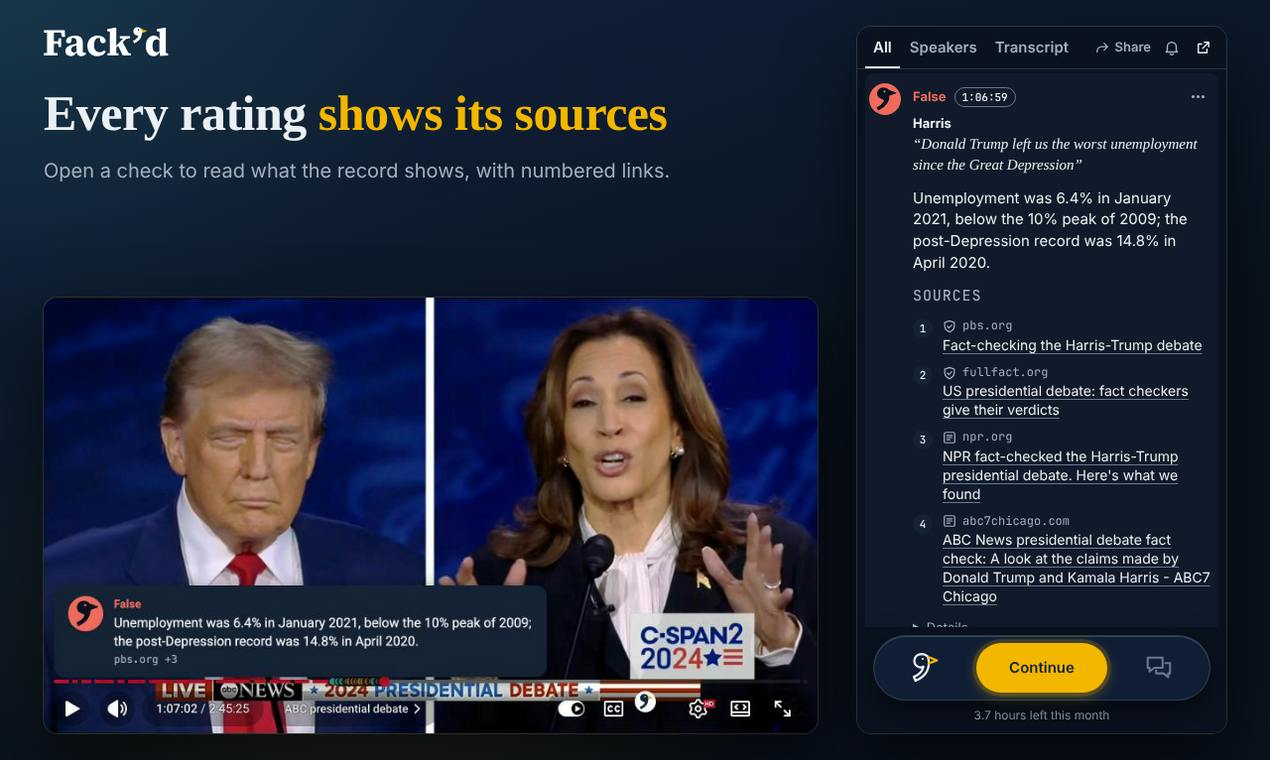
Fack'd is a Chrome extension that fact-checks speakers' claims in real time while YouTube videos play, showing original words, timestamps, ratings (true, misleading, false), and readable sources so users can check without interrupting viewing. It offers free viewing of already-checked videos plus 10 free checks after login. Built by Philip Loyd with AI and Google Cloud Run, it faces challenges in accuracy, speed, and coverage.
In an age of information overload, interviews, debates, and news videos on YouTube are often rife with unverified claims. Manual fact-checking is not only time-consuming but often lags behind. A Chrome extension called Fack'd aims to change this: it fact-checks speakers' statements in real time while you watch a video, complete with timestamps, ratings, and readable sources.
How Real-Time Checking Works
Fack'd's design approach is straightforward: open the extension alongside a YouTube video, and as the video plays, the extension captures the speaker's key claims and displays the corresponding fact-check results. Each result contains three core elements: the speaker's original words, a timestamp (so you can locate the exact spot in the video), and a rating (e.g., true, misleading, false). More importantly, each check includes readable source links so you can verify it yourself.
This "check while you watch" experience is especially suited to political debates, talk shows, or in-depth reporting. You no longer need to pause the video and open a new tab to search—you can keep your viewing rhythm while getting instant context.
Rating systems in fact-checking are typically not a simple true/false binary but rather a multi-level spectrum. For example, PolitiFact's Truth-O-Meter has six levels from "True" to "Pants on Fire," while FactCheck.org more often uses descriptive labels such as "accurate/inaccurate/misleading." The "true, misleading, false" framework mentioned by Fack'd is a common simplified three-to-five-level scheme. Such ratings are essentially judgments about how well a statement matches the evidence, not judgments about the speaker's motives. Different organizations define "misleading" quite differently: some mean technically correct but implying a wrong conclusion, while others mean key context is missing. Therefore, when comparing ratings across platforms, pay attention to whether the underlying evaluation criteria are consistent.
Free and Paid Models
Fack'd offers two ways to use it. You can watch videos that others have already fact-checked for free—meaning the community or system has completed checks on some videos, and you can benefit directly. If you want to fact-check a video of your own choosing, you need to log in, after which you get 10 free checks. This model both encourages sharing and sets a reasonable threshold for heavy users.
From a product design perspective, this mechanism of "free viewing of existing checks + paid/quota-based initiation of new checks" helps balance server costs and user growth. However, specific pricing and quota details are not yet clear in public information.
Technical Background and Developer
Fack'd was built by developer Philip Loyd, and its product categories involve Chrome extensions, news, artificial intelligence, and Google Cloud Run. This suggests it may rely on cloud AI capabilities to accelerate the checking process, such as automatic transcription, claim extraction, and source retrieval. The use of Google Cloud Run also implies an architecture with elastic scaling capable of handling sudden traffic spikes.
On Product Hunt, Fack'd received 84 upvotes and 8 comments, ranking 13th. For a tool-type product, this result is not outstanding, but it does reflect a certain degree of early attention. The small number of comments may indicate the product is still in an early stage and the user community has not yet fully formed.
Google Cloud Run is a fully managed serverless container runtime provided by Google Cloud. After developers package an application as a container image, Cloud Run automatically scales instances based on request volume—from zero to hundreds of concurrent instances—and bills based on actual CPU and memory usage. For a fact-checking tool like Fack'd, a video playback session may suddenly generate a large number of checking requests (such as during a popular live debate), and Cloud Run's elastic scaling can prevent service unavailability caused by traffic spikes while scaling instances to zero when there are no requests to control costs. This architectural choice suggests that Fack'd's backend checking logic (such as speech-to-text, claim extraction, and source retrieval) is likely deployed as containerized microservices rather than running on fixed servers.
Potential Challenges and Limitations
Real-time fact-checking is no easy task. First, the accuracy of checking depends heavily on the quality of sources and the AI model's comprehension ability. If the sources themselves are biased or outdated, the check results may also be distorted. Second, real-time requirements demand sufficiently fast processing; otherwise, check results may lag behind video playback and degrade the experience. In addition, for non-English content or specialized domains (such as science and law), checking difficulty increases significantly.
Fack'd currently appears to focus mainly on English content, and its checking scope may be limited to already established fact-checking databases or lists of trusted sources. Users need to recognize that any automated fact-checking tool is only an aid and cannot fully replace human judgment.
The technical pipeline for automated fact-checking typically includes three key stages: speech recognition (converting video audio to text), claim detection and extraction (identifying verifiable factual assertions from continuous speech and filtering out opinions, rhetorical questions, and rhetoric), and evidence retrieval and verification (finding evidence in a trusted source library that supports or refutes the assertion). Each stage carries a risk of accumulated error: a decline in speech recognition accuracy due to accents, background noise, and technical terminology directly leads to incorrect targets for subsequent checking; if claim detection misclassifies an opinion as fact, it produces meaningless checks; and evidence retrieval is limited by the coverage and update frequency of the source library. In real-time scenarios, these three stages must also be completed within seconds, imposing much higher requirements on model inference speed and retrieval efficiency than offline checking.
Conclusion
Fack'd attempts to embed fact-checking into the viewing experience and reduce the friction of information verification. Its real-time nature, source transparency, and free viewing model are highlights, but accuracy, coverage, and sustainability still need time to be tested. For viewers who frequently watch interviews and debate-style content, this tool is worth a try. As AI capabilities improve and source networks expand, real-time checking is expected to become a standard feature of video consumption.
One-line Summary
Fack'd is a Chrome extension that fact-checks speakers' statements in real time during YouTube playback, with timestamps, ratings, and sources.
Paragraph Summary
Fack'd is a Chrome extension designed to solve the problem of hard-to-verify claims in YouTube interviews, debates, and news videos. While a video plays, it captures the speaker's key claims and displays the original words, timestamps, ratings (such as true, misleading, false), and readable source links, letting users check while watching without interrupting the viewing experience. The product uses a hybrid model of free viewing of already-checked videos and 10 free checks after logging in. It was built by developer Philip Loyd, and its tech stack involves AI and Google Cloud Run, suggesting reliance on elastic cloud computing for automatic transcription, claim extraction, and source retrieval. On Product Hunt it received 84 upvotes and 8 comments, ranking 13th, indicating early attention but a still-small community. Real-time checking faces challenges such as accuracy depending on source quality and AI comprehension, processing speed needing to match playback pace, and limited coverage of non-English and specialized domains; the tool should be used only as an aid rather than a replacement for human judgment.
Related articles

Prospero: A Lightweight Native AI Coding Tool Built with ImGui
Prospero is a bloat-free native AI coding tool built with ImGui, emphasizing lightweight design, high performance, and low dependencies. This article analyzes its design philosophy, technical choices, and the divergence between platformization and toolization in AI coding tools.

WebRTC Abused: New Variant of Credit Card Skimming Scripts on Shopping Sites
Security researchers found skimming scripts on popular shopping sites using WebRTC data channels to exfiltrate credit card data. This article analyzes the technical原理, differences from traditional Magecart attacks, and defense strategies for e-commerce platforms in third-party script governance and CSP policies.

Single GB10 Card Hits 101 tok/s: Inkling 2 Mini Performance Tested on vLLM
A developer shared on Hacker News running Inkling 2 Mini with vLLM on a single GB10 at 101 tok/s. This article analyzes the technical context, the significance of vLLM with small models on single cards, and caveats for interpreting tok/s metrics.