Fairness Meets Explainability: The Challenges of a Reinforcement Learning Multi-Instance Student Early Warning System

RL-MIL student risk prediction achieves strong baselines, but preference-conditioned fairness control collapses in practice.
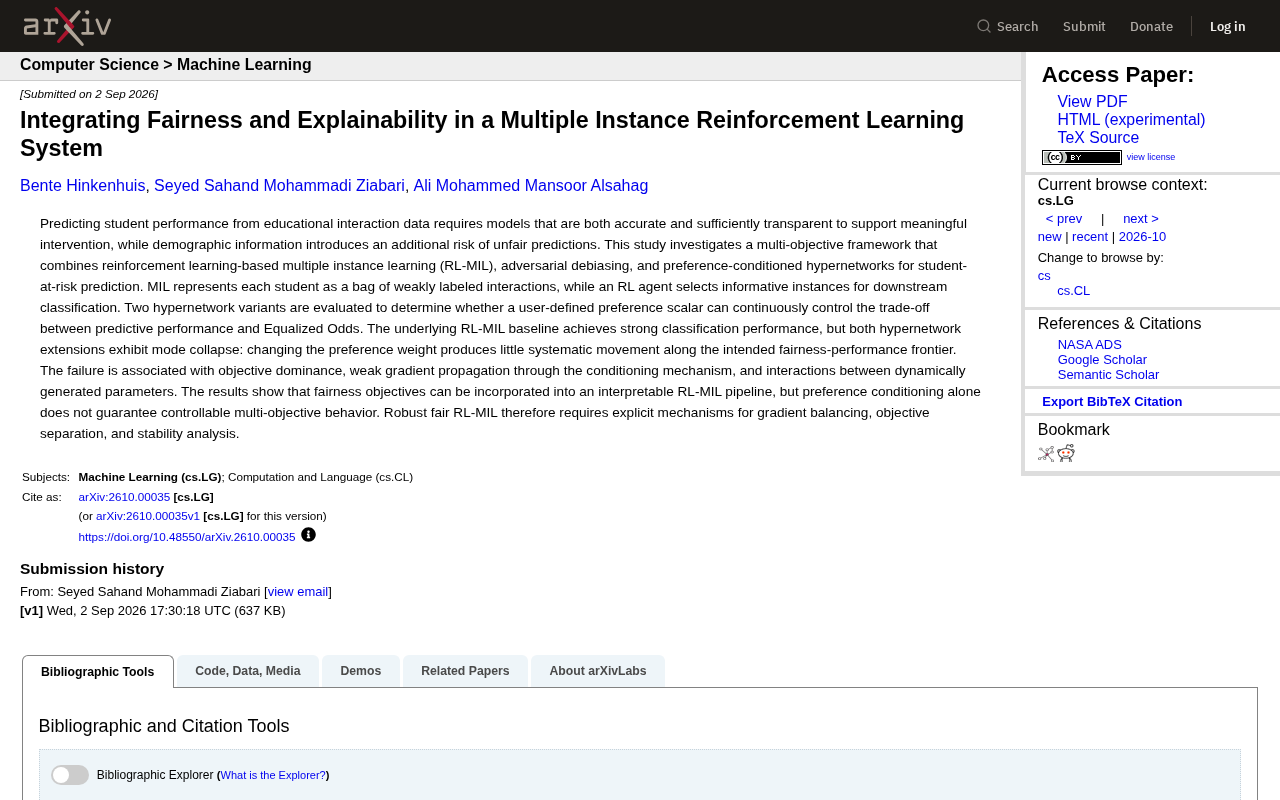
This arXiv study addresses the dual challenge of explainability and fairness in predicting student academic risk, proposing a multi-objective framework combining RL-based Multiple Instance Learning (RL-MIL), adversarial debiasing, and preference-conditioned hypernetworks. While the RL-MIL baseline delivers strong classification performance and accommodates fairness objectives, both hypernetwork extensions suffer mode collapse — users cannot effectively steer the model along the fairness–performance Pareto front by adjusting the preference scalar. The failures are attributed to objective dominance, weak gradient propagation, and complex interactions among dynamically generated parameters, pointing to the need for explicit gradient balancing and objective decoupling in robust fair RL-MIL systems.
Educational data analytics is emerging as one of the most important application domains for AI. A newly published arXiv study (arXiv:2610.00035v1) tackles a particularly challenging problem: how to predict student academic risk in a way that is both accurate and explainable, while avoiding unfair biases introduced by demographic information (such as gender or race). The results are a mixed bag — promising in some respects, but revealing deep limitations in current multi-objective optimization approaches.
Background: Why Student Early Warning Systems Need Both Fairness and Transparency
Predicting student performance from educational interaction data is a classic task in smart education. But such predictions come with two non-negotiable prerequisites: the model must be transparent enough for teachers and administrators to take meaningful interventions; and once the model has access to demographic information, it risks developing systematic biases against certain groups, potentially amplifying inequities in educational resource allocation.
In other words, a high-accuracy black-box model offers limited value in an educational context — if a teacher doesn't know why a student was flagged as "high risk," they can't provide targeted support. And if the model is biased against a particular demographic group, it may deepen rather than alleviate educational inequality. This is precisely what the study attempts to address simultaneously across two dimensions: explainability and fairness.
Technical Framework: RL-MIL, Adversarial Debiasing, and Hypernetworks
The study proposes a multi-objective framework that integrates three technical components. The core is Reinforcement Learning-based Multiple Instance Learning (RL-MIL). Multiple Instance Learning (MIL) represents each student as a "bag" containing a large set of weakly labeled interaction behavior records, while a reinforcement learning agent selects the most informative instances from this bag for use by a downstream classifier. This design naturally provides a degree of explainability — the selected instances reveal the basis for the model's judgment.
To address fairness, the study incorporates adversarial debiasing, using adversarial training to suppress the model from learning biases from demographic features.
The Attempt at Preference-Conditioned Hypernetworks
The most exploratory component of the framework is the preference-conditioned hypernetwork. The researchers evaluated two hypernetwork variants, hoping that a user-defined "preference scalar" could continuously modulate the model's trade-off between predictive performance and fairness (measured by Equalized Odds). Ideally, an administrator would only need to adjust a single parameter to smoothly slide between "more accurate" and "more fair," finding the balance best suited to a specific educational context.
Multiple Instance Learning (MIL) is a weakly supervised learning paradigm originally developed for drug activity prediction and now widely applied in medical imaging, text classification, and behavioral analysis. The core idea is that training labels are attached only at the "bag" level, not to individual "instances" within the bag. In student modeling, all of a student's learning behavior records (clicks, submissions, video views, etc.) form a bag, while each individual behavior log is an instance — we only know whether the student ultimately passed the course, without labeling which specific behaviors were "decisive." Reinforcement learning plays the role of training an "instance selector": the agent samples the most representative subset of instances from the bag. These selected instances are used both for downstream classification and naturally form human-readable explanations — producing insights like "the model flagged this student as high risk because they failed to submit assignments for three consecutive weeks in Week 3."
Hypernetworks are "networks that generate the weights of other networks": a small network (the hypernetwork) takes some conditional input and dynamically outputs the parameters of a primary network, allowing the primary network's behavior to vary continuously with the condition. In multi-objective scenarios, this conditional input is typically a scalar or vector representing preferences over objective weights. In theory, a hypernetwork only needs to be trained once; at inference time, changing the preference input instantly "generates" model parameters at different points on the Pareto front, without retraining for each trade-off point. Equalized Odds is a commonly used metric in algorithmic fairness, requiring that a model's true positive rates and false positive rates remain consistent across different demographic groups — i.e., the probability of the model making an error should not differ systematically based on a protected attribute such as race or gender.
Key Findings: Strong Baseline, But Preference Control Fails
The study arrives at a thought-provoking, split conclusion. On one hand, the underlying RL-MIL baseline model achieved strong classification performance, demonstrating that this explainable pipeline is viable for predicting student risk. Fairness objectives can indeed be incorporated into this explainable framework.
On the other hand, both hypernetwork extensions suffered from mode collapse: changing the preference weight almost never produced systematic movement along the expected "fairness–performance frontier." In other words, regardless of how users adjusted the preference scalar, the model's behavior did not change in a controllable way — the mechanism that was supposed to provide flexible control simply did not work.
Mode Collapse is a term originally used to describe a common pathology in generative adversarial network (GAN) training, where the generator gets stuck producing only a few types of outputs and fails to cover the diversity of the target distribution. In the context of multi-objective optimization, the term is borrowed to describe a similar phenomenon: no matter what preference input the model receives, its output behavior barely changes, always "collapsing" to the same solution. This means the hypernetwork has not truly learned a mapping from preference space to the Pareto front; instead, it ignores the conditional input and degenerates into an ordinary network with fixed outputs. This failure mode is particularly dangerous in high-stakes applications requiring fine-grained control — decision-makers believe they are adjusting the system, when in fact the system is not responding at all.
Root Causes: Three Core Problems in Multi-Objective Optimization
The study's analysis of the failure, which has implications for the broader field of multi-objective machine learning, points to three main issues:
- Objective dominance: One objective overwhelmingly dominates the gradient direction during optimization, making it difficult for the other objective to have meaningful influence.
- Weak gradient propagation: The gradient signal transmitted through the conditioning mechanism is too weak, leaving the preference scalar with negligible impact on model parameters.
- Interactions between dynamically generated parameters: The parameters dynamically generated by the hypernetwork interact in complex ways that undermine controllability.
These findings demonstrate that "preference conditioning" alone is insufficient to guarantee controllable multi-objective behavior. Building robust fair RL-MIL systems requires explicit gradient balancing, objective decoupling, and stability analysis mechanisms.
Gradient Balancing is a family of techniques for handling multi-objective conflicts, with representative methods including PCGrad (which projects conflicting gradients onto a conflict-free subspace) and MGDA (Multiple Gradient Descent Algorithm, which finds a descent direction that simultaneously reduces all objectives). Objective Decoupling refers to explicitly isolating the optimization paths of different objectives at the architectural or training-process level, preventing gradients from interfering with one another. In adversarial debiasing frameworks, if the classifier's gradients and the adversary's gradients compete intensely in the same parameter space, the "objective dominance" phenomenon described in this paper is likely to emerge. These directions have been explored in natural language processing and computer vision, but remain largely uncharted territory in educational settings that combine reinforcement learning — and this paper's negative results clearly define the technical challenges that future research must address.
Implications for AI Fairness Research
The value of this study lies not only in the methods it proposes, but also in its honest reporting of negative results. At a time when many papers tend to present only success stories, the in-depth analysis of mode collapse provides a rare engineering lesson: the seemingly elegant "one-knob control" mechanisms in multi-objective optimization are often undermined by the underlying optimization dynamics.
For educational AI practitioners, this means fairness cannot be bolted on as an afterthought — it must be considered at the architectural design level, with attention to gradient flow and inter-objective balance. Explainability and fairness can coexist within the same framework, but making the two controllably tradeable remains an open research challenge. As AI increasingly intervenes in high-stakes decisions that affect individual lives, rigorous foundational research of this kind becomes ever more important.
Related articles

Chain of Thought Isn't Just for AI: How Humans Can Use CoT to Improve Thinking Quality
Chain of Thought isn't just a prompt trick for large models. Starting from a Hacker News discussion, this article analyzes why CoT works for human thinking too, breaks down actionable ways to transfer it, and highlights the key differences between human CoT and machine CoT.
Cloudflare Teams Up with OpenAI: Closi…
Cloudflare Teams Up with OpenAI: Closing the Loop from Vulnerability Discovery to Defense with AI
Cloudflare uses OpenAI Daybreak to investigate security vulnerabilities and generate reviewable remediation plans, while developers use Codex to boost coding efficiency and quality.

Orca Multi-Agent Orchestration in Practice: A Guide to Parallel Collaboration with Claude and Codex
Orca is Stable AI's free open-source agent workbench supporting 34 agents like Claude Code and Codex in parallel. Learn its Git worktree isolation, multi-model orchestration, and mobile management.