Fairphone 6+ Deep Dive: The Ideals and Realities of a Repairable, Modular Smartphone
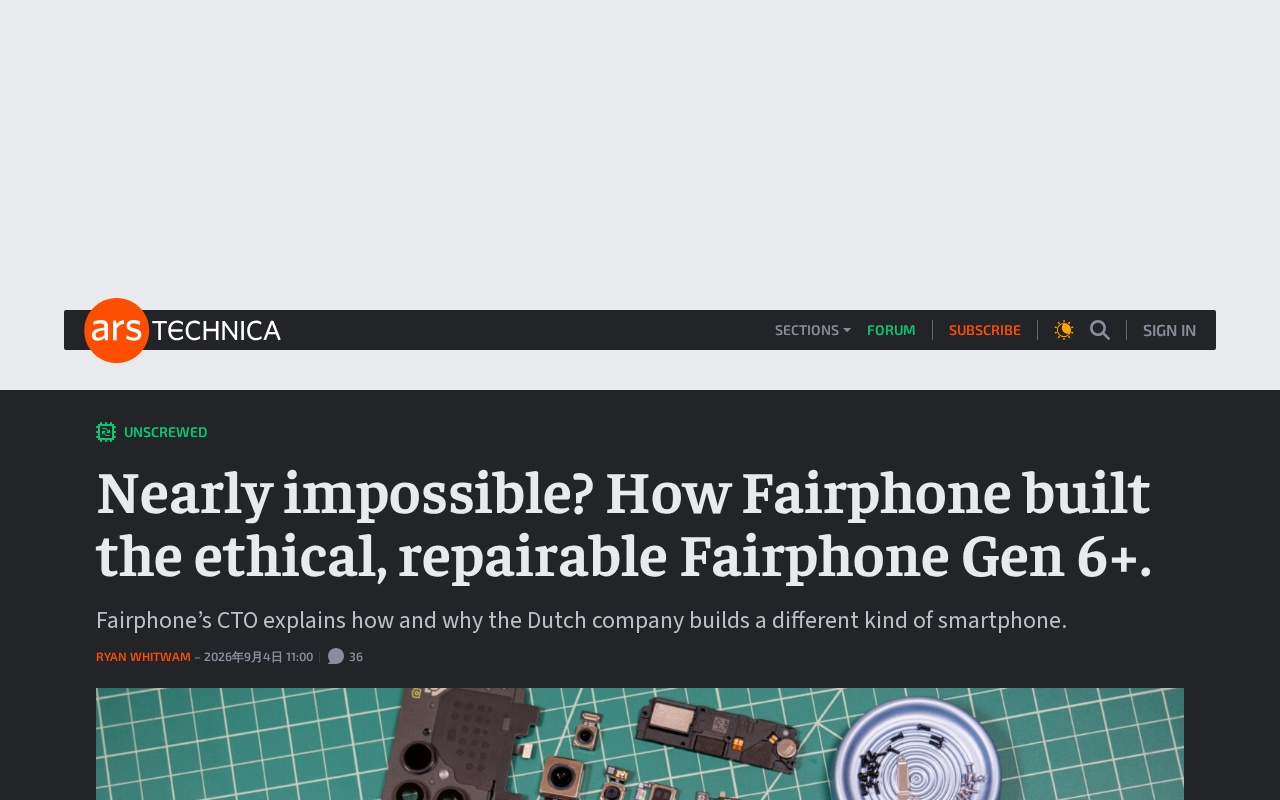
Fairphone 6+ proves sustainable, repairable smartphones are possible—but reveals the steep costs of doing it right.
The Fairphone 6+ represents the most mature attempt yet at a modular, repairable smartphone built on ethical supply chain principles. With user-replaceable components, 8 years of software updates, conflict-free mineral sourcing, and factory labor protections, it challenges the industry's planned obsolescence model. However, the engineering trade-offs, price premiums, and supply chain complexities reveal the steep real-world costs of internalizing sustainability—offering both inspiration and a sobering mirror for the broader tech industry.
A Hardware Philosophy That Swims Against the Tide
Since its founding in 2013, Fairphone has consistently charted a path few dare to tread in the smartphone industry: rather than competing on specs and iteration speed, it places repairability, supply chain ethics, and environmental sustainability as the first principles of product design. In an industry built on planned obsolescence as a business model, this is an act of near-defiance.
Planned obsolescence refers to manufacturers deliberately limiting a product's lifespan or functional cycle to compel consumers to purchase replacements within a relatively short timeframe. The strategy can be traced back to the 1920s Phoebus Cartel, a consortium of lightbulb manufacturers that artificially reduced bulb lifespans from 2,500 hours to 1,000 hours. In the smartphone industry, planned obsolescence manifests in particularly subtle yet pervasive ways: discontinuing system updates to force software-level obsolescence, using adhesive-sealed batteries that push repair costs close to the price of a new device, and releasing cosmetically tweaked models annually to create social pressure for upgrades. France became the first country in 2015 to criminalize planned obsolescence, with penalties of up to two years in prison and €300,000 in fines, marking the beginning of an institutional pushback against this business model worldwide. The Fairphone 6+ is the latest—and most mature—manifestation of this counter-philosophy.
The story behind this phone reflects a core contradiction: the consumer electronics industry's economies of scale and supply chain leverage are highly concentrated, and the cost, negotiation, and engineering challenges a single brand faces when insisting on "ethical sourcing" at every step are almost unimaginably steep. Fairphone's answer: take it slow, but never compromise.
Fairphone 6+ Repairability Design: The Engineering Cost of Modularity
How Modular Architecture Enables User Self-Repair
The Fairphone 6+ continues the brand's signature modular architecture: the battery, camera, display, USB port board, and other core components can all be replaced by users themselves, without specialized tools or authorized service centers. This design directly challenges the prevailing trend among modern flagships—which, in pursuit of thinness and water resistance, often seal devices to the point of being virtually unrepairable.
But modularity comes at a cost. To make each module removable, engineers must sacrifice a significant number of space optimization strategies, resulting in a device that is thicker and heavier than competitors at the same price point. Specifically, modular design requires each replaceable component to have its own dedicated connector interface and structural reinforcement, and these interfaces themselves consume precious internal space while also introducing additional electrical impedance and signal loss risks. The redundant design of internal interconnect interfaces also drives up material costs. Fairphone's engineering team has openly acknowledged that finding the balance between modularity and performance was one of the most time-consuming aspects of the entire R&D cycle.
8 Years of System Updates: The Logic Behind Long-Cycle Software Support
Hardware repairability is only one side of the coin. Fairphone has committed to providing the 6+ with at least 8 years of Android system updates and 10 years of security patch support—a remarkably rare promise in the Android ecosystem. Software longevity directly determines the actual usable lifespan of a device—a phone with perfectly functional hardware but no access to security updates is, for most users, effectively obsolete.
Behind this commitment lies intensive negotiations with chipset suppliers. The SoC (System on a Chip) is a smartphone's core processor, integrating critical modules including the CPU, GPU, baseband modem, and ISP. The Android phone SoC market is currently dominated by Qualcomm, MediaTek, and Samsung Exynos. SoC vendors typically provide only 3–4 years of driver and firmware support for a given chip before redirecting engineering resources to next-generation product lines. This means that even if a phone manufacturer is willing to provide long-term system updates, it may be unable to do so because the underlying chip drivers are no longer maintained. Google's Tensor chip and Qualcomm's recently introduced extended-support programs are improving this situation, but for a small manufacturer like Fairphone—with annual shipment volumes far below Samsung or Apple—securing long-term support commitments from SoC vendors requires additional licensing fees and ongoing engineering collaboration costs, with very limited bargaining leverage.
Ethical Supply Chain: Full-Chain Traceability from Mine to Factory
Responsible Sourcing of Conflict Minerals
Fairphone embeds the concept of "fairness" all the way into its raw material procurement. The cobalt used in the 6+ comes from certified responsible mining projects, and conflict minerals such as tin, tungsten, and gold all carry traceable supply chain documentation. The company regularly publishes supply chain transparency reports disclosing the countries of origin and partner mines for each raw material.
The "conflict minerals" in question specifically refer to Tin, Tantalum, Tungsten, and Gold—collectively known as 3TG. These minerals are found in abundance in the Democratic Republic of the Congo and the surrounding Great Lakes region, where mining revenues have long been used by armed groups to fund civil war and human rights abuses. Section 1502 of the U.S. Dodd-Frank Act of 2010 was the first legislation requiring publicly traded companies to disclose the origins of 3TG minerals in their products. The OECD subsequently published its Due Diligence Guidance for Responsible Supply Chains of Minerals from Conflict-Affected and High-Risk Areas, which has become the globally accepted compliance framework. However, achieving full-chain mineral traceability is extraordinarily complex—a single smartphone contains over 60 chemical elements, and its supply chain can span hundreds of companies across dozens of countries. Fairphone's traceability approach includes partnering with the RMI (Responsible Minerals Initiative) for smelter audits and establishing direct trade relationships with ASM (Artisanal and Small-scale Mining) communities in the Congo.
This is no easy feat. The global electronic component supply chain is deeply layered, with the raw materials on a single motherboard often passing through four to six intermediaries before reaching the assembly plant. Fairphone's approach is to penetrate down to the third and fourth tiers of the supply chain and establish direct procurement relationships—a minority practice in the industry. The trade-off is significantly higher procurement costs compared to industry averages, which are ultimately reflected in the product's retail price.
Labor Rights Protections at Contract Factories
Beyond minerals, Fairphone also imposes explicit requirements on labor conditions at its contract factories, including minimum wage standards, working hour limits, and union rights protections. The company conducts annual third-party audits of its partner factories and publishes the results openly. This practice is likewise the exception rather than the rule in the consumer electronics contract manufacturing sector. It's worth noting that global electronics contract manufacturing is heavily concentrated in mainland China and Southeast Asia, where the widespread phenomenon of "audit fatigue"—factories making temporary fixes to pass audits rather than substantively improving labor conditions—has long plagued responsible sourcing efforts. Fairphone employs unannounced audit mechanisms and an ongoing Living Wage Bonus fund for workers to try to break through this impasse. The worker welfare fund at its partner factories has cumulatively distributed hundreds of thousands of euros.
Market Positioning: The Tension Between Price Premiums and Idealism
The Cost Reality Behind Mid-to-High-End Pricing
The Fairphone 6+ is priced in the mid-to-high-end segment, above the vast majority of Android competitors with comparable specifications. This is a direct reflection of the premiums associated with ethical sourcing and modular engineering. Critics point out that this effectively makes Fairphone a "moral product" accessible only to consumers with above-average financial means—an inherent contradiction with its mission of inclusivity.
From an economics perspective, this premium reflects the true cost of internalizing externalities. The low prices of conventional phones are largely possible because social costs—environmental pollution, labor rights violations, and e-waste disposal—are externalized, borne by society and the environment rather than by manufacturers and consumers. Fairphone's pricing, in a sense, represents the "true price" of a smartphone when social costs are not passed on to others. Yet globally, more than 50 million metric tons of e-waste are generated annually (according to UN data), with phones accounting for a significant share, and the proportion of consumers truly willing to pay the "true price" remains limited.
Fairphone's response: scaling up is the only path to cost reduction, and scaling up requires time and user support. Every Fairphone sold serves as proof to the entire industry that sustainable hardware is commercially viable, thereby pushing larger manufacturers to follow suit. This is a classic "first-mover" logic, and its effectiveness remains to be proven over time.
Advancing Right-to-Repair Legislation: Industry Impact Beyond Its Own Scale
Here's a notable detail: Fairphone's existence has already generated an industry impact far exceeding its own scale. During the EU's legislative process for smartphone "right to repair" laws, Fairphone's products and advocacy work have been cited multiple times as evidence of feasibility.
The EU's "Right to Repair" legislation is one of the most influential sustainable consumption policy experiments globally. In March 2023, the European Commission proposed the Rules on the Promotion of the Repair of Goods, requiring manufacturers to offer repair services and spare parts at reasonable prices even beyond the warranty period. In April 2024, the European Parliament formally adopted the regulation. More critically, the EU's already-passed Ecodesign Regulation sets specific repairability, durability, and recyclability requirements for smartphones and tablets, including mandating user-replaceable batteries (effective from 2027), requiring spare parts availability for at least 7 years, and requiring devices to pass a standardized repairability scoring system. These laws directly reference the practices of pioneers like Fairphone as proof of technical feasibility, demonstrating that modular design and long-term spare parts supply are entirely achievable from an engineering standpoint.
Apple and Samsung have both launched official repair programs in recent years (such as Apple's Self Service Repair initiative and Samsung's partnership with iFixit), partly in response to regulatory pressure and growing consumer awareness—and Fairphone deserves significant credit for helping shape that awareness.
Deeper Implications for the Smartphone Industry
The significance of the Fairphone 6+ extends far beyond being a phone where you can swap out the battery yourself. What it truly validates is a proposition: under current technological and supply chain conditions, can a small-scale manufacturer internalize ethics and sustainability as core product attributes without fundamentally compromising commercial viability?
The answer: yes, but it is extraordinarily difficult and requires sustained price premiums to sustain. For large manufacturers that claim "green transformation doesn't affect competitiveness," this serves as both encouragement and a mirror. Truly sustainable hardware isn't about slapping on an eco-friendly label—it means shouldering higher costs and greater responsibility at every stage, from the mine and the factory to engineering design and software support.
From a broader perspective, Fairphone's practices are helping to shape a fundamental discussion about "product ownership." As manufacturers increasingly narrow consumers' control over their purchased devices through software locks, accessory monopolies, and repair restrictions, Fairphone represents a radically different product philosophy: consumers truly own their devices, including the right to open them, repair them, and extend their lifecycles. This idea is moving from a fringe consensus toward the mainstream policy agenda.
Fairphone has proven this path is viable, but it has also revealed just how difficult it is to walk. That may be the company's most honest—and most valuable—contribution to the entire industry.
Related articles

Meta vs. Publishers: The AI Data Battle Over Terms of Service Changes and the Future of the Internet
Meta changed its business account terms to allow AI training on linked website data, sparking backlash from publishers and creators. Industry groups demanded negotiations, forcing Meta to remove 'training' wording and delay the effective date. The dispute reveals the deeper battle over data authorization and the future of the internet in the AI era.

When Outside Xbox Meets Blood on the Clocktower: A Legion Match in Minecraft
Outside Xbox guests Ellen and Mike play Minecraft Blood on the Clocktower in a Legion game. How can three good players fight an evil majority amid information noise? This article breaks down Legion mechanics, information-role mind games, and the endgame reversal.

Kimi K3.1 Hands-On Test: Open-Source Model Nears Opus, Video Generation Steals the Show
Kimi K3.1 completed motion graphics, 3D rendering, mini-games, and video generation in a live test. Analysis of its 2.8T MoE architecture, gap vs Opus/GPT, and hidden video generation.