Inline: The Multiplayer Chat Tool That Brings AI Agents Into Team Collaboration
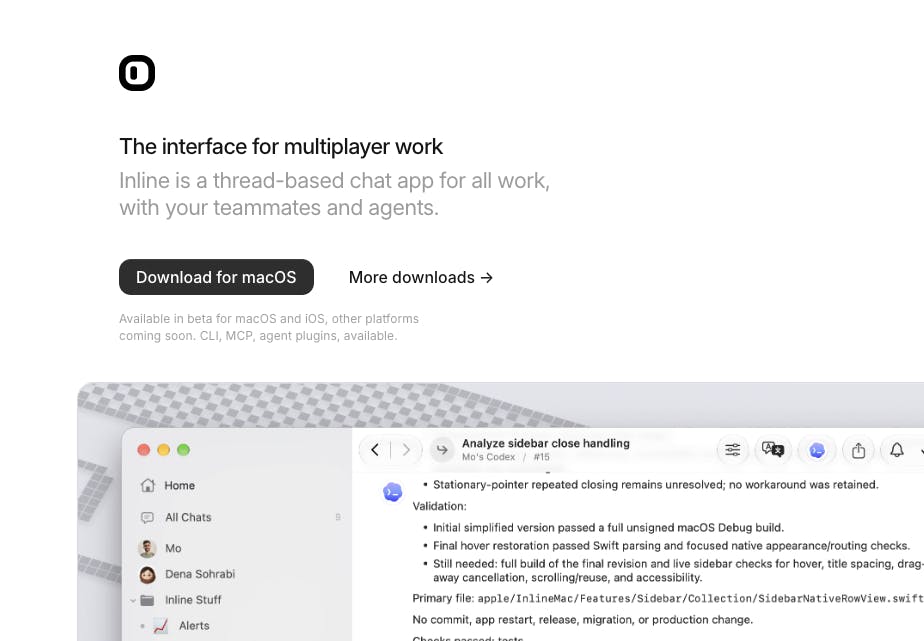
Inline brings AI agents into team chat as equal collaborators in a thread-based workspace.
Inline is an AI-native, thread-based team chat tool that places AI agents alongside human team members as equal collaborators. By treating threads as first-class citizens and embedding AI directly into conversation flows, it aims to provide context-aware, continuous AI collaboration rather than isolated chatbot interactions. While facing significant challenges from entrenched players like Slack and Microsoft Teams, Inline represents the broader industry shift toward multiplayer human-AI workflows.
When AI Becomes a Team Member
Over the past two years, the form of AI tools has undergone a clear evolution — from standalone chat windows to deep integration within workflows. Inline, which recently launched on Product Hunt, represents a compelling new approach: instead of having you chat with an AI in isolation, it pulls AI agents directly into your team's daily communication, enabling humans and AI to collaborate in the same space.
Inline's tagline is straightforward: "Multiplayer work with AI, teammates, and friends." It's positioned as a "thread-based work chat app" where team members and AI agents coexist within the same communication system.
The product was built by Dena Sohrabi and team. After launch, it received 76 upvotes, ranking 13th on the daily leaderboard, and is categorized under both "Messaging" and "Artificial Intelligence."
Inline's Thread-Based Communication Design: More Than Just Another Slack
Inline's core product philosophy is "thread-based chat" — a point worth unpacking.
Thread-based communication was first widely adopted in email and forums. Its core idea is organizing related messages into tree-like structures by topic, rather than simple chronological timelines. Slack officially introduced threads in 2017, allowing users to branch sub-conversations under channel messages — a design that significantly alleviated information overload. But Slack's threads are fundamentally a supplement to the channel model, not part of the underlying architecture. Inline treats threads as a first-class citizen, meaning the entire information architecture is organized around topics from the ground up. Technically, this is closer to the philosophy of Twist (an async communication tool developed by the Todoist team), but with an added AI dimension.
Why Threads Are Critical for AI Collaboration
Traditional team communication tools (like early Slack channels) often fall into the "information waterfall" trap — all messages stack linearly, discussion topics intertwine, and important information gets easily buried. Thread-based design gives each topic an independent, traceable conversation thread.
This structural advantage becomes even more significant when AI agents enter the picture. When AI participates in a discussion, it needs clear context boundaries. Threads naturally provide the AI with the context of "what this conversation is about," enabling more precise responses and making AI-generated content auditable and easy to trace back.
It's worth explaining the concept of AI Agents here, as it's one of the hottest directions in AI right now and fundamentally different from traditional AI chatbots. Chatbots typically handle single-turn or multi-turn conversations, while AI agents possess the ability to autonomously plan, invoke tools, and execute tasks. A typical AI agent architecture includes a perception module (understanding inputs), a planning module (formulating action steps), an execution module (calling external tools to complete tasks), and a memory module (maintaining long-term context). In team collaboration scenarios, AI agents can proactively monitor task cues in conversations, automatically compile meeting notes, and even generate action items based on discussion content and assign them to relevant members — far beyond simple Q&A. Thread-based structure happens to provide clear scoping for these capabilities — each thread serves as an independent task context.
AI and Humans Sharing One Workspace
Inline's differentiation isn't that it "has AI integrated" — it's that it places AI on an equal collaborative footing with human colleagues. You can summon an AI agent in a thread the same way you'd @mention a coworker; the AI's output flows directly into the conversation stream rather than being isolated in a separate tab.
This "Multiplayer" design philosophy is essentially redefining AI's role within a team — shifting from a passive "tool" to an active "team member." The Multiplayer concept originally came from the gaming industry and has been widely borrowed in the productivity tool space in recent years. Figma is one of the most successful examples, having fundamentally changed how designers work through real-time multiplayer collaborative editing of design files, eventually reaching a $20 billion valuation in an acquisition deal by Adobe (though the deal later fell through due to antitrust scrutiny). Google Docs' real-time collaboration feature is another classic embodiment of this philosophy. Inline extends the Multiplayer concept from documents and design into the team communication layer, adding AI as a collaborative participant. At its core, it's exploring a new paradigm of human-computer interaction — AI is no longer a database to be queried, but a collaborator with a "seat at the table."
Industry Trends Behind the Product Positioning
Inline's emergence isn't an isolated phenomenon — it's a microcosm of the current wave of AI collaboration tools.
Embedding AI Agents in Workflows Is the New Battleground
Numerous products are exploring how to embed AI agents into actual workflows. From code collaboration to project management, an industry consensus is forming: AI's value lies not in one-off conversations, but in continuous, context-aware collaboration. Inline enters from the "communication layer," aiming to become the intersection of team information flow and AI capabilities.
The Messaging Space Faces a Potential Reshuffling
Categorizing Inline under "Messaging" means it directly competes with established players like Slack, Microsoft Teams, and Discord. This is an extremely difficult red ocean market. Inline's bet is whether an AI-native design can become the lever that triggers user migration.
AI-native is a product design paradigm contrasted with "AI-enhanced," and understanding this distinction is crucial for evaluating Inline's competitiveness. AI-enhanced products layer AI capabilities onto existing features — for example, Slack AI, launched in 2023, essentially "retrofits" intelligent summaries and search functionality onto the existing product architecture. AI-native products, on the other hand, rebuild everything — from product architecture to interaction design to data flows — around AI capabilities. This is similar to the difference between "mobile-native" and "mobile-adapted" — Instagram was designed for phones from the start, while many early websites merely adapted their desktop versions for mobile screens. The advantage of AI-native tools is that AI isn't an optional add-on but a core part of the experience, with information architecture naturally optimized for AI's contextual understanding.
While legacy tools are gradually adding AI features, these tend to be patch-like, "bolt-on" integrations. AI-native tools built from scratch can theoretically deliver a smoother collaborative experience.
Opportunities and Challenges Facing Inline
Objectively, the challenges facing Inline are substantial.
First is the cost of migrating user habits. Team communication tools have extremely strong network effects and switching inertia. A team abandoning Slack or Teams for a new tool requires very compelling motivation. Network Effect is one of the most powerful moats for communication products — when every member of a team uses Slack, a single member can hardly migrate to a new platform alone, because the value of a communication tool is directly proportional to the number of users. Slack currently has over 32 million daily active users, and Microsoft Teams, powered by the Microsoft 365 ecosystem, boasts 300 million monthly active users. Historically, disruptive replacements in team communication have typically accompanied fundamental shifts in work paradigms — for example, Slack was able to challenge email in part because the rise of agile development and remote work created new demand for real-time communication. Whether deep integration of AI agents into workflows constitutes a similar paradigm shift will determine the breakthrough potential of new tools like Inline.
Second is the real-world effectiveness of AI capabilities. "Pulling AI agents into conversations" sounds great, but whether AI actually reduces communication costs and improves collaboration efficiency in real work scenarios — rather than generating more noise — is what will determine its long-term value. Current large language models still suffer from hallucination problems, generating information that appears plausible but is actually inaccurate, which could create misinformation risks in team collaboration contexts. Additionally, the timing and frequency of AI agent interventions in multi-person conversations need careful design — being too proactive may disrupt natural human-to-human communication, while being too passive fails to demonstrate value.
That said, based on its current Product Hunt performance of 76 upvotes and a spot near the top of the daily rankings, Inline's "human-AI hybrid collaboration" direction clearly strikes a nerve with some early adopters.
Conclusion: The Next Step for AI Team Collaboration Tools
Inline represents an important attempt at moving AI collaboration tools from "single-user conversations" to "multiplayer co-creation." Its thread-based communication design and AI-native positioning respond to the growing demand for intelligence in team collaboration.
As an early-stage product, whether it can gain a foothold in a messaging market dominated by Slack and Teams remains to be seen. But the direction it points toward — making AI agents truly equal members of team workflows — is undoubtedly an industry trend worth watching. For teams searching for the next generation of AI collaboration tools, Inline might be worth a try.
Related articles
Clockwork: Schedule AI Coding Agents on Your Calendar for Unattended, Automated Execution
Clockwork schedules AI coding agents on your calendar for unattended execution, featuring git worktree sandboxing, risk-based approval pauses, and transparent API cost reports.
Fairphone 6+ Deep Dive: The Ideals and Realities of a Repairable, Modular Smartphone
Deep dive into Fairphone 6+'s modular design, 8-year update promise, ethical supply chain practices, and the real challenges facing repairable sustainable smartphones.
Corporate America's Collective Shift to Open-Source AI: The Triple Forces of Cost, Compliance, and Technical Autonomy
U.S. enterprises are accelerating open-source AI adoption, driven by cost control, data compliance, and technical autonomy. This article analyzes the motivations, challenges, and industry impact.