Fake Web3 Accelerator Uses npm Packages to Hijack AI Agent Traffic

Malicious npm packages disguised as a Web3 accelerator use free AI credits as bait to hijack AI Agent traffic, exposing a tool-layer trust blind spot.
A project disguised as a Web3 accelerator uses free AI credits as bait to distribute malicious npm packages to AI developers, spreading infostealers, planting backdoors, and hijacking AI Agent outbound traffic on Windows and macOS. The attack occurs entirely at the tool layer, not the model layer: any npm package with sufficient runtime permissions can intercept or redirect Agent calls, while developers lack visibility into runtime behavior. Reddit discussions propose package auditing, dependency pinning, isolated execution, and outbound restrictions, but no standard answer exists. The incident shows npm supply chain risks are migrating to the AI layer.
Event Overview: When "Free AI Credits" Become Bait for a Supply Chain Attack
A project disguised as a Web3 accelerator has been distributing malicious npm packages to AI developers, using free AI credits as bait. Once installed on Windows and macOS systems, these packages spread infostealers, plant backdoors, and hijack AI Agents' outbound traffic. According to discussions in the Reddit community, the attackers never touched the model itself—the entire attack took place at the tool layer.
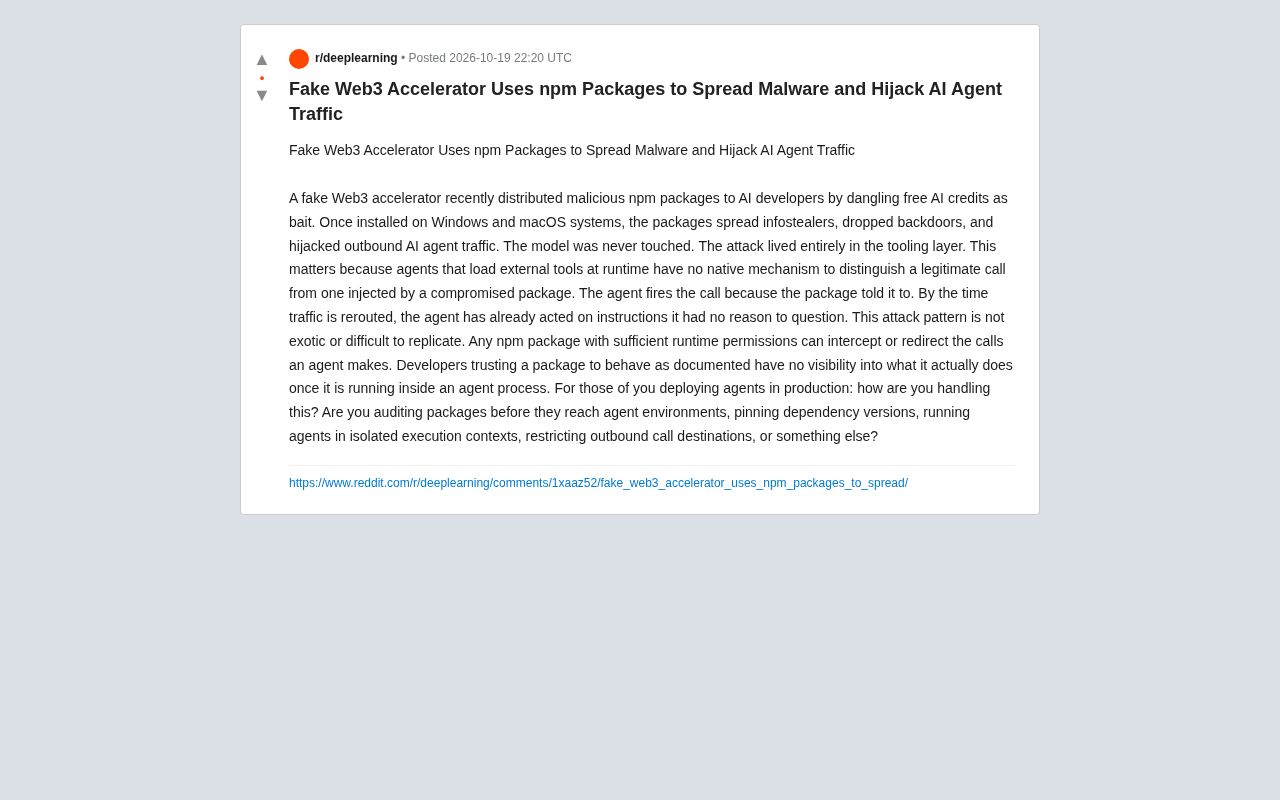
The core of this incident is this: AI Agents load external tools at runtime, but they lack a native mechanism to distinguish legitimate calls from calls injected by compromised packages. An Agent makes a particular call because the package "tells" it to. By the time traffic is redirected, the Agent has long since executed instructions it had no reason to question.
npm packages: npm (Node Package Manager) is the official package manager for the Node.js JavaScript runtime environment and the world's largest software registry, hosting millions of open-source code packages. Developers can use the npm install command to automatically pull third-party packages and their dependency trees into a project. This convenience also brings supply chain risks: npm allows packages to execute scripts during installation (such as postinstall), and by default does not enforce signature verification, so attackers can distribute malicious code by publishing malicious packages or hijacking legitimate ones. Historically, well-known npm packages such as event-stream and ua-parser-js have been poisoned, and this incident is an extension of that risk pattern into the AI Agent toolchain.
Why the Attack Is Hard to Detect: The Trust Blind Spot at the Tool Layer
This type of attack is not complicated, nor is it particularly "advanced." Any npm package with sufficient runtime permissions can intercept or redirect calls made by an Agent. Developers trust that a package will behave as documented, but once it enters the Agent process, its actual behavior becomes invisible.
The author of the original Reddit post raised a key question: the model was not compromised; the toolchain was. This means traditional model-centric security thinking has a blind spot—you cannot discover anomalies at the tool layer by auditing the model. Attackers exploit this trust asymmetry: developers trust a package's "claims," while its runtime "behavior" lacks transparency.
Infostealer: A category of malware specifically designed to steal sensitive data from infected systems, including passwords saved in browsers, cookies, cryptocurrency wallet private keys, SSH keys, API tokens, and instant messaging credentials. Unlike ransomware, infostealers usually aim for silent persistence, exfiltrating data within a short time and then cleaning up traces; victims often only notice after their credentials have been abused. In AI development scenarios, attackers are especially interested in API keys in environment variables (such as access tokens for OpenAI and Anthropic) and cloud service credentials, which can be directly converted into financial gain or used as a springboard for further intrusion.
Defense Approaches in Production Environments: Several Directions Discussed by the Community
The original post asked developers deploying Agents in production environments: how do you handle this problem? Several defense directions emerged in the discussion:
- Package auditing: Review packages before they enter the Agent environment, rather than remediating afterward.
- Dependency version pinning: Pin dependency versions to avoid uncontrollable changes introduced by automatic upgrades.
- Isolated execution contexts: Run Agents in isolated environments to limit their blast radius.
- Restricting outbound call targets: Whitelist or restrict the external addresses an Agent can access.
Each of these measures involves trade-offs. Auditing requires additional tooling and manpower, version pinning may miss security updates, isolated environments increase operational complexity, and outbound restrictions may affect functional completeness. The community did not provide a "standard answer," but the consensus is clear: npm packages cannot be assumed to be trustworthy by default.
Dependency version pinning: Through lockfiles such as package-lock.json, yarn.lock, or pnpm-lock.yaml, a project's dependencies and their full dependency trees are pinned to exact versions and integrity hashes. This way, even if upstream publishes a new version or an attacker tampers with a package, installation will verify the hash and reject inconsistent packages. But version pinning is not a silver bullet: it cannot defend against a package that was already malicious when first introduced, and it may miss security patches if dependencies are not updated for a long time. In practice, it is usually combined with automated dependency review tools (such as Dependabot and Socket.dev) to balance security and update needs.
Implications for the AI Agent Ecosystem: Tool Calls Need "Visibility"
This incident exposes a structural gap: when Agents load external tools at runtime, they lack visibility into the tools' actual behavior. Developers can see a package's documentation and code, but not its runtime behavior inside the Agent process. Attackers do not need to compromise the model; they only need to let a package with sufficient permissions "do what it wants to do."
From a defense perspective, this requires bringing supply chain security practices into the Agent toolchain—including package source verification, runtime behavior monitoring, and the principle of least privilege. More importantly, Agent design itself needs to consider: when external tools can instruct an Agent to make calls, how can the call chain be made transparent to developers? This remains an open question.
Principle of Least Privilege: This principle requires that any component (including software packages, processes, and Agents) should have only the minimum permissions necessary to perform its intended function. In AI Agent scenarios, this means npm packages should not by default inherit the Agent process's full network, file system, and credential access capabilities. This can be achieved through sandboxed runtimes (such as containers, gVisor, and WebAssembly isolation), fine-grained network policies (such as allowing access only to whitelisted domains), and temporary credentials scoped per tool. Although least privilege cannot prevent a malicious package from executing, it can significantly reduce the scope of damage it causes and buy response time for runtime anomaly detection.
This Is Not an Isolated Case: Supply Chain Risks in the npm Ecosystem Are Migrating to the AI Layer
The npm ecosystem has long faced supply chain attacks, but what makes this incident unusual is that the target has shifted to AI Agents. As more developers deploy Agents to production environments and allow them to dynamically load tools at runtime, the attack surface expands from the traditional application layer to the Agent toolchain layer.
The Reddit discussion did not provide the attacker's specific identity or the duration of the campaign, but it made one point clear: this type of attack is "not exotic, and not hard to replicate." This means similar techniques may be adopted by more attackers. For teams deploying Agents, the question to answer now is not "could we be attacked," but "when an attack happens at the tool layer, do I have the ability to detect and block it?"
(This article is based on public discussions in the Reddit community; incident details are subject to the original post.)
One-line Summary
Malicious npm packages disguised as a Web3 accelerator use free AI credits as bait to hijack AI Agent traffic, exposing a trust blind spot at the tool layer.
Paragraph Summary
A project disguised as a Web3 accelerator uses free AI credits as bait to distribute malicious npm packages to AI developers, spreading infostealers, planting backdoors, and hijacking AI Agents' outbound traffic on Windows and macOS. The attack occurs entirely at the tool layer rather than the model layer: any npm package with sufficient runtime permissions can intercept or redirect Agent calls, while developers lack visibility into the package's runtime behavior. Reddit community discussions propose defense directions such as package auditing, dependency version pinning, isolated execution contexts, and restricting outbound targets, but each involves trade-offs and there is no standard answer yet. The incident shows that npm supply chain risks are migrating to the AI layer, and the visibility gap in Agent tool-call chains urgently needs to be addressed.
Related articles

Chain of Thought Isn't Just for AI: How Humans Can Use CoT to Improve Thinking Quality
Chain of Thought isn't just a prompt trick for large models. Starting from a Hacker News discussion, this article analyzes why CoT works for human thinking too, breaks down actionable ways to transfer it, and highlights the key differences between human CoT and machine CoT.
Cloudflare Teams Up with OpenAI: Closi…
Cloudflare Teams Up with OpenAI: Closing the Loop from Vulnerability Discovery to Defense with AI
Cloudflare uses OpenAI Daybreak to investigate security vulnerabilities and generate reviewable remediation plans, while developers use Codex to boost coding efficiency and quality.

Orca Multi-Agent Orchestration in Practice: A Guide to Parallel Collaboration with Claude and Codex
Orca is Stable AI's free open-source agent workbench supporting 34 agents like Claude Code and Codex in parallel. Learn its Git worktree isolation, multi-model orchestration, and mobile management.