Fancy Prompts Don't Affect Small Models—Only the Format Line Determines Success

Tests show that prompt wording style has almost no effect on local small-model accuracy; the format instruction line is what really determines success.
A systematic test of 8 local models and more than 5,000 calls examined plain, normal, and fancy prompt styles. In 40 non-math tasks, models above 8B varied by no more than 4 points; models below 4B did slightly better with normal style. Math tasks fluctuated by 30 points, but the cause was the format line, not wording: fancy phrasing made models stop reasoning, dropping accuracy from 79% to 11%. After unifying the format line, style differences caused at most 5 points of variation.
Title
Fancy Prompts Don't Affect Small Models—Only the Format Line Determines Success
Meta Description
A test covering 8 local LLMs and over 5,000 calls shows that fancy prompt styles have little effect on small models. What really determines output quality is the format instruction line—it can even create a 45-point performance gap.
Article Content
When writing prompts for LLMs, many people habitually add a pile of modifiers, trying to make the instructions sound more "professional." But for smaller local models, are these flowery words actually useful? A systematic test of 8 local models and more than 5,000 calls gave a negative answer: ornate phrasing has almost no effect on model performance. What truly determines output quality is the line telling the model how to format its answer.
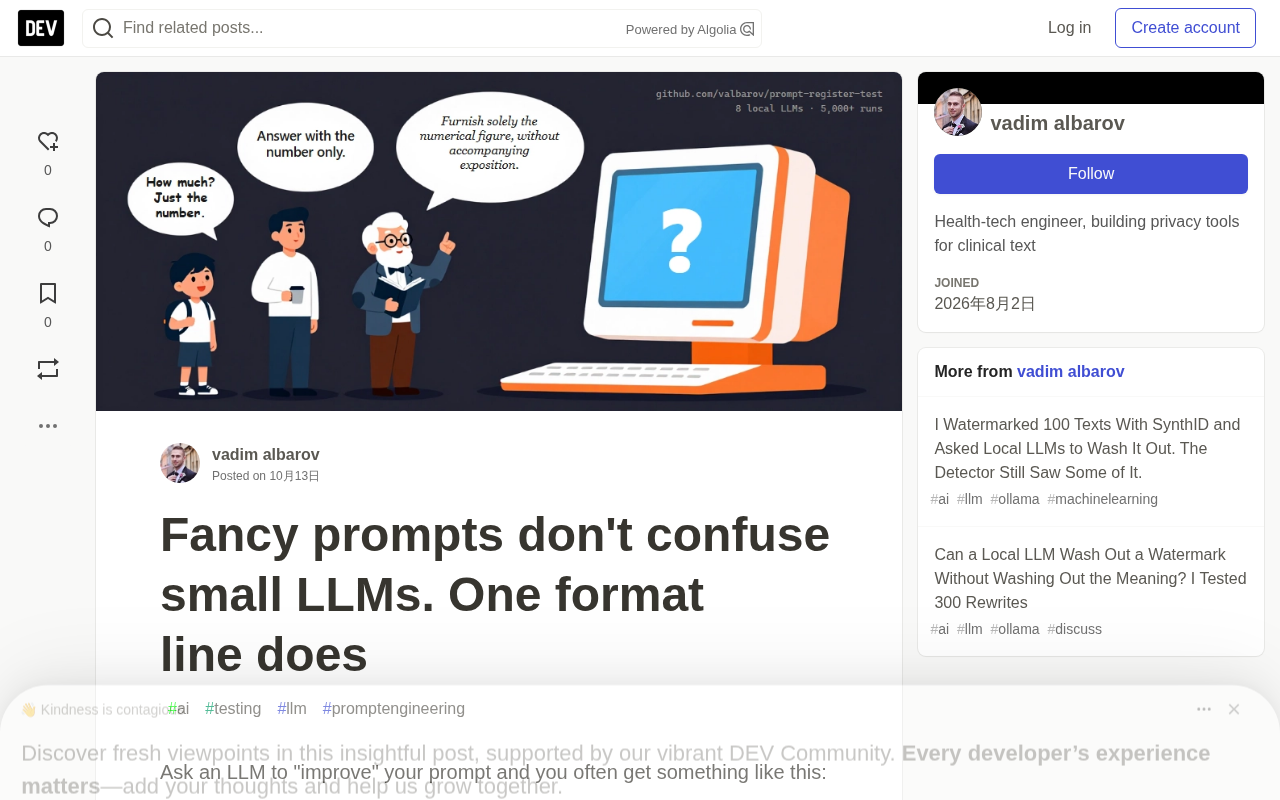
Test Design: Three Prompt Styles, from Simple to Fancy
The tester designed 50 automatically verifiable tasks, divided into five categories: multi-step math calculations, extracting JSON from order notes, classifying support tickets, conditional filtering and sorting, and writing tasks with strict formatting requirements. Each category had 10 questions, and every question had a standard answer.
Each task was rewritten into three versions. The facts, numbers, and conditions were completely identical; only the wording differed. Take the instruction "give only the number" as an example:
| Style | Example | Reading grade | Average sentence length | Share of words with 9+ letters |
|---|---|---|---|---|
| Plain | Give only the number. | 4.1 | 9.8 words | 1% |
| Normal | Answer with the number only. | 8.3 | 12.3 words | 4% |
| Fancy | Furnish solely the numerical figure, without accompanying exposition. | 17.9 | 22.6 words | 26% |
The test covered 8 local models: Qwen3's 0.6B, 1.7B, 4B, 8B, and 14B, plus Gemma3's 1B, 4B, and 12B. All were deployed through Ollama with thinking mode disabled. Each prompt was run 3 times with a fixed random seed. The main experiment totaled 3,600 calls, and the supplementary math experiment added another 1,440.
Finding 1: In Non-Math Tasks, Wording Style Has Almost No Effect
In the 40 non-math tasks, how did model accuracy look? From the data, models at 8B and above differed by no more than 4 percentage points across the three styles. Even fancy English written in 23-word sentences did not trouble them.
But on models at 4B and below, a noteworthy pattern appeared: the normal style scored highest, while both the plain and fancy styles dropped by about 8 points. However, all confidence intervals crossed zero, so this difference cannot be strictly proven significant and can only be treated as a trend signal.
This suggests a counterintuitive phenomenon: for small models, using very simple language (short sentences, low reading grade) is not safer than normal language. The tester analyzed that the reason may be that the plain version distributes the facts across more short sentences, requiring the small model to do extra information integration work.
Finding 2: Math Tasks Fluctuate by 30 Points, and the Problem Is Suppressed Reasoning
The math task results look striking: plain style 28%, normal style 34%, fancy style only 18%. Qwen3 4B-instruct scored 93% under the normal style, then dropped sharply to 43% when switched to the fancy style.
But after analyzing the responses in depth, the reason emerged. When the model wrote out reasoning steps, accuracy was 79%; when it gave only a bare number, accuracy was only 11%. Because the test disabled thinking mode, writing out steps was itself the model's "thinking process."
The format line directly determined how often the model wrote steps: the normal format line "Answer with the number only" led 37% of responses to show reasoning, the plain version 27%, and the fancy version only 8%. Fancy wording did not make the model "fail to understand." On the contrary, the model followed it more strictly, thus stopping reasoning and guessing the answer directly.
To separate the effects of the two variables, the tester unified the final line across all versions:
- Using their respective format lines: plain 28%, normal 34%, fancy 18%
- Unified to "Answer with the number only": 37%, 35%, 40%
- Unified to "Work it out step by step, then write the final number": 84%, 83%, 79%
After unifying the final line, stylistic differences in the problem text caused at most a 5-point fluctuation; changing the format line created a 45-point gap.
A more extreme example came from Qwen3 1.7B: "Give only the number" made it show reasoning 17% of the time, while "Answer with the number only" reached 80%. Almost the same meaning, completely different behavior.
What is "thinking mode"? New-generation models represented by Qwen3 support generating a "chain of thought" before formally answering—the model first outputs an internal reasoning process (usually wrapped in specific tags), then gives the final answer. This mechanism is implemented through additional reinforcement learning training and, when enabled, can significantly improve performance on complex tasks such as math and logic. The tests in this article uniformly disabled thinking mode in order to observe model behavior in a "normal conversation" state. The key difference is this: thinking mode is an internal, specially trained reasoning channel of the model; the "writing out reasoning steps" discussed in this article is the model spontaneously writing the calculation process in an ordinary response, a kind of "explicit reasoning." The mechanisms differ, but the effects are related—both increase the amount of computation the model actually performs. For this reason, after thinking mode is disabled, whether the model is willing to write steps in the main body becomes the key variable determining math accuracy.
Finding 3: Fancy Vocabulary May Quietly Change the Meaning of the Question
In a customer information extraction task, the order note began: "Hi, this is Laura Becker from Becker Design. We'd like 12 desk lamps..."
- Plain prompt ("the name of the customer"): 88% answered Laura Becker
- Normal prompt ("customer name"): 96%
- Fancy prompt ("the appellation of the commissioning customer"): only 25%, with most models answering Becker Design
This is not necessarily a "wrong answer." The "commissioning customer" can indeed be understood as the company entity. The fancy wording made the question ambiguous, and the model chose another reasonable interpretation. When the tester used Claude to check the semantic consistency of the three versions, this ambiguity was not flagged either.
This is precisely the core risk when LLMs rewrite prompts: every fancy word is a small-probability event of semantic drift.
Verification and Revision of the Familiarity Theory
A natural hypothesis is this: instruction fine-tuning data is mainly ordinary, direct English, so the "normal" style is most familiar to the model, while being too simple or too fancy deviates from the training distribution. Small models are worse at handling unfamiliar input, which could explain why models below 4B perform best on the normal style.
The tester verified this hypothesis using perplexity. The perplexity of the fancy style was about twice that of the normal style (Qwen3 0.6B: 37.2 vs 16.7), so it indeed "looks more unfamiliar." But the perplexity of the plain style and the normal style were almost the same (15.6 vs 16.7), yet the small model performed worse on the plain style, showing that "familiarity" is not the whole reason.
More importantly, after correlating perplexity with per-question accuracy, the relationship in non-math tasks was weak (r between -0.15 and 0.08), indistinguishable from zero.
The revised explanation is this: although fancy English is unfamiliar, the model can still understand it, and unfamiliar vocabulary itself hardly harms accuracy; the problem with the plain style lies in structure. After breaking the task into more short sentences, the small model needs extra information stitching. What really matters is not which words are used, but how the task is organized and how strictly the model follows the format line.
What is perplexity? It is a metric measuring how "surprised" a language model is by a piece of text: the less certain the model is about predicting the next word, the higher the perplexity. It can be roughly understood as "how unfamiliar this text looks." Common expressions within the training distribution have low perplexity, while rare or awkward wording has high perplexity. Perplexity is therefore often used to test whether a model has seen similar expressions. But the findings in this article remind us that low perplexity does not equal good task performance—it only reflects familiarity with vocabulary and grammar, not whether the sentence's information structure is easy for the model to integrate. Plain prompts and normal prompts had almost the same perplexity, yet the small model performed worse, showing that the real bottleneck is how the task is organized, not the surface-level "unfamiliarity."
Implications for Prompt Engineering
This test offers several practical suggestions:
Do not bother rewriting prompts into fancy English. Not only does it not help; it may also change the original semantics.
Do not deliberately "dumb down" small models either. Normal, direct English performs no worse than any style, and even slightly better below 4B.
Focus your effort on the format line. Telling a model without thinking mode to "give only the number" is equivalent to making it guess. If you need a correct numerical answer, let it show its reasoning process, then read the last line.
Carefully review prompts rewritten by LLMs. Pay special attention to words that could have two interpretations. Every such word is a potential semantic shift.
Limitations and Caveats
The scale was limited: 50 tasks and 3 trials per prompt. The style versions were written by one person (with LLM assistance), and another author's "fancy" might have a different level of difficulty. The fancy version was longer than the normal version, so length and style were partially confounded. The test was limited to English and local models at 14B and below; frontier models were not included in this round. The perplexity check covered only the three smaller Qwen models and used full-precision weights, while actual runs used Ollama's 4-bit quantized versions. The explanation about "structure" is the tester's best inference, not a variable directly isolated by the experiment.
What does 4-bit quantization mean? Original model weights are usually stored as 16-bit floating-point numbers, with each parameter taking 2 bytes; 4-bit quantization compresses each parameter to about 0.5 bytes, which can reduce memory usage and operating cost severalfold at the price of introducing a small amount of numerical error. The perplexity check in this article used full-precision weights, while actual inference ran through Ollama with 4-bit quantization. Quantization may slightly change model behavior, especially sensitivity to prompt format—so whether the perplexity conclusions can be directly extrapolated to quantized models still needs caution. This is also why the author lists it as one of the limitations.
One-line Summary
Tests show that prompt wording style has almost no effect on local small-model accuracy; the format instruction line is what really determines success.
Paragraph Summary
A systematic test of 8 local models and more than 5,000 calls examined differences among plain, normal, and fancy prompt styles. The results showed that in 40 non-math tasks, models above 8B reacted to style differences by no more than 4 percentage points; among models below 4B, the "normal" style was slightly better, while plain and fancy both dropped by about 8 points. Math tasks fluctuated by as much as 30 points, but the root cause was not difficult wording—it was the format line. Fancy wording made the model follow "give only the number" more strictly, causing it to stop writing reasoning steps, with accuracy plunging from 79% to 11%. After unifying the format line, stylistic differences in the problem text caused at most a 5-point fluctuation. In addition, fancy vocabulary may introduce semantic ambiguity, for example interpreting a "customer name" as a company name. The author suggests: do not pursue fancy expression, and do not deliberately dumb down small models. Instead, focus effort on the format line and task structure.
Related articles

How Big Can Stars Really Get? The Physical Limits of the Largest Stars
Red supergiants are the largest stars by volume, with radii up to 2,000 times the Sun, engulfing the inner solar system. But there is no precise upper limit on stellar size—models predict up to 15,000 solar radii. The most massive blue stars are far smaller than red supergiants—biggest and heaviest are two different things.

Apple HomeView Smart Display Full Feature Breakdown: Wall-Mount or Desktop, $299
Apple launches HomeView, a $299 smart display with wall-mount and desktop options, 12MP camera for facial recognition, smart home control, music playback, and recipe step-by-step cooking. Full breakdown of watch faces, apps, privacy, and cooking integration.

Where Did the Promised New Studio Go? Craft Computing Answers After Five Years
Craft Computing's host responds to viewer questions: the new studio promised five years ago was shelved as construction costs soared from $30,000 to $75,000, and was replaced by a 168-square-foot garage conversion.