Fast Tree Transform: A New Tool Unifying Hadamard and Haar for Graph Signal Processing
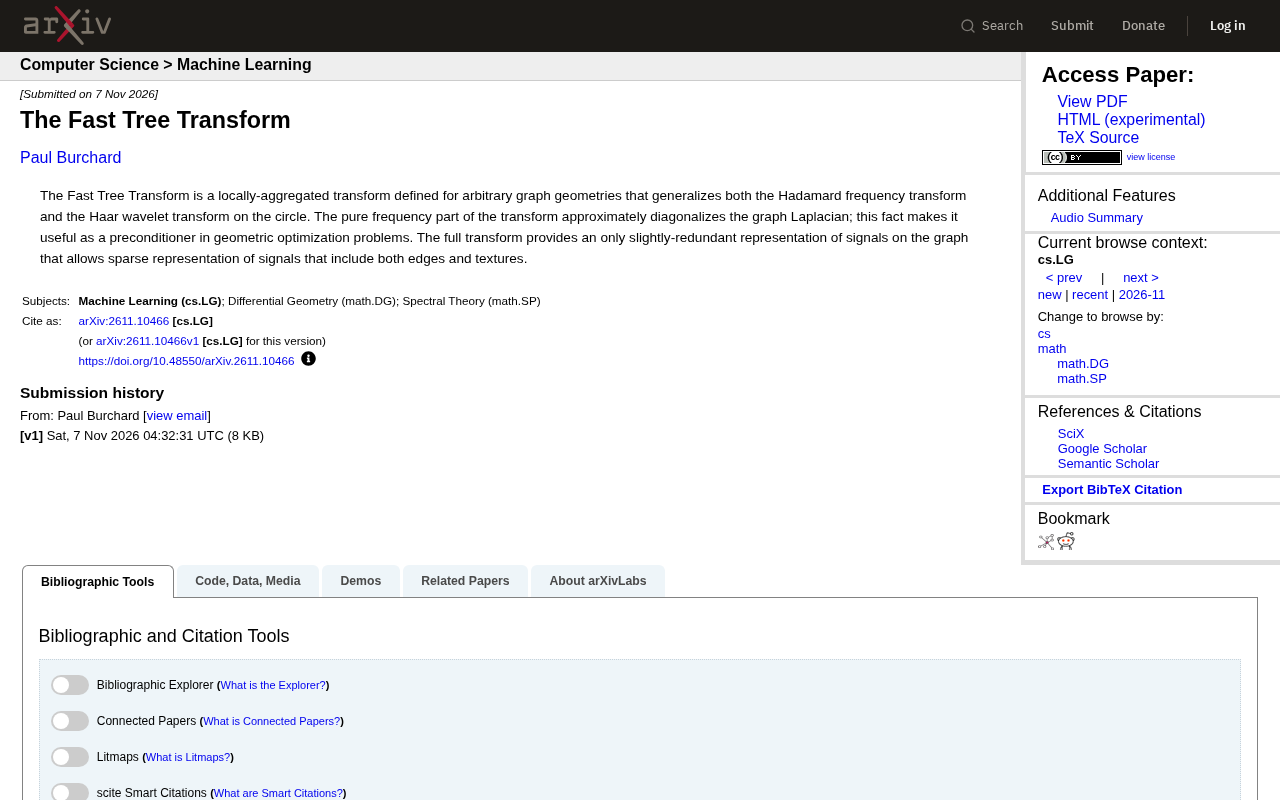
The Fast Tree Transform unifies Hadamard and Haar transforms, providing a preconditioner and sparse representation for arbitrary graphs.
The Fast Tree Transform is a new transform defined on arbitrary graphs that unifies the Hadamard frequency transform on the circle and the Haar wavelet transform into a local aggregation framework. Its pure frequency part approximately diagonalizes the graph Laplacian, serving as a preconditioner for linear systems in geometric optimization and accelerating iterative solutions. The complete transform is only slightly redundant and can sparsely represent signals containing both edges and textures, making it suitable for unstructured graph data. This work comes from a research preprint; currently available information is limited to the abstract, and the specific construction, complexity, and experimental data have not yet been disclosed.
A new transform tool has emerged in the field of graph signal processing—the Fast Tree Transform. Defined on arbitrary graph geometries, it unifies the Hadamard frequency transform on the circle and the Haar wavelet transform into a single local aggregation framework. This work comes from a research preprint, and its core contribution lies in providing a representation for signals on graphs that approximately diagonalizes the Laplacian matrix, thereby serving as a preconditioner in geometric optimization.
Core Idea of the Fast Tree Transform
In traditional signal processing, the Hadamard transform excels at handling frequency information, while the Haar wavelet is sensitive to edges and abrupt changes. However, both are typically defined on regular grids or the circle, making them difficult to generalize directly to arbitrary graph structures. The Fast Tree Transform constructs a transform that contains both frequency components and preserves local geometric features by performing layer-by-layer local aggregation operations that merge information between graph nodes.
According to the original description, the "pure frequency part" of this transform can approximately diagonalize the graph Laplacian matrix. This means that the transformed coefficients are nearly independent in the frequency domain, which has a preconditioning effect for solving linear systems involving the graph Laplacian (such as discretized partial differential equations in geometric optimization). The role of a preconditioner is to improve the convergence rate of iterative solvers, and the approximate diagonalization provided by the Fast Tree Transform precisely meets this need.
The graph Laplacian is a core operator in graph signal processing, defined as L = D - A (where D is the degree matrix and A is the adjacency matrix). Its quadratic form x^T L x = Σ_{(i,j)∈E} (x_i - x_j)^2 measures the smoothness of a signal on the graph. The eigendecomposition of the Laplacian gives the graph Fourier basis, but the computational cost is high. Diagonalizing the Laplacian means finding a basis in which L is approximately diagonal, thereby simplifying operations involving L. A preconditioner is an operator used to accelerate iterative solutions of linear systems; ideally, it should be easy to invert and should reduce the condition number. The transform matrix constructed by the Fast Tree Transform through local aggregation, with its pure frequency part, approximately achieves this diagonalization, thus serving as a preconditioner.
Connection to Hadamard and Haar
The relationship between the Fast Tree Transform and classical transforms is noteworthy. On the circle, the Hadamard transform corresponds to a complete frequency basis, while the Haar wavelet corresponds to a multiscale edge basis. The Fast Tree Transform incorporates both into the same framework: the pure frequency part degenerates to Hadamard-like behavior, while the complete transform introduces multiscale localization through tree-structured aggregation, similar to the Haar wavelet but defined on arbitrary graphs.
This unification is not merely a mathematical game. Real signals often contain both smooth frequency components and sharp edges or textures. The complete form of the Fast Tree Transform provides a representation that is "only slightly redundant," enabling signals containing both edges and textures to be expressed sparsely. Sparse representation has direct value for compression, denoising, and feature extraction.
The Hadamard transform is an orthogonal transform based on the Hadamard matrix, whose elements are ±1; its computation involves only addition and subtraction, giving it low complexity. On the circle, it corresponds to a frequency transform, but the frequency ordering differs from that of the Fourier transform. The Haar wavelet is the simplest wavelet transform, using step functions as its basis; it is sensitive to edges and abrupt changes and possesses multiscale analysis capability. Both are well-defined on regular grids, but generalizing them to arbitrary graph structures poses challenges because the irregularity of graphs undermines the traditional definitions of frequency and scale. The Fast Tree Transform simulates the behavior of these two transforms on arbitrary graphs through tree-structured aggregation operations, thereby unifying them.
Potential Applications in Geometric Optimization
The original text explicitly states that this transform can serve as a preconditioner for geometric optimization problems. Geometric optimization often involves solving variational problems on discrete surfaces, the core of which is large sparse linear systems. The condition number of the graph Laplacian is often poor, causing direct iterative solutions to converge slowly. The pure frequency part of the Fast Tree Transform approximately diagonalizes the Laplacian, which amounts to constructing an approximation that is easy to invert, thereby accelerating iterative methods such as conjugate gradient.
This approach has similarities to multigrid methods: both improve the condition number through multiscale decomposition. However, the advantage of the Fast Tree Transform is that it applies to arbitrary graph geometries and does not require regular grid structures. For unstructured point clouds, irregular triangular meshes, or general graph data, this adaptability is particularly important.
Multigrid is a technique for accelerating the solution of linear systems arising from the discretization of partial differential equations, by smoothing errors across grids at different scales. Its core idea is to eliminate high-frequency errors on fine grids and handle low-frequency errors on coarse grids. The condition number of the graph Laplacian worsens as the graph size increases, causing iterative solvers to converge slowly. Multigrid improves the condition number by constructing a hierarchy. The tree-structured aggregation of the Fast Tree Transform resembles the multigrid hierarchy but applies to arbitrary graphs without relying on regular grids. Compared with algebraic multigrid, the Fast Tree Transform may provide a more direct frequency-localization decomposition.
Sparsity Advantages in Signal Representation
Beyond its preconditioning use, the complete transform of the Fast Tree Transform also has potential in signal representation. The original text emphasizes that it is "only slightly redundant," meaning that the number of transform coefficients is close to the original signal dimension, without introducing excessive storage overhead. At the same time, because the transform captures both frequency and local edges, its sparsity may be superior to using a frequency transform or wavelet transform alone for mixed content commonly found in natural images or geometric signals.
However, currently available public information is limited to the abstract level; the specific construction details of the transform, computational complexity, and sparsity comparison data on standard datasets have not yet been disclosed. Actual effectiveness awaits verification after the full paper or code is released.
Positioning and Outlook
The Fast Tree Transform lies at the intersection of graph signal processing and harmonic analysis. It attempts to answer a fundamental question: can a fast transform be defined on arbitrary graphs that possesses both frequency selectivity and localization capability? Judging from the abstract, the answer is yes, and two concrete uses—preconditioner and sparse representation—are given.
For researchers working in geometric processing, graph neural networks, or scientific computing, this transform is worth attention. Its local aggregation structure may be suitable for parallel implementation, and its role as a preconditioner is directly related to the efficiency of large-scale geometric optimization. What remains to be seen is whether the construction of the transform is concise enough for engineering implementation, and how competitive it is in practical problems compared with existing preconditioners (such as algebraic multigrid).
The original text does not provide experimental data or complexity analysis, so the above judgments are based on the conceptual level. The value of this work ultimately depends on the theoretical guarantees and numerical validation in the full paper.
One-line Summary
The Fast Tree Transform unifies the Hadamard and Haar transforms, providing a preconditioner and sparse representation for arbitrary graphs.
Paragraph Summary
The Fast Tree Transform is a new transform defined on arbitrary graphs that unifies the Hadamard frequency transform on the circle and the Haar wavelet transform into a local aggregation framework. The pure frequency part of the transform can approximately diagonalize the graph Laplacian, thereby serving as a preconditioner for linear systems in geometric optimization and accelerating iterative solutions. The complete transform is only slightly redundant and can sparsely represent signals containing both edges and textures, making it suitable for unstructured graph data. This work comes from a research preprint; currently available information is limited to the abstract, and the specific construction, complexity, and experimental data have not yet been disclosed.
Related articles
Vim Search and Replace in Practice: 3 Techniques to Boost Ops Efficiency
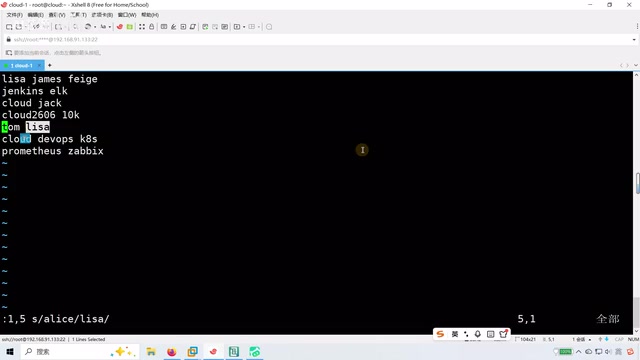
Based on Bilibili creator Feige's Vim tutorial, this article explains three range syntaxes for search and replace, the global g flag, delimiter switching for special characters, and practical set number and set list tips to help cloud ops staff boost text-processing efficiency.

AgentScope 2.0 in Practice: A Guide to Building Production-Grade AI Agents
A hands-on AgentScope 2.0 tutorial covering ReAct agents, a three-dimensional security defense line (tool review, HITL, sandbox isolation), and context management for building production-grade AI agents from scratch.

Meta AI Assistant Muse Reportedly Mixes Up Conversations, Putting User Privacy at Risk
Meta AI assistant Muse reportedly mixed up conversations, with users seeing others' parenting requests, career advice, product orders, and bank account balances. The article analyzes the privacy leak impact, technical roots, and industry reflection.