FastCDTW: An Efficient Gradient-Friendly Approximation for Continuous Dynamic Time Warping

FastCDTW makes Continuous DTW efficiently differentiable for seamless integration into deep learning pipelines.
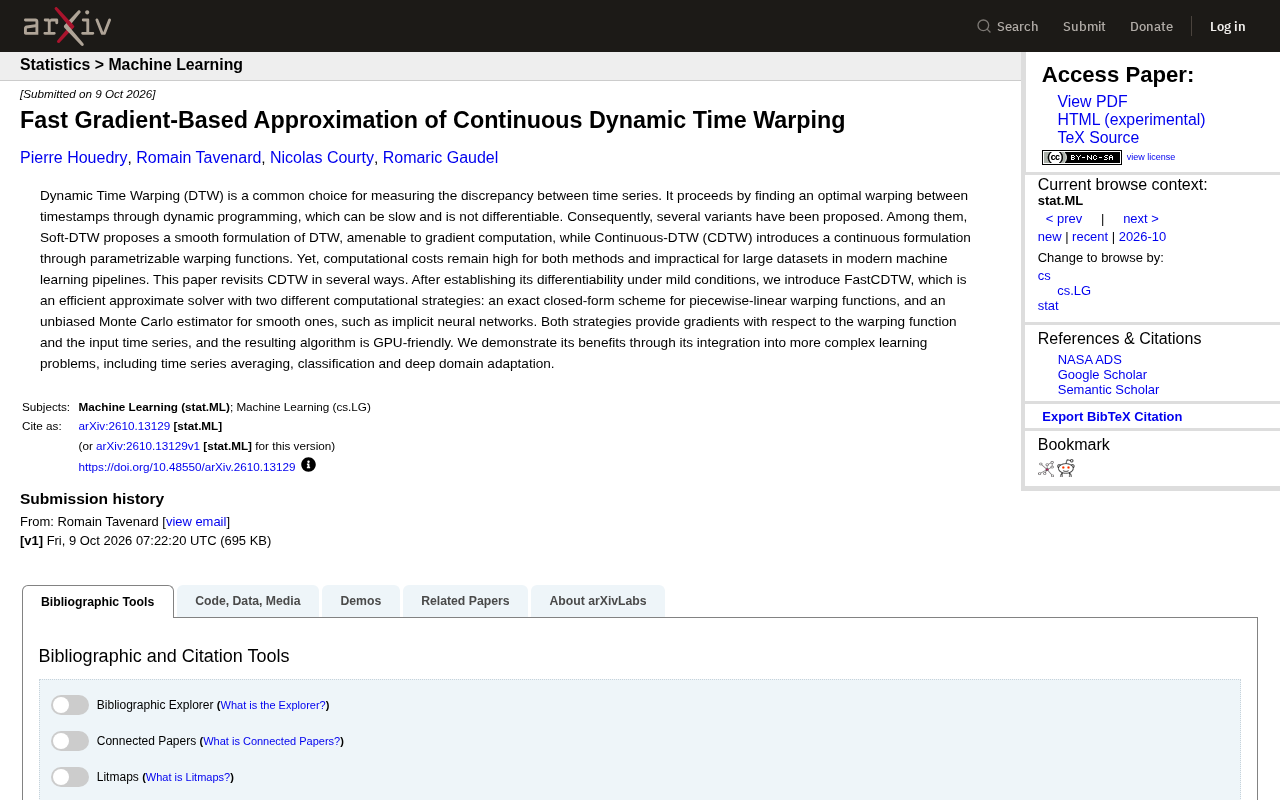
Traditional DTW is non-differentiable and computationally slow, limiting its use in modern machine learning. Existing differentiable variants like Soft-DTW and CDTW address some issues but remain too expensive at scale. This paper proposes FastCDTW, first proving CDTW's differentiability under mild conditions, then introducing a dual-track approximation: exact closed-form solutions for piecewise-linear warping functions and unbiased Monte Carlo estimation for smooth ones parameterized by implicit neural networks. Both approaches yield gradients with respect to warping functions and input sequences, are GPU-friendly, and are validated on time series averaging, classification, and deep domain adaptation tasks.
The Long-Standing Challenge of Time Series Metrics
Dynamic Time Warping (DTW) is one of the most widely used methods for measuring the difference between two time series. Its core idea is to find an optimal "warping" path between time steps via dynamic programming, enabling alignment of sequences that differ in length or tempo. This capability has made DTW a staple in applications such as speech recognition, gesture matching, and financial trend comparison.
However, DTW has two fundamental limitations that are hard to work around. First, its dynamic programming–based solver is slow and becomes prohibitively expensive at scale. Second, DTW is not differentiable, making it impossible to integrate directly into modern machine learning pipelines that rely on gradient-based optimization. In short, using DTW as a loss function or intermediate layer in a neural network is practically infeasible.
Why Existing Variants Still Fall Short
To address the differentiability problem, the research community has proposed several DTW variants. Soft-DTW replaces the hard optimal selection in standard DTW with a smooth softening formula, making the metric differentiable and thus compatible with backpropagation. Another line of work, Continuous DTW (CDTW), introduces a continuous modeling perspective by describing sequence alignment through a parameterizable warping function.
Both approaches address some of the pain points, but neither clears the efficiency hurdle. The computational cost of both Soft-DTW and CDTW remains high, making them impractical on large-scale datasets. For deep learning tasks that routinely process massive time series, a speed bottleneck directly determines whether a method can be deployed in practice.
The key trick in Soft-DTW is replacing the min operation in dynamic programming with a soft-min operator (a smooth approximation based on log-sum-exp), with a temperature parameter γ controlling the degree of smoothing: as γ→0 it recovers standard DTW, while larger γ yields more stable gradients at the cost of metric precision. CDTW takes a different route: it lifts the discrete alignment path to a continuous warping function φ:[0,1]→[0,1], reformulating DTW's cumulative cost as the minimization of a path integral, thereby defining sequence distance in a continuous function space. This continuous perspective opens up a richer parameterization space, but also substantially increases the computational cost of evaluating the integral exactly — and that is precisely the core tension that FastCDTW aims to resolve.
FastCDTW's Core Contributions
This paper revisits CDTW and advances it on multiple fronts. The authors first establish the differentiability of CDTW under mild conditions, providing the theoretical foundation for incorporating it into gradient-based optimization.
Building on this, the paper introduces FastCDTW — an efficient approximate solver. Its elegance lies in designing two complementary computational strategies tailored to different types of warping functions:
Piecewise-Linear Warping Functions: Exact Closed-Form Solutions
When the warping function is piecewise-linear, FastCDTW computes an exact closed-form solution. This means no iterative approximation is needed — the result is computed directly, achieving both accuracy and speed.
Smooth Warping Functions: Unbiased Monte Carlo Estimation
For more general smooth warping functions — such as those parameterized by implicit neural networks — FastCDTW uses an unbiased Monte Carlo estimator. By approximating the integral through random sampling, this approach avoids the high cost of exact computation while maintaining statistical unbiasedness.
Both strategies simultaneously provide gradients with respect to both the warping function and the input time series, and the overall algorithm is GPU-friendly, naturally suited to the parallel computing environments of modern deep learning.
The key advantage of an unbiased Monte Carlo estimator is that its expected estimate of the integral introduces no systematic bias. This means gradients still point in the statistically correct optimization direction, without harming convergence during gradient descent–based training. An implicit neural network, in this context, refers to using a small neural network to directly parameterize the warping function φ itself — rather than specifying its form explicitly. The network takes normalized time coordinates as input and outputs the corresponding alignment position. This dramatically increases the expressiveness of the warping function, capturing arbitrarily complex nonlinear alignment patterns, but at the cost of losing the analytical structure available in the piecewise-linear case — hence the need for stochastic estimation. The pairing of two strategies is essentially an adaptive division of labor between "function complexity" and "computational approach."
Validation on Real Tasks
The paper goes beyond theoretical contributions by integrating FastCDTW into several more complex learning problems, including:
- Time series averaging: Computing the "mean" shape of multiple sequences under warping-based alignment;
- Classification: Using the differentiable CDTW metric in time series classification tasks;
- Deep domain adaptation: Leveraging the alignment metric to reduce distributional discrepancy between source and target domains.
These application scenarios span unsupervised, supervised, and transfer learning settings, demonstrating that FastCDTW is not an isolated metric tool but a differentiable module that can be embedded into end-to-end learning systems of various kinds.
Deep domain adaptation is an important branch of transfer learning, aiming to reduce the gap in feature distributions between a source domain (with labeled data) and a target domain (with no or few labels), so that models maintain strong performance on the target domain. Common approaches minimize some distribution discrepancy measure in feature space — such as MMD (Maximum Mean Discrepancy) or adversarial training. Incorporating FastCDTW into this framework means distributional differences between domains can be measured in terms of temporal alignment — rather than simple pointwise L2 distance — making it particularly natural for time series domain adaptation scenarios where tempo, phase, or rate differ systematically (e.g., sensor signals from different devices, or speech features from different speakers).
Significance and Outlook
The value of FastCDTW lies in combining two goals that were previously difficult to achieve simultaneously: continuous modeling and efficient differentiability. The dual-track design — closed-form solutions for structurally simple cases and Monte Carlo estimation for complex ones — represents a pragmatic balance between engineering and theory: it sacrifices no precision in specific settings while using stochastic approximation to extend to more general function classes.
For researchers and engineers who need to perform alignment, clustering, or transfer learning on large-scale time series, a GPU-friendly, differentiable DTW variant with manageable computational cost means that many ideas previously bottlenecked by efficiency can finally be put into practice. As flexible parameterization approaches like implicit neural networks become more widespread, the application boundaries of such continuous metrics are poised to expand further.
Related articles

Chain of Thought Isn't Just for AI: How Humans Can Use CoT to Improve Thinking Quality
Chain of Thought isn't just a prompt trick for large models. Starting from a Hacker News discussion, this article analyzes why CoT works for human thinking too, breaks down actionable ways to transfer it, and highlights the key differences between human CoT and machine CoT.
Cloudflare Teams Up with OpenAI: Closi…
Cloudflare Teams Up with OpenAI: Closing the Loop from Vulnerability Discovery to Defense with AI
Cloudflare uses OpenAI Daybreak to investigate security vulnerabilities and generate reviewable remediation plans, while developers use Codex to boost coding efficiency and quality.

Orca Multi-Agent Orchestration in Practice: A Guide to Parallel Collaboration with Claude and Codex
Orca is Stable AI's free open-source agent workbench supporting 34 agents like Claude Code and Codex in parallel. Learn its Git worktree isolation, multi-model orchestration, and mobile management.