FastMCP: The Python Toolkit That Simplifies MCP Server Development

FastMCP abstracts MCP protocol complexity so Python developers can build AI tool agents with far less boilerplate.
FastMCP is a Python toolkit purpose-built for MCP Server development. Its core value lies in separating boilerplate concerns — protocol handshakes, tool registration, state management — from business logic, so developers only need to declare their tools and logic. Compared to manual implementation, it can save hours or days of repetitive work, making it especially well-suited for teams rapidly deploying tool-enabled autonomous AI agents. The article also honestly addresses its limitations: the MCP protocol is still evolving quickly, so production deployments require careful evaluation of security, permission models, and operational monitoring — particularly in regulated industries like finance or healthcare.
Why MCP Server Development Needs Dedicated Tooling
MCP (Model Context Protocol) is rapidly becoming a key standard for connecting large language models with external tools and data sources. But building an MCP Server from scratch is no small feat — developers must wrestle with protocol details, state management, tool registration, and a host of other tedious concerns.
As one technical video on YouTube puts it: nobody wants to debug "500 lines of fragile glue code" just to manage state. When your goal is to build a tool-enabled autonomous agent and ship it to production, the underlying boilerplate becomes the biggest obstacle.

This is the core pain point FastMCP sets out to solve. It positions itself as a better Python toolkit specifically designed for building and operating MCP Servers — letting developers focus on business logic instead of reinventing infrastructure.
MCP (Model Context Protocol) was proposed and open-sourced by Anthropic in late 2024 to provide a standardized "tool-calling interface" specification for large language models. By analogy, it functions much like the USB protocol does for hardware peripherals — unifying how LLMs communicate with external tools, databases, and APIs so that tools from different sources can be seamlessly invoked by models from different vendors. The MCP Server is the service-side role in this architecture, responsible for registering and exposing specific tools (such as file I/O, code execution, or database queries) that MCP Clients (typically the LLM host environment) can call on demand. Because the protocol spans JSON-RPC communication, tool metadata descriptions, and session state management, manually implementing a production-ready MCP Server requires substantial boilerplate — which is the direct motivation behind frameworks like FastMCP.
FastMCP's Core Idea: Decoupling Complexity
FastMCP's central design philosophy is to "physically decouple the complexity." It strips away the messy boilerplate and provides a clean, purpose-built architecture dedicated to MCP Server construction.

The immediate benefit: developers no longer need to hand-write and maintain mountains of fragile glue code. Protocol handshakes, tool exposure, and state management are all encapsulated by the framework — you simply declare your tools and business logic.
Build It Yourself vs. Use a Framework?
The video raises a question many engineers ask: why not just roll your own? The answer comes down to return on investment. Building your own solution means you alone bear the cost of protocol evolution, edge cases, and ongoing maintenance. A mature framework, by contrast, can save hours or even days of repetitive development work.
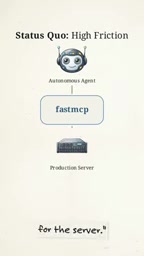
For teams looking to quickly validate an idea or ship a product, that time savings is especially valuable. The framework absorbs the complexity of the protocol layer, dramatically accelerating iteration speed.
Trade-offs to Consider Before Going to Production
That said, the video is honest about an important caveat: the MCP protocol itself is still evolving rapidly. This means that before placing FastMCP on any critical path, production-grade security and operational readiness require careful evaluation.
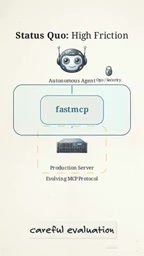
In other words, FastMCP excels at eliminating boilerplate burden during development — but protocol maturity, security auditing, monitoring, and alerting in production are still the developer's responsibility. For an early-stage technology stack, this is expected, and it's a reality that must factor into any adoption decision.
When Is It the Right Fit?
Overall, FastMCP is best suited for teams that want to deploy robust, tool-enabled AI agents without maintaining fragile boilerplate. Its decoupled architecture is purpose-built for exactly this problem.
If your project demands extremely high protocol stability — or operates in a heavily regulated domain like finance or healthcare — a more thorough evaluation and hardening process is recommended before going live.
The "rapid evolution" of the MCP protocol translates to several concrete risks in practice: interface specifications may introduce breaking changes that require updates to existing implementations; the permission model and sandboxing mechanisms for tool calls are not yet fully standardized, leaving the attack surface somewhat ambiguous; and when an LLM gains access to high-privilege tools like file system access or code execution through MCP, the impact of prompt injection attacks is significantly amplified. A production readiness checklist should therefore typically include: a version-locking strategy for both the framework and the protocol, authentication and audit logging for tool calls, and input validation for tool invocations driven by LLM outputs. For internal tooling or prototype validation on non-critical paths, these risks are generally acceptable. Once external user data or high-privilege operations are involved, an additional security hardening layer becomes necessary.
Summary
FastMCP represents one direction in the maturing MCP ecosystem toolchain — by encapsulating protocol complexity and eliminating boilerplate, it lets Python developers focus on building agent capabilities rather than infrastructure. The productivity gains during development are clear, but it's equally important to recognize that MCP itself is still evolving, and production deployments warrant careful evaluation. For developers looking to quickly build tool-augmented AI agents, this is a toolkit worth watching.
Related articles

Perplexity Open-Sources SPACE: Firecracker MicroVM Sandboxes Built for AI Agents
Perplexity open-sources SPACE, a Firecracker microVM sandbox for AI Agents. Each task runs in its own microVM with credentials and egress controlled externally. Apache 2.0 on GitHub.

Six Memory Control Bugs Hit Anthropic's Coding Agent in a Single Week
Six interconnected memory control bugs surfaced in Anthropic's coding agent in one week, covering remote compaction, lost decisions, and reload failures. HyperMarrow's author analyzes the root causes and proposes five design rules, arguing agent memory should be user-owned storage, not runtime-internal state.

Ace Menu Bar Tool Quick Start: A Desktop Study Companion for Students at a Glance
Ace is a Mac menu bar desktop study companion that turns lectures into notes and flashcards and supports real-time translation. Here's a look at its core features, target users, and how to get it free.