FDE Enterprise AI Deployment in Practice: Why 90% of Traditional Enterprise AI Projects Fail

Enterprise AI projects fail not from weak technology, but from poor business understanding, data silos, and unmeasurable ROI.
A large share of traditional enterprise AI projects look great as demos but collapse in production. An FDE (Forward Deployed Engineer) tutorial identifies three core failure drivers: large models can't access enterprise private data, ROI is impossible to quantify for leadership, and business teams operate in silos from security and compliance. A financial expense reimbursement case study shows how OCR noise, duplicate invoice detection, and implicit reimbursement policies — invisible during a polished demo — become production-level disasters. The FDE role emerges as the answer: unlike engineers who just implement specs, FDEs conduct deep on-site business research and own the full delivery chain. The key takeaway: map out your business rules, data access plan, and ROI metrics before building any demo.
From Demo to Production: The Real Gap in Enterprise AI Projects
In recent years, many traditional enterprises have been trying to embrace large language models, but the success rate of actually deploying AI projects into production environments remains low. A Bilibili content creator, in their FDE (Forward Deployed Engineer) enterprise deployment tutorial, makes a core point: the reason so many traditional enterprise AI projects have failed over the past few years isn't that the technology wasn't advanced enough — it's that projects look great as demos but die the moment they hit production.
This observation deserves serious consideration. Many developers can quickly build a RAG-based Q&A system or an Agent prototype, run it, and get impressive demo results. But once it's connected to a real enterprise business system — with production-level requirements for stability, security, scalability, and maintainability — the project struggles to survive. What enterprises need isn't a demo that runs; it's a system that genuinely reduces costs, improves efficiency, and generates real business value.
Three Major Roadblocks to Enterprise AI Deployment
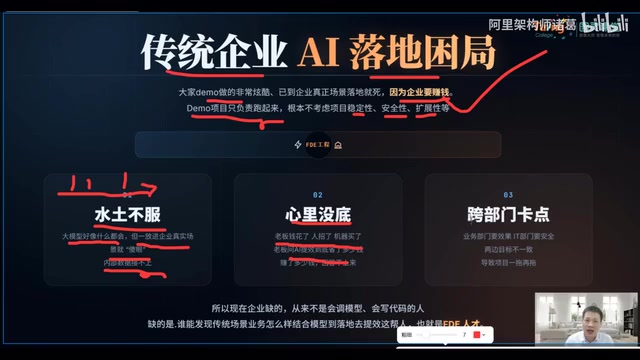
The tutorial categorizes the reasons traditional enterprise AI deployments fail into three layers — an analytical framework worth examining.
Smart Models That Can't Reach Your Business Data
The first obstacle is the disconnect between models and business data. Large models may seem omniscient, but once they enter real-world scenarios in industries like finance, law, or energy, they often hit a wall — because they can't connect to an enterprise's private data. The proprietary knowledge, historical records, and implicit business rules within these industries simply aren't part of any model's public training corpus.
This problem is typically addressed technically through RAG (Retrieval-Augmented Generation): vectorizing private enterprise documents and database content, storing them in a vector database, and dynamically retrieving relevant snippets as context at inference time. But RAG is no silver bullet. In production, engineering challenges around data cleaning quality, retrieval recall rates, document update frequency, and permission isolation all significantly impact real-world performance. For heavily regulated industries like finance and healthcare, there are also data security compliance hurdles around whether private data can leave the internal network or move to the cloud — further complicating integration.
Massive Investment, Unmeasurable ROI
The second obstacle is the inability to quantify return on investment. According to the tutorial author, eight or nine out of ten executives want to embrace AI, and many companies have spent heavily on hiring, hardware, and compute. But when leadership asks, "How much has this project improved efficiency, reduced costs, or generated revenue?" — the team has no answer. Enterprises exist to generate profit, not to build demos.
Business Teams and Security Reviews Operating in Silos
The third obstacle is fragmented internal collaboration. Business teams focus on outcomes; security and compliance teams focus on regulations. When their standards don't align, Agent or fine-tuning projects stall mid-execution.
The FDE Role: A Critical Position in the AI Era
These pain points are precisely what gave rise to one of the most important roles in the large model era — the FDE (Forward Deployed Engineer). The tutorial argues this role is particularly well-suited for experienced professionals looking to transition: traditional architects, Java/Python developers, front-end engineers, and other seasoned practitioners.
The key difference between an FDE and a traditional engineer is this: conventional technical engineers "just write code — they don't understand the business or manage requirements" and simply implement whatever document they're handed. An FDE, by contrast, conducts deep on-site business research, thoroughly analyzes users' vague requirements, and balances stability, security, and real-world deployment outcomes. It's an upgrade from being a "construction crew" to being someone who understands both design and construction.
According to the tutorial author, the course covers seven enterprise-level projects spanning scenarios including financial expense reimbursement, intelligent logistics, medical records, smart dispatch, e-commerce customer service, beverage industry marketing, and defense/state-owned enterprise alert monitoring — attempting to cover AI transformation needs across multiple traditional industries.

The FDE (Forward Deployed Engineer) role was first systematically defined and popularized by Palantir. Palantir's FDE model requires engineers to be embedded long-term at customer sites, handling not just software deployment and technical integration, but also requirements analysis, business modeling, and solution consulting. This is fundamentally different from the traditional software company model of "pre-sales + implementation + development" as three separate functions — the FDE emphasizes a single person owning the full chain from business understanding to engineering delivery. The wave of large model deployments has caused demand for this role to surge, because the value of LLM projects is highly dependent on deep understanding of business context, and engineers with purely technical backgrounds struggle to independently close the loop from discovery to deployment.
Case Study: Why a Financial Expense Reimbursement Multimodal Project Failed
The tutorial uses a real-world enterprise financial expense reimbursement multimodal project as its primary case study, retrospectively examining where the traditional development process broke down.
Where the Traditional Process Breaks Down
A typical failure path looks like this: the business stakeholder (a CFO) submits a one-line requirement — "build a system that automatically reviews invoices"; a finance manager compiles the requirement into a document without any on-site investigation; a technical engineer receives the document, builds a PoC (Proof of Concept) demo, gets executive sign-off, and kicks off development; once development is complete, it goes live and connects directly to the real business system.
The problem: if the requirements document is written by someone without sufficient understanding, it becomes an "incomplete document." Developers implement exactly what it says, and the final product diverges dramatically from actual business needs.
PoC (Proof of Concept) is a common phase before software projects are formally greenlit, designed to validate technical feasibility at minimum cost. However, in AI projects, the data used during the PoC phase is typically hand-picked "clean samples," with demo scenarios carefully curated — making model performance appear far better than the real-world average. This "PoC illusion" is one of the structural reasons AI projects experience such dramatic drops between approval and production: decision-makers approve the project based on PoC results, but in production, noisy data, edge cases, and implicit business rules flood in and performance plummets. Running stress tests with data that approximates real-world distribution before starting formal development is an effective way to mitigate this risk.
Disaster Upon Launch
Once connected to a real environment, problems erupt all at once. Using invoice recognition as an example:
- Inaccurate OCR: Physical invoices, digital invoices, glare from photography, and handwritten notes can all cause field loss or recognition errors;
- Difficulty detecting duplicate invoices: The system may fail to identify invoices submitted for duplicate reimbursement;
- Implicit business rules the model simply doesn't know: For example, hotel reimbursement caps differ between Tier 1 and Tier 2 cities; taxi rides after 9 PM aren't reimbursable — these internal company policies are invisible to a large model.
For financial use cases, data accuracy requirements are extremely high — a single incorrect digit can cause significant financial damage to the company. These are exactly the kinds of failures that never surface in a carefully constructed demo, yet become catastrophic in production.

Content Assessment: Valuable Insights, but Keep Perspective
The core insight this tutorial offers — that the hard part of enterprise AI deployment is business understanding, private data integration, and ROI quantification, not the technology itself — genuinely addresses real industry pain points. The rise of the FDE role also reflects a genuine market need for talent that bridges technical depth and business deployment expertise.
That said, some perspective is warranted. The original content is presented in a live-stream format, with significant repetition and marketing cues (repeated calls to "like and subscribe"), and the specific technical solutions and architectural details are not thoroughly developed. For developers who genuinely want to enter the FDE space, this type of content is better treated as a conceptual framework for orientation — actual skill development still requires systematic project practice and engineering experience.
For traditional enterprises pushing forward with AI transformation, this analysis at least provides a useful checklist: before launching a project, clarify whether business rules have been mapped out, how private data will be integrated, and how ROI will be measured. That groundwork may matter far more than rushing to build an impressive demo.
Related articles

Understanding DeepSeek in 3 Minutes: The Rise from a Quant Hedge Fund to an Open-Source AI Leader
DeepSeek's history in 3 minutes: from High-Flyer Quant's compute build-up to V2's MLA inference cost cuts, V3's $5.576M training bill, R1's open-source global shock, and V4 with a $7B Series A.

Local Creative Writing Model Showdown: Fine-tuned Qwen3.8 27B Wins, DeepSeek v4.1 Underwhelms
Bilibili creator tests seven local creative writing models: Hemingway and HumanLike Chat based on Qwen3.8 27B perform best, DeepSeek v4.1 is plain, Dongfang Shuo ranks last with confused characters. Includes three test prompts, scores, and usage advice.

Liang Wenfeng's Three Big Bets: Why Did DeepSeek Open-Source Its 82% Gross Margin?
Why did DeepSeek open-source DeepInfer, its 82% gross margin inference framework, and then launch a hundred-billion funding round? An analysis of Liang Wenfeng's three big bets and the open-source strategy.