FDE (Forward Deployed Engineer): The Hottest Cross-Disciplinary New Career in the AI Era

FDE is the translator of AI implementation, bridging the gap between model capabilities and business value
FDE (Forward Deployed Engineer) is a new role born as AI shifts from general large-model competition to deep vertical industry cultivation. ByteDance, Meituan, Alibaba, Tencent, and top overseas large-model companies are all hiring heavily. Its rise stems from three drivers: scenario adaptation needs, industry trust reconstruction, and the dynamic evolution characteristics of AI applications. FDE is neither a pure technical role nor a pure business role, but a cross-disciplinary translator who goes deep into client front lines with both technical depth and business acumen. It originated from Palantir's military intelligence practice and has now become the mainstream delivery model for AI commercialization. The article also provides a four-step roadmap for ordinary people to enter the field: prompt engineering, knowledge base construction, Agent workflows, and real-world scenario practice.
A New Role on the Rise: What Exactly Is an FDE?
Recently, a new role called FDE has been appearing with increasing frequency in the job market. ByteDance, Meituan, Alibaba, and Tencent are all hiring, and top overseas large-model companies are scrambling to snap them up, with salaries reaching the $400,000 range.
FDE stands for Forward Deployed Engineer. Fresh graduates with English proficiency can command a starting salary equivalent to 35,000 RMB, and there's no need to worry about being replaced by AI—this is becoming reality.
The role isn't strict about your academic background, and it's equally friendly to liberal arts graduates. Its core logic isn't about having you grind through low-level algorithms, but about making you a "translator" between AI capabilities and business value.
Why Is FDE Suddenly Booming?
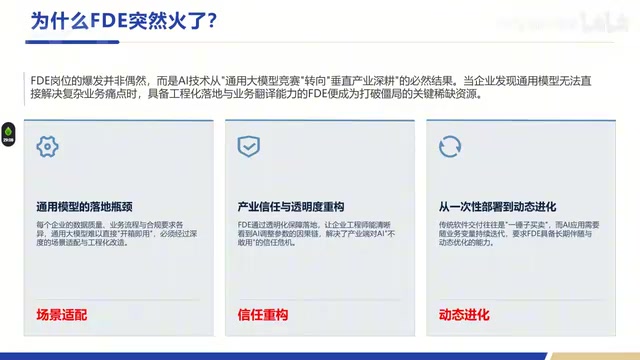
The surge in FDE positions is no accident—it's the inevitable result of AI technology shifting from general large-model competition toward deep vertical industry cultivation. When enterprises discover that general-purpose models can't directly solve business pain points, FDEs with engineering implementation and business translation capabilities become the critical scarce resource that breaks the deadlock.
There are three important dimensions here:
Scenario adaptation. Every enterprise has different data quality, business processes, and compliance requirements. General-purpose large models can't be used out of the box—they require deep scenario adaptation and engineering transformation.
Trust reconstruction. Through transparent safeguards, FDEs enable enterprise engineers to clearly see the entire causal chain of parameter tuning, resolving the industry's trust crisis of "not daring to use" AI.
Dynamic evolution. Traditional software is typically a one-time deal, but AI applications need continuous iteration as business changes, requiring FDEs to have long-term accompaniment and dynamic optimization capabilities.
These three factors combined explain why both the salary and demand for this role are climbing rapidly.
The relationship between RAG (Retrieval-Augmented Generation) and knowledge base construction. RAG is currently one of the most mainstream technical paths for enterprises to implement AI. It refers to retrieving relevant document fragments from an enterprise's own knowledge base before calling a large model to generate an answer, then feeding the retrieved results as context to the large model—so that outputs are grounded in evidence and hallucinations are reduced. It solves the problem of general-purpose large models not understanding enterprise-internal knowledge, and it's also the most commonly used method for FDEs when helping enterprises with implementation. The "knowledge base construction" mentioned in this article is precisely the application-layer practice of RAG.
FDE's Role Positioning: Neither Pure Tech Nor Pure Business
FDE is not a pure technical engineer in the traditional sense, nor a researcher staying in a lab. It's more like a cross-disciplinary translator with both technical depth and business acumen.
Externally, FDEs go deep into the front lines to uncover pain points, acting as value consultants who understand clients' real needs. Internally, FDEs overcome data and system compatibility challenges, acting as solution builders who ensure models run stably in production environments.
There's a key difference between FDE and traditional IT implementation consultants: FDE emphasizes understanding the underlying AI logic, including the ability to embed physical laws into models, making technical decisions explainable.
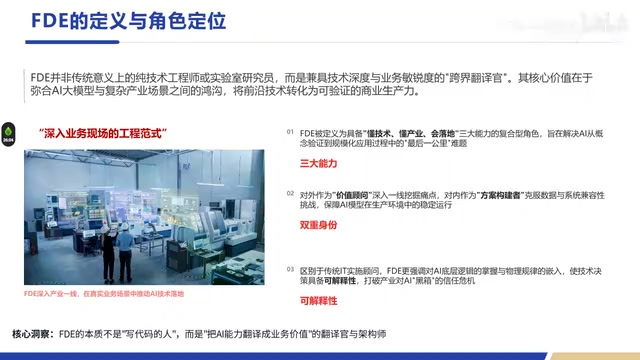
This directly breaks the industry's trust crisis over the AI "black box."
In summary, the essence of FDE is not the person who writes code, but the translator and architect who converts AI capabilities into business value.
From Palantir to OpenAI: The Evolution of Forward Deployment
The concept of forward deployment originated in the military domain. The earliest trace can be found in U.S. intelligence agencies, where Palantir pioneered the work model of stationing technical personnel directly at client sites to fight side by side, in order to solve the predicament of engineers being unable to access dense data.
Subsequently, Palantir institutionalized this model into a two-person collaboration mechanism—one person responsible for uncovering needs, another for technical implementation. This formed the methodological foundation of FDE.
What truly brought this model to scale was in recent years. As AI deeply penetrated various industries, top AI companies like OpenAI began building large-scale FDE teams, marking this model's transition from military front lines to commercial battlefields.
The domestic market is following suit. Large-scale AI implementations in finance, government affairs, and manufacturing all require large numbers of FDEs, but composite talents who understand both technology and business are extremely scarce.
Palantir's two-person collaboration mechanism. This mechanism is commonly known as the "Echo/Delta" division of labor model: the Echo role is responsible for going deep into client sites, understanding business pain points, and defining requirements; the Delta role is responsible for technical implementation and engineering execution. The two work in pairs on-site and iterate rapidly. This methodology was later borrowed by a large number of AI companies and became the standard collaboration architecture for FDE teams. It places "understanding business" and "understanding technology" into the same combat unit, avoiding the information loss between requirements and delivery under the traditional B2B model.
The Essential Difference Between FDE and Traditional Roles
Many people think FDE is just a more advanced version of technical outsourcing or implementation. Actually, they're completely different.
Traditional algorithm engineers only care about accuracy in the lab, not noise on the factory floor. Traditional implementation only cares about selling and installing standard software.
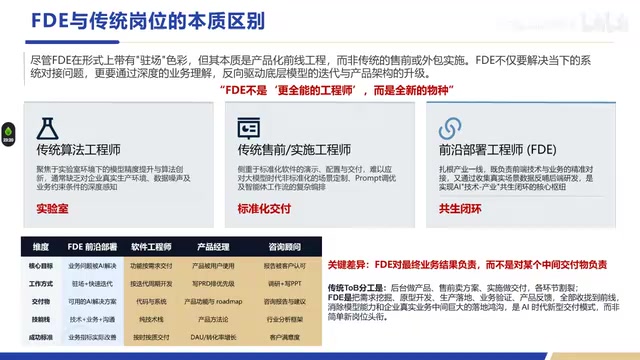
FDE, however, is productized frontline engineering—it needs to feed real frontline data back to the backend, reverse-driving the iteration of underlying models.
The real dividing line is this: traditional roles guard their own deliverables—once deployment is complete and the ticket is closed, they consider the job done. But FDE guards whether the client's business problem is truly solved.
Traditional B2B division of labor often has the backend building products, pre-sales selling solutions, and implementation delivering them—each stage quite fragmented. FDE consolidates requirement discovery, prototype development, production deployment, business validation, and product feedback delivery all at the front line, eliminating the enormous implementation gap between model capabilities and enterprises' real business needs.
How Can Ordinary People Enter This Field? A Four-Step Roadmap
To seize this wave of opportunity, you don't need to grind through low-level algorithms right away. Just follow four steps:
Step 1: Learn prompt engineering. Understand how to make large models stably output what you want. Once you've learned this, you can build your first working thing—auto-generating daily reports, auto-analyzing comments, auto-writing sales pitches. Go from "knowing how to use AI" to "being able to command AI."
Step 2: Learn knowledge base construction. Learn to feed an enterprise's own materials to AI so it answers with evidence. This is the most commonly used and most impressive skill for FDEs when helping enterprises with implementation.
Step 3: Learn Agent workflows. Learn to chain multiple AIs into an automated pipeline, where one task goes from input to output fully automatically. This step corresponds to FDE's most core delivery capability—turning a vague business requirement into a working automated workflow.
Step 4: Practice with real scenarios. Don't wait for someone to teach you—pick a workflow around you and redo it with AI yourself. As long as it actually runs, it's not a toy—it's your FDE portfolio and your strongest confidence in interviews.
Where Are FDE's Talent Barriers?
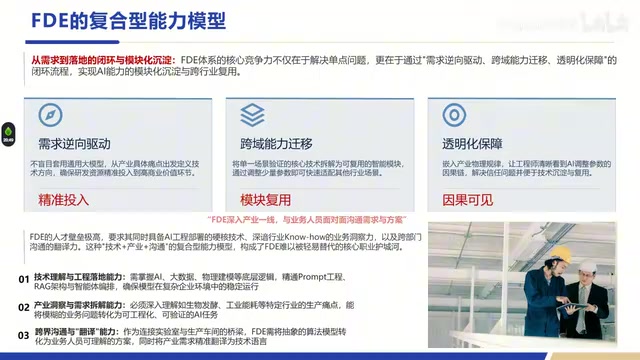
FDE has very high talent barriers—it's not something you can handle by casually writing a few lines of code.
Technical foundation must be solid. You need to understand the underlying logic of large models, RAG, and agent orchestration.
Industry insight must be deep. For example, if you're doing AI for a distillery, you need to understand fermentation processes.
Communication and translation skills are the hardest. You need to translate lab jargon into plain language that a workshop supervisor can understand, while also translating workshop pain points into requirement documents that R&D can understand.
All three are indispensable, and together they form FDE's career moat.
In terms of specific capabilities, FDE insists on reverse-driven requirements—not blindly applying large models, but defining requirements starting from industry pain points, ensuring R&D resources are precisely invested in high-value areas. At the same time, it decomposes validated core technologies into reusable intelligent modules that can be quickly adapted to different industry scenarios by adjusting a small number of parameters.
FDE's scarcity is also reflected in the fact that it solves the "last mile" problem of AI from proof of concept to scaled application. What enterprises need is not a smarter model, but someone who can make the model truly work in specific business contexts. This may be FDE's most core value today.
Agent workflows and agent orchestration. An Agent (intelligent agent) refers to a program unit driven by a large model that can autonomously call tools, decompose tasks, and execute multiple steps. An Agent workflow chains multiple Agents together in a business-logic-driven automated pipeline—for example, one responsible for retrieving materials, one for generating reports, and one for checking compliance. Agent orchestration refers to the ability to design and schedule this pipeline, involving task decomposition, tool invocation, state management, and exception handling. This is also the key technical threshold for FDE to advance from "knowing how to use AI" to "delivering automated workflows."
Related articles

Former Cursor Engineer: Is Agent Harness Dead? The Data Flywheel and Three Things the Model Can't Absorb
Former Cursor Agent Harness engineer Jediah Katz breaks down Harness evolution: how the data flywheel lets models absorb coding skills, why Harness isn't dead, and why infrastructure, trust, and efficiency can't be absorbed by models.

Cursor Practical Guide: Core Features of the AI Programming Tool and Development Efficiency Comparison
A deep dive into the Cursor AI programming tool from a Bilibili tutorial: AI-native design, intelligent code generation, context awareness, and efficiency comparisons with VS Code across completion, debugging, and refactoring, plus target user analysis.

Trump's Request to Rename the Atlantic Rejected by Google; 1Password Lets AI Agents Log In Securely
The Vergecast roundup: Trump's request to rename the Atlantic the 'Trump Ocean' was politely declined by Google's CEO; 1Password's new feature lets AI agents log into accounts without touching passwords; OPPO launches the world's first 200-megapixel phone, the Find X10 Pro Max. All three point to the boundaries of tech authorization and trust.