FDE Forward Deployed Engineer: The New Species of AI Implementation and Practical Pathways

FDE is the key role bridging the gap between products and client needs in the AI era, requiring both technical and business skills.
The article systematically breaks down the FDE (Forward Deployment Engineer) role. FDE originated from Palantir's deep customization practice, with the core being sitting at the client site and distilling customized deliveries into reusable product capabilities. In the AI era, declining on-site customization costs and rising enterprise customization demands make FDE scaling possible. The technical competency stack shows a gradient: agent development and private deployment as the starting point, fine-tuning to break through effect ceilings, and reinforcement learning and pre-training as advanced levels. The biggest bottleneck for enterprise implementation is the lack of validation methods for fine-tuning effects. Enterprise-level deployment recommends 8B+ models, with budgets diverging significantly.
FDE Forward Deployed Engineer: The New Species of AI Implementation and Practical Pathways
AI implementation is hard—the difficulty lies in the gap between technology and business. A role called FDE (Forward Deployment Engineer) is becoming the key to bridging this gap. Based on insights from frontline practitioners, this article breaks down the origins, competency model, and practical pathways of FDE.
What Is FDE: An Engineer Sitting at the Client Site
FDE stands for Forward Deployment Engineer. Its core definition is straightforward: an engineer who sits at the client site to bridge the gap between product capabilities and the client's real needs.
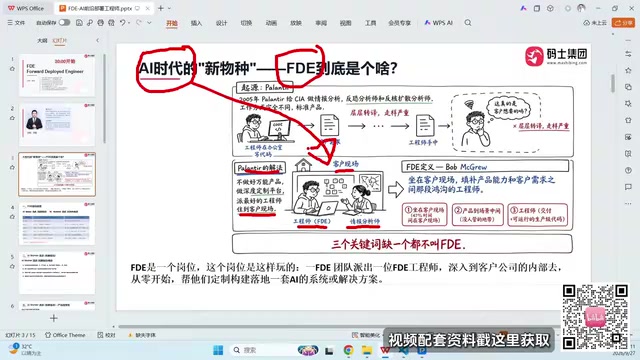
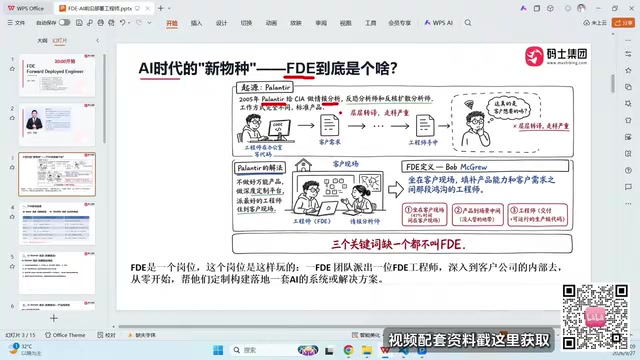
This concept didn't emerge from thin air. According to the sharing practitioner, the practice of FDE can be traced back to companies like Palantir—when building intelligence analysis projects for government agencies, they found that standardized products were often designed by programmers "brainstorming" in the office, with requirements severely distorted after layers of relay. Palantir's solution was not to build a universal product, but to build a deeply customized platform and send their best engineers to work on-site with clients.
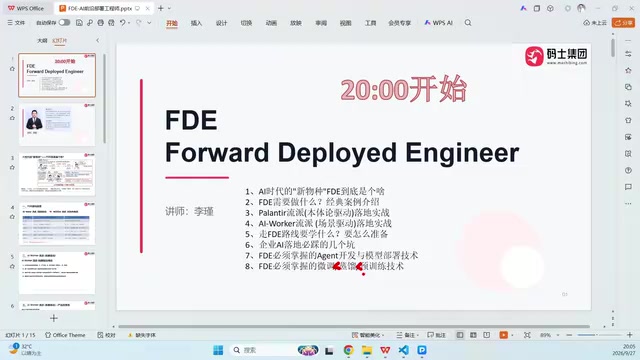
This is fundamentally different from traditional outsourcing. Outsourcing is "take one project, do one project"—when the client changes, the previous code is hard to reuse. FDE requires that every on-site delivery can be distilled into product capability—when the client changes, you only need to adjust parameters, environment, and variables to deploy quickly. Whether you have "product reuse" capability is the key watershed that distinguishes FDE from ordinary on-site development.
Palantir Model: Palantir is a U.S. big data analytics company founded in 2003, with early clients mainly U.S. government intelligence agencies. Its core products Gotham and Foundry are not out-of-the-box standardized software, but platforms that require engineers to deeply engage in customizing client business processes. Palantir's uniqueness lies in stationing its best engineers (called "forward deployed engineers" or "deployment strategists") at client sites long-term, working alongside analysts and operators, continuously abstracting reusable product modules while solving specific problems. This dual-wheel model of "on-site customization + product distillation" has enabled Palantir to build extremely high client stickiness in counterterrorism, military, and financial risk control domains, and has become the prototype for the FDE concept.
Why FDE Only Emerged in the AI Era
A natural question: on-site service existed in the software outsourcing era, so why has FDE only become a buzzword in the AI era?
The answer lies in the cost structure. In the past, sending a core engineer with an annual salary of 800,000 RMB to a client site meant the company bore a million-level labor burden, while client requirements often expanded continuously during communication, making the input-output ratio extremely unfavorable. Therefore, most companies were unwilling to put their best engineers on the front line.
AI changed two things. First, model and agent technologies made "rapid prototyping and rapid validation" possible, dramatically reducing the marginal cost of on-site customization. Second, enterprise clients' expectations for AI implementation shifted from "buying a standard SaaS" to "solving my specific business problem," making standardized products increasingly difficult to deliver value directly. With both supply and demand sides changing simultaneously, the FDE role finally has the soil for规模化 existence.
FDE Competency Stack: From Agent Development to Fine-tuning
What preparation is needed to pursue the FDE path? The practitioner provided a clear gradient of technical pathways.
The first layer is AI Agent development and private model deployment. This is the entry point and also the part that most enterprise projects implement first.
The second layer is fine-tuning. In many scenarios, agent orchestration alone cannot meet acceptance criteria. The practitioner used a vivid metaphor: if the business requires a score of 95, agent development alone might cap at 90. Fine-tuning is the necessary means to break through the ceiling.
The third layer is reinforcement learning and pre-training. In terms of difficulty ranking, fine-tuning is less than reinforcement learning, and reinforcement learning is less than pre-training. The practitioner advises against tackling pre-training first, and instead advancing in the order of "Agent development → private deployment → fine-tuning → reinforcement learning."
A detail: for enterprise-level deployment, it's now generally recommended to use models of at least 8B; models below 8B have little significance in actual business. Hardware costs are an unavoidable reality: a set of NVIDIA GPUs may require million-level investment. Financial and healthcare clients may accept procurement orders over 2 million RMB, but traditional enterprises may only be willing to budget 20,000 RMB for AI transformation—this budget divergence directly determines the form and depth of FDE projects.
Fine-tuning: Fine-tuning refers to further training model parameters on top of a pre-trained large model using domain-specific labeled data to adapt it to downstream tasks. Compared to prompt engineering or agent orchestration, fine-tuning can more fundamentally change the model's behavioral patterns—the former schedules within the model's existing capability boundaries, while the latter attempts to expand the boundaries themselves. Fine-tuning data requirements typically range from hundreds to tens of thousands of examples, with costs depending on model size and training method (full-parameter fine-tuning or parameter-efficient fine-tuning like LoRA). The core challenge is not training itself, but effect validation: how to design a credible evaluation set to quantify differences in business metrics before and after fine-tuning—this is what enterprise clients care about most.
Reinforcement Learning and Pre-training: In AI implementation, reinforcement learning (RL) usually refers to reinforcement learning from human feedback (RLHF) or reinforcement learning from verifiable rewards (RLVR), used to optimize model decision strategies on specific tasks, typically applied in complex reasoning, code generation, and similar scenarios. Pre-training is training a foundation model from scratch using massive general corpora, requiring thousands of GPUs and millions of dollars in investment—usually only model vendors or a very few top-tier enterprises venture into this. For FDE, reinforcement learning is an advanced method after fine-tuning, applicable when fine-tuning still cannot meet acceptance criteria and the task has clear reward signals; pre-training is essentially beyond the capability boundary of a single project and is more of a knowledge background for understanding where model capabilities come from.
Real-world Pitfalls of Enterprise Implementation: Why Fine-tuning Stalls
The practitioner mentioned a common misconception: many companies don't "lack the conditions for fine-tuning" but "are unwilling to fine-tune." The core bottleneck is validation—how to quantitatively compare performance before and after fine-tuning? If the enterprise itself cannot perceive improvement, or even feels it's "getting worse with tuning," it's hard to convince decision-makers to invest hundreds of thousands in manpower or outsourcing fees.

This reveals a fact often overlooked from a technical perspective: FDE is not only a technical role but also assumes product manager responsibilities. At the client site, engineers must directly face ambiguous requirements, budget constraints, and negotiation over acceptance criteria. Whether technical value can be translated into business benefits the client can perceive often determines project success more than the model itself.
From an industry distribution perspective, deep customization services similar to the Palantir model are not uncommon in China, especially in scenarios with long-term cooperation such as government affairs and finance. The localized practice of FDE is spreading from a few pioneers to more enterprises.
8B Model Threshold: 8B refers to models with approximately 8 billion parameters, one of the mainstream specifications for current open-source models (such as Llama 3 8B, Qwen 2.5 7B/14B, etc.). Parameter count is directly related to the model's knowledge capacity and reasoning ability: models below 8B often struggle with complex instruction following, multi-step reasoning, and domain knowledge coverage, making it difficult to meet enterprise-level business acceptance standards. Models above 8B have significantly higher hardware requirements—for example, inference at FP16 precision requires about 16GB of VRAM for an 8B model, and over 140GB for a 70B model, usually requiring multi-GPU parallelism. This is why hardware costs for enterprise-level deployment easily reach million-level, becoming a key variable in FDE project budget divergence.
Final Thoughts
The essence of FDE is to advance AI capabilities from "can demo" to "can pass acceptance." It requires engineers to possess algorithmic foundations, engineering skills, and business communication abilities simultaneously, and requires organizations to accept the dual-wheel logic of "on-site customization + product distillation." For individuals, starting from agent development and progressively deepening into fine-tuning and reinforcement learning is a relatively pragmatic growth path; for enterprises, clarifying acceptance criteria first before deciding whether to invest in fine-tuning is more important than blindly chasing new technologies.
One-line Summary
FDE is the key role bridging the gap between products and client needs in the AI era, requiring both technical and business skills.
Paragraph Summary
The article systematically breaks down the FDE (Forward Deployment Engineer) role. FDE originated from Palantir's deep customization practice, with the core being sitting at the client site and distilling customized deliveries into reusable product capabilities, fundamentally different from ordinary outsourcing. In the AI era, declining on-site customization costs and rising enterprise customization demands make FDE scaling possible. The technical competency stack shows a gradient: agent development and private deployment as the starting point, fine-tuning to break through effect ceilings, and reinforcement learning and pre-training as advanced levels. The biggest bottleneck for enterprise implementation is not technical conditions but the lack of validation methods for pre/post fine-tuning effects, leading decision-makers to be unwilling to invest. FDE also needs to serve as product manager, translating technical value into business benefits. Enterprise-level deployment recommends models of 8B or above, with budgets diverging明显 from 20,000 to over 2 million RMB.
Related articles

Chain of Thought Isn't Just for AI: How Humans Can Use CoT to Improve Thinking Quality
Chain of Thought isn't just a prompt trick for large models. Starting from a Hacker News discussion, this article analyzes why CoT works for human thinking too, breaks down actionable ways to transfer it, and highlights the key differences between human CoT and machine CoT.
Cloudflare Teams Up with OpenAI: Closi…
Cloudflare Teams Up with OpenAI: Closing the Loop from Vulnerability Discovery to Defense with AI
Cloudflare uses OpenAI Daybreak to investigate security vulnerabilities and generate reviewable remediation plans, while developers use Codex to boost coding efficiency and quality.

Orca Multi-Agent Orchestration in Practice: A Guide to Parallel Collaboration with Claude and Codex
Orca is Stable AI's free open-source agent workbench supporting 34 agents like Claude Code and Codex in parallel. Learn its Git worktree isolation, multi-model orchestration, and mobile management.