FDE in Practice: The Complete Enterprise Project Pipeline from Vague Requirements to Agent Deployment

As coding gets easier, the real premium shifts to FDEs who can take vague requirements all the way to working delivery.
As LLMs and Agents make building demos trivial, the real challenge has moved to business understanding, solution design, and production delivery. This article introduces the FDE (Forward Deployed Engineer) role — sitting at the intersection of business and engineering — and walks through a complete enterprise project pipeline: from market research and business modeling to product prototyping, Docker deployment, and delivery documentation. End-to-end delivery capability is the most undervalued skill in AI roles today, and the ideal centerpiece for a job-seeker's portfolio.
When AI Makes Coding Easier, the Skills That Actually Matter Have Shifted
Large language models and Agent capabilities are advancing rapidly, making it faster than ever to build a working demo or implement a specific feature. But this creates a counterintuitive outcome: as "getting things built" becomes less scarce, the skills that truly command a premium have started to shift.
In traditional software projects, development itself was the hardest part. Now, the problems that actually frustrate enterprises haven't disappeared with technological progress — clients often can't articulate what they really want, business objectives remain fuzzy, data is scattered across different systems, and workflows, permissions, and team dynamics all vary. An AI application that looks polished in a demo environment can immediately run into a cascade of unexpected issues the moment it enters a real business setting.
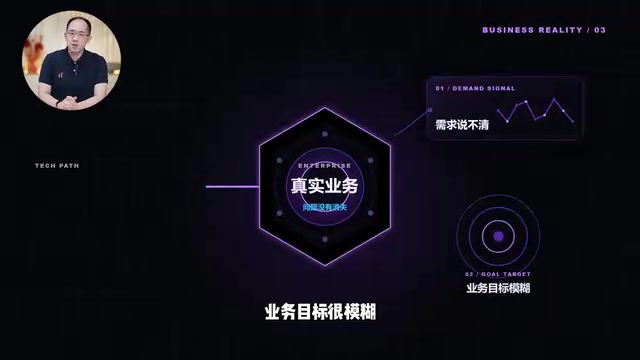
In other words, what's scarce is no longer "being able to build it" — it's "being able to make it land." The rare skill is finding someone who can understand the business, diagnose the problem, design a solution, do the engineering, and drive AI all the way into a real operational context until it's usable, verifiable, and genuinely delivering value.
What Exactly Is an FDE?
An FDE (Forward Deployed Engineer) stands at the intersection of business and technology. It's not purely a pre-sales role, not a product manager, and not a traditional developer whose job begins and ends with writing code.
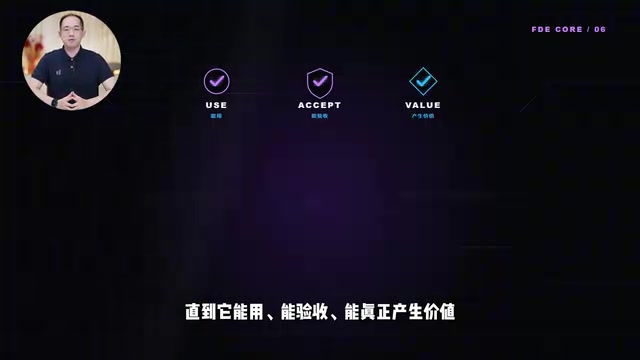
The real challenge of being an FDE has never been "can you build an Agent?" Technical implementation is just one piece. What it truly tests is whether you can take a vague business requirement, progressively break it down into clear problems, and then translate those into something verifiable, buildable, deployable, and ultimately deliverable.
This means an FDE needs to hold three perspectives simultaneously: a business perspective to hear the real need behind what a client can't quite articulate; a product perspective to converge that need into a feasible solution; and an engineering perspective to actually build and deploy that solution to a production environment. All three are essential — and that's precisely why this role is so difficult to replace.
The FDE title was first popularized at scale by Palantir. When selling its data analytics platform to governments and large enterprises, Palantir found that clients were often unable to complete system integration and business adaptation on their own. So the company developed a cohort of engineers who were equally fluent in software engineering and client-side operations. These engineers embedded directly with clients — for weeks or even months — to bridge Palantir's products with real business workflows. The model was later adopted by OpenAI, Palantir's competitors, and a wide range of enterprise AI service providers, gradually forming its own distinct job category. Unlike traditional "pre-sales solution engineers," FDEs don't just demo products and hand requirements off to a development team — they personally close the loop from solution design all the way through to engineering delivery. That's why the role typically demands strong coding skills alongside the ability to communicate fluently with non-technical business stakeholders.
A Complete Enterprise Project Pipeline
The approach here isn't to dive into an isolated technical topic, but to walk the entire length of a real enterprise project pipeline.
The pipeline breaks down into several phases:
From Business Goals to Technical Solution
Using a data analytics project as an example, the starting point is understanding what problem an FDE is actually solving — and then tracing the path from business objectives down to a technical plan. The key at this stage is to use market research, competitive analysis, and business modeling to genuinely clarify what was originally vague: what the client actually wants, how the existing market addresses it, and where the core logic of the business chain lies.
From Business Model to Product Prototype
Once the business is clearly understood, the next step is translating the business model into a core interaction flow, a human approval process, and a product prototype. This stage is about making abstract business understanding explicit — turning it into something discussable and confirmable, so you don't discover midway through development that you've been heading in the wrong direction. The inclusion of a human approval step also reflects the real enterprise need for controllability and compliance.
From Development to Delivery
Finally, the project moves into engineering execution: API integration, MVP acceptance testing, Docker deployment, and writing the delivery documentation.
Notably, "delivery documentation" is called out as a standalone milestone — and for good reason. In enterprise projects, delivery doesn't end when the code runs. A complete set of acceptance criteria and maintainable documentation is often what separates a demo from a genuinely usable system.
MVP (Minimum Viable Product) acceptance is a critical checkpoint in enterprise projects. It means delivering a working version that validates the core business value — even before all features are complete — so that the client or internal stakeholders can confirm the direction before further iteration continues. The value of this approach is that it decouples "done" from "done right," preventing teams from investing heavily in the wrong direction. Docker containerization, meanwhile, solves the classic problem of "it works on my machine but breaks in production" — by packaging an application and all its dependencies into a standardized image, it ensures consistency between development and production environments while making ongoing maintenance and scaling more controllable. Together, these two practices form the technical foundation for moving an AI application from "demo-ready" to "production-ready."
Why This Kind of Project Makes a Strong Portfolio Piece
For job seekers, the value of this pipeline lies in its completeness. A huge number of AI projects in the wild stop at feature demonstration — they look impressive but fall apart under scrutiny: Where does the data come from? How does the workflow actually get implemented? Who signs off on acceptance?
A project that has genuinely gone through requirements gathering, business analysis, solution design, engineering development, performance evaluation, and final delivery can show an interviewer directly that you have end-to-end delivery capability — not just the ability to call a few APIs. That's precisely the most undervalued and most needed skill amid today's AI talent supply-demand mismatch.
The course comes with a set of FDE project practice materials covering the key stages of requirements research, business analysis, solution design, and project delivery — designed to help build a complete mental framework for moving from a business problem to a technical solution.
Takeaway
As code becomes increasingly easy to generate and the barriers around tech stacks continue to flatten, the real moat is shifting back to older, harder-to-automate capabilities: understanding the business, breaking down problems, and driving things to completion. The rise of the FDE role is, at its core, a repricing of what engineering skill is worth in the AI era. The scarce resource is the person who can take a vague requirement all the way through to a usable, delivered solution.
Related articles

MCP Protocol in 60 Seconds: A Real Session, Message by Message
Dissecting a real MCP session message by message: how an Agent dynamically discovers tools, forwards call requests, and has an MCP server execute them — all in just 9 JSON messages, with the model and reasoning loop untouched.

n8n 40-Minute Masterclass: Build Your First AI Automation Workflow from Scratch
Distilled from a 40-minute n8n masterclass: the core differences between automation, AI, and AI Agents, a comparison of n8n's four deployment methods, and a complete guide from dashboard to your first workflow.

Why Does a 35GB Quantized Model Blow Up an 80GB GPU? The Truth About KV Cache VRAM
Why does a 35GB 4-bit quantized LLM still blow up an 80GB GPU? This article breaks down the four components of inference VRAM, provides precise KV Cache formulas, compares GQA vs DeepSeek MLA memory, and offers production-grade OOM prevention like FP8 KV Cache.