FDE: The Key Role for Enterprise AI Implementation — A Practical Analysis from a Bilibili Tutorial

The main reason enterprise AI implementation fails is the lack of the FDE role, which requires combined technical and business capabilities to bridge the last mile.
The article points out that the failure of many traditional enterprise AI projects is not because models aren't smart enough, but because of the missing key role of FDE (Forward Deployed Engineer). Teams can easily build a Demo, but in real business environments, three weaknesses — data silos, difficulty proving value, and missing implicit rules — quickly surface. Using a financial reimbursement project as an example, traditional programmers don't understand the business and skip on-site research, causing problems after full launch; FDE combines technical and business skills and completes risk assessment before development. The article also covers multi-industry projects in logistics, healthcare, e-commerce, and defense, showing FDE's universality and identifying older programmers and traditional developers as suitable for transitioning to FDE.
Why Do Enterprise AI Projects Always "Die the Moment They Go Live"?
Many teams can easily build a Demo, but once the project enters a real business environment, it quickly collapses. According to analysis by a Bilibili creator, a large number of traditional enterprise AI projects have failed over the past three years. The root cause isn't that the models aren't smart enough — it's the absence of a critical role: FDE (Forward Deployed Engineer). This position is becoming the core gap in enterprise transformation in the era of large models.
The Gap Between Demo and Production Environment
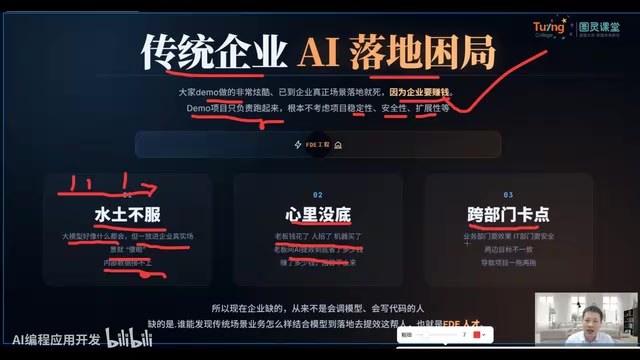
The creator points out bluntly in the video: self-learning online can get an Agent or RAG Demo running, but enterprise-level projects must consider stability, security, scalability, and maintainability. More critically, companies need to make money, not build a pretty demonstration. Many bosses spend large sums on compute and models but can't answer "how much efficiency will this project actually improve and how much cost will it actually reduce for the company?"
RAG (Retrieval-Augmented Generation) is a technical architecture that combines external knowledge base retrieval with large model generation: the system first retrieves content relevant to the question from the enterprise's documents, databases, or knowledge bases, then feeds that content as context to the large model to generate an answer. Its value lies in letting the model "know" private information beyond its training data without retraining the model. But in enterprise scenarios, the difficulty of RAG isn't in model invocation — it's in retrieval quality, data permission isolation, document chunking strategy, and answer traceability. If retrieval fails or retrieves the wrong content, the model will give answers that seem reasonable but are actually wrong — a typical source of the gap between Demo and production.
Three Fatal Weaknesses
The video summarizes the three major obstacles to enterprise AI implementation:
- Data silos: Although large models are smart, they can't connect to a company's private data, and they're "stumped" when placed in real scenarios.
- Difficulty proving value: Business departments and security review departments see inconsistent results, which stalls project progress.
- Missing implicit rules: Enterprises have a large number of undocumented rules (such as travel reimbursement standards and special approval exceptions) that models cannot learn, easily triggering business risks.
These weaknesses are precisely the core problems that FDE is meant to solve.
POC (Proof of Concept) refers to building a runnable prototype at minimal cost before formal development investment, to verify whether a technical approach is feasible and whether the results meet expectations. POC itself is a normal part of the R&D process; the problem is that many enterprises equate the "demo effect" of a POC directly with "production-ready." A POC typically covers only a small number of samples, idealized data, and a single workflow, without involving concurrency pressure, exception handling, permission control, or long-term maintenance. Once fully launched, data distribution shifts and edge cases surface, and the system quickly fails. Therefore, a POC should be positioned as a risk probe, not a deliverable — with on-site research, architecture evaluation, and canary validation still needed in between.
What Does FDE Actually Do? Understanding the Role's Value Through a Financial Reimbursement Project
The video uses a group's finance and tax reimbursement multimodal project as an example to recreate the failure points of the traditional development process.
The "Abandoned Project" Chain of the Traditional Process
The finance manager organizes vague requirements into a document, the programmer takes the document and writes code directly, builds a POC (proof of concept) to show the boss, and after confirming the results, launches it fully. Sounds reasonable, but the problem is: programmers don't understand the business, don't do on-site research, and don't conduct risk architecture evaluation. After launch, OCR errors in invoice recognition, inability to detect duplicate invoices, lost special notes... various disasters erupt one after another.
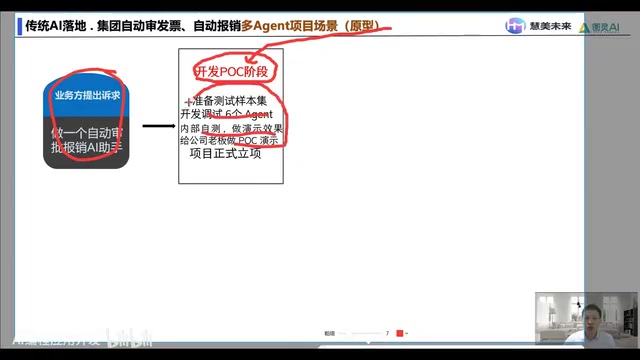
How FDE Gets Involved
What makes FDE different is that they understand both technology and business. They go deep on-site to sort out implicit rules, complete risk assessments before development, and ensure the system can connect to the enterprise's private data. The video emphasizes that FDE is not simply an algorithm role or a development role, but a hybrid talent who can truly help companies achieve cost reduction and efficiency gains.
Multi-Industry Practice: A Map of FDE Projects from Logistics to Healthcare
The video showcases multiple enterprise-level projects covering typical scenarios in different industries, confirming the universality of the FDE approach.
Intelligent Logistics System
Traditional logistics companies have complex nodes and extremely high manual processing costs. The project uses FDE process technology to achieve intelligent inspection, inventory queries, and warehouse data supplementation, demonstrating how to embed large model capabilities into complex business nodes.
Healthcare Pathology Intelligence
Case documentation at large hospitals (such as secondary and tertiary hospitals) consumes enormous manual costs. The project combines multimodal large models, RAG, and multimodal Agent technology to build a pathology intelligence platform that helps doctors improve efficiency. According to the creator, this is one of the real projects his team has implemented in China's healthcare industry.
A multimodal large model refers to a large model capable of processing multiple input modalities such as text, images, audio, and video simultaneously. In healthcare pathology scenarios, the model needs to understand pathology slide images, test report text, and medical record descriptions, and synthesize this information to assist in generating diagnostic opinions or medical record documents. Compared with pure text models, the key challenges of multimodal models lie in the alignment and fusion of information across modalities, as well as the extremely high requirements for accuracy and interpretability in the medical field. A multimodal Agent, building on this, further possesses task planning and tool-calling capabilities, enabling it to complete composite workflows such as "read image — retrieve similar cases — generate report" step by step — which is why it is adopted in pathology intelligence platforms.
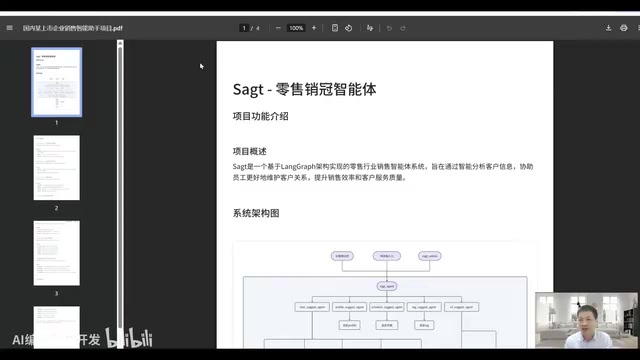
E-commerce Multi-Agent System
Addressing the pain point of losing young consumers in the alcoholic beverages industry, the team designed an e-commerce scenario solution based on multi-Agent, multimodal RAG, and other technologies for a listed alcoholic beverages company. The video mentions that this combines technologies such as DPC and Skill, reflecting the reuse of big-tech logic in enterprise-level projects.
Early Warning and Surveillance System for a Defense State-Owned Enterprise
The video also mentions an early warning and surveillance system project for a defense state-owned enterprise, adopting a large model fine-tuning approach. However, the creator says this part will be explained at the end of the course and does not elaborate on the details.
Who Is Suited to Transition to FDE?
The video clearly states that FDE is an ideal direction for older programmers, traditional architects, Java/Python backend developers, frontend engineers, and similar groups. Compared with pure algorithm roles, FDE emphasizes engineering implementation capability and business understanding — precisely an extension of the strengths of many technical professionals.
Suggested Learning Path
The creator reminds viewers that introductory tutorials on Bilibili can only get you through a Demo, while enterprise-level projects require gradually increasing difficulty. He suggests not stopping at the level of calling model APIs, but instead deeply understanding business scenarios, data security, and system stability.
Conclusion
The bottleneck of enterprise AI implementation isn't the model itself, but the "last mile" connecting models to business. As an emerging role, FDE is filling this gap. Through multi-industry projects in finance, logistics, healthcare, e-commerce, and more, the video demonstrates the practical value of FDE. For developers who want to capture the dividends of large models, transitioning to FDE may be a path worth considering.
Note: This article is based on content from a Bilibili creator's video; project details are subject to the original video.
One-line Summary
The main reason enterprise AI implementation fails is the lack of the FDE role, which requires combined technical and business capabilities to bridge the last mile.
Paragraph Summary
The article points out that the failure of a large number of traditional enterprise AI projects is not because the models aren't smart enough, but because of the absence of the key role of FDE (Forward Deployed Engineer). Teams can easily build a Demo, but once in a real business environment, three major weaknesses — data silos, difficulty proving value, and missing implicit rules — quickly surface. Using a financial reimbursement project as an example, in the traditional process programmers don't understand the business and don't do on-site research, and after full launch, problems with OCR recognition, duplicate invoices, and special notes erupt one after another; FDE, by contrast, combines technical and business capabilities and completes risk sorting and architecture evaluation before development. The article also showcases multi-industry projects in logistics, healthcare, e-commerce, and defense state-owned enterprises, illustrating the universality of the FDE approach, and notes that older programmers and traditional developers are suitable candidates for transitioning to FDE.
Related articles

LLM Application Development Interview Crash Course: High-Frequency Topics on LLMs, RAG, and Agents
A systematic guide to high-frequency LLM application development interview topics: LLM fundamentals, Prompt and Context Engineering, the RAG pipeline, Agent loop prevention and memory design, tool calling, and AI coding engineering follow-ups, with preparation strategies and answer approaches.

Animal Conservationist Maya Higa's Advice to Her 9-Year-Old Self
Animal conservationist Maya Higa shares advice to her 9-year-old self, core values, and a philosophy of observing nature in a National Geographic interview, discussing Jane Goodall and Bill Nye's influence—offering transferable inspiration for tech content creators.

EACL 2027 Decisions Imminent: The Wait and Anxiety Trending on Reddit
EACL 2027 decisions are imminent, and a Reddit decision thread has drawn collective attention from authors. This article analyzes the waiting anxiety during conference decision periods, the review decision mechanism, and how authors should plan resubmission and revision after decisions are released.