FDSML: Revolutionizing Synthetic Pretraining with Parameter-Aware Triplet Loss

FDSML replaces discrete labels with generation parameters for relational supervision, significantly improving retrieval transfer in synthetic pretraining.
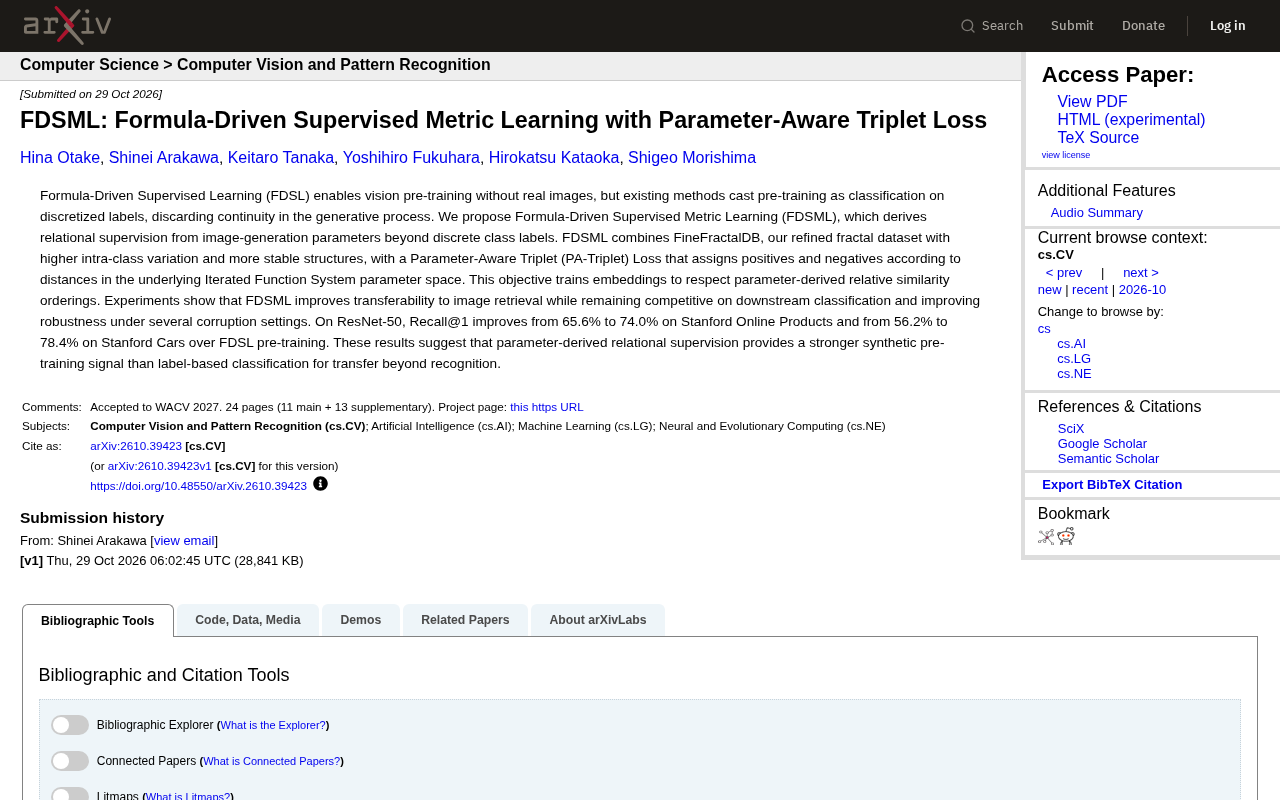
The article introduces FDSML (Formula-Driven Supervised Metric Learning), a synthetic data pretraining method that overcomes the limitation of traditional FDSL's discrete label-based pretraining by shifting supervision to fractal image generation parameters (IFS parameters). Using a Parameter-Aware Triplet Loss (PA-Triplet Loss), it assigns positive and negative pairs based on parameter-space distances to learn a continuous similarity metric space. The accompanying FineFractalDB dataset offers higher intra-class variability and stable structures. On ResNet-50, FDSML improves Recall@1 from 65.6% to 74.0% on Stanford Online Products and from 56.2% to 78.4% on Stanford Cars, while maintaining competitive downstream classification and improving robustness. Relational supervision is seen as a new paradigm for synthetic pretraining, potentially extendable to diffusion models.
Synthetic data pretraining is undergoing a key upgrade. Traditionally, Formula-Driven Supervised Learning (FDSL) generates images via fractal formulas and discretizes labels for classification-based pretraining, but this approach ignores the continuous relational information embedded in the generation process. The newly proposed FDSML (Formula-Driven Supervised Metric Learning) shifts the supervision signal from discrete class labels to image generation parameters, constructing relational supervision through a Parameter-Aware Triplet Loss (PA-Triplet Loss), achieving significant improvements on image retrieval tasks.
The Limitation of FDSL: Discrete Labels Lose Continuity
The core idea of FDSL is to use mathematical formulas (such as fractals) to generate synthetic images, enabling pretraining of vision models without real data. However, existing methods model pretraining as a classification task over discretized labels, which causes the rich continuous information in the generation process to be discarded—image generation parameters (such as those of iterated function systems) could reveal relative similarities between samples, but classification labels only tell the model "which class it belongs to" and cannot express "who is more similar to whom."
According to the paper, this discretization limits the model's ability to learn fine-grained relationships, especially affecting tasks that rely on relative ordering, such as image retrieval. FDSML targets this gap, attempting to elevate the supervision signal from the "category" level to the "relational" level.
The Iterated Function System (IFS) is a classic construction in fractal geometry: it consists of a set of contractive affine transformations, and by repeatedly applying these transformations to an initial shape, it eventually converges to a self-similar fractal attractor (such as the Sierpinski triangle or the Barnsley fern). In FDSL, each fractal image is generated from a set of randomly sampled IFS parameters, so these parameters naturally form a continuous high-dimensional space—small changes in parameters lead to smooth gradients in image texture and structure. FDSML leverages this property: the closer two images' corresponding IFS parameter vectors are in Euclidean space, the higher their visual similarity typically is. This makes IFS parameters a finer-grained supervision signal than discrete class labels.
Triplet Loss is one of the core objective functions in metric learning, widely used in face recognition and image retrieval. It takes a triplet (anchor, positive, negative) at each step, optimizing so that the embedding distance between the anchor and positive is smaller than that between the anchor and negative, usually with a margin to prevent degenerate solutions. The innovation of FDSML's PA-Triplet Loss is that the division of positive and negative samples no longer relies on human-annotated categories, but is automatically determined based on distances in the IFS parameter space, thereby directly converting generation parameters into relational supervision signals.
The Core of FDSML: Parameter-Aware Triplet Loss
FDSML consists of two key components: the FineFractalDB dataset and the PA-Triplet Loss. FineFractalDB is a refinement of existing fractal datasets, with higher intra-class variability and more stable structures, providing richer sample pairs for relational learning. The PA-Triplet Loss assigns positive and negative sample pairs based on distances in the underlying Iterated Function System (IFS) parameter space—samples close in parameter space are treated as positive pairs, and those far apart as negative pairs—thereby training embeddings to respect the relative similarity ordering derived from parameters.
This design enables the model to learn not merely to distinguish categories, but to learn a continuous similarity metric space. The paper points out that this objective directly optimizes embeddings to preserve the relative order derived from parameters, laying a better foundation for transfer to retrieval tasks.
Experimental Results: Significant Gains in Retrieval Performance
On a ResNet-50 backbone, the FDSML-pretrained model outperforms FDSL on multiple retrieval benchmarks. Specifically, on the Stanford Online Products dataset, Recall@1 improves from 65.6% to 74.0%; on Stanford Cars, from 56.2% to 78.4%. These gains indicate that parameter-derived relational supervision provides a stronger synthetic pretraining signal than label-based classification pretraining, especially benefiting transfer tasks beyond recognition.
Beyond retrieval tasks, FDSML remains competitive on downstream classification tasks and exhibits better robustness under various corruption settings. This means relational supervision not only avoids sacrificing classification performance but also enhances the model's resistance to image degradation.
Recall@1 is one of the most commonly used evaluation metrics in image retrieval, referring to the proportion of queries for which the correct match is ranked first among retrieval results. For example, on the Stanford Online Products (SOP) dataset, Recall@1 improving from 65.6% to 74.0% means that for every 100 queries, the correct match appears at the top about 8.4 more times. SOP is a classic metric learning benchmark containing about 120,000 online product images across more than 20,000 categories, with subtle visual differences between categories, making it a strong test of the model's ability to discriminate fine-grained similarities; Stanford Cars contains 196 car models with about 16,000 images, also known for large intra-class variation and small inter-class variation. The significant improvements on these two benchmarks demonstrate that the embedding space learned by FDSML has stronger generalization ability on fine-grained ranking tasks. ResNet-50, as the backbone network, is a common standard architecture for measuring the transfer effectiveness of pretraining methods, ensuring fair comparison.
Significance and Outlook: Relational Supervision as a New Paradigm for Synthetic Pretraining
The proposal of FDSML highlights a broader trend: the value of synthetic pretraining lies not only in being "data-free," but also in how supervision signals are designed. By mining the continuous parameters in the generation process, models can learn more general representations, which is particularly important for data-scarce or privacy-sensitive scenarios. In the future, this parameter-aware relational learning approach may be extended to the pretraining of other generative models (such as diffusion models), further unlocking the potential of synthetic data.
One-line Summary
FDSML replaces discrete labels with generation parameters to construct relational supervision, significantly improving retrieval transfer performance of synthetic pretraining.
Paragraph Summary
The article introduces the synthetic data pretraining method FDSML (Formula-Driven Supervised Metric Learning), which addresses the limitation of traditional FDSL that pretrains only with discrete class labels by shifting the supervision signal to the generation parameters (IFS parameters) of fractal images. Through a Parameter-Aware Triplet Loss (PA-Triplet Loss), it assigns positive and negative sample pairs based on distances in parameter space, thereby learning a continuous similarity metric space. The accompanying FineFractalDB dataset provides higher intra-class variability and stable structures. On ResNet-50, FDSML improves Recall@1 on Stanford Online Products from 65.6% to 74.0% and on Stanford Cars from 56.2% to 78.4%, while maintaining competitive downstream classification performance and improving robustness. The article argues that relational supervision offers a new paradigm for synthetic pretraining and can be extended to other generative models such as diffusion models in the future.
Related articles

Fifty Years Studying Power: Robert Caro's Writing and Insights on Power
Robert Caro reflects on 50 years studying power: Lyndon Johnson's persuasion and leverage, Robert Moses's transformation from idealist to ruthless builder, the dilemmas of large-scale construction, and his methods of compressing themes and solitary focus in biography writing.

Can a $20,000 Robot Do Your Chores? The Test Results Are Surprising
A YouTube test video shows how a $20,000 robot responds to commands like washing dishes, turning off lights, taking out trash, and feeding the dog. This article analyzes its real capability boundaries, the state of voice interaction technology, and how far household robots are from mainstream adoption.

The Complete Guide to Running AI Models Locally: Inference Engines and Tool Stack Explained
A systematic breakdown of the complete local LLM tool stack: from PyTorch and GGML compute libraries to llama.cpp, vLLM, SGLang inference engines and Ollama, LM Studio wrapper layers, with benchmark data on performance differences and selection logic.