Feasibility Analysis: Deploying DeepSeek V4 Flash on Dual DGX Spark Systems

Analyzing whether dual DGX Spark systems can run DeepSeek V4 Flash offline with acceptable throughput.
This article examines the feasibility of deploying DeepSeek V4 Flash on two NVIDIA DGX Spark units in a fully offline environment. While the combined 256GB unified memory is likely sufficient for quantized model weights, the real bottleneck lies in LPDDR5x bandwidth (~273GB/s) and cross-machine communication overhead. The analysis covers MoE architecture implications, quantization strategies, inference framework selection, and practical deployment recommendations.
A Real-World Need from an Offline Scenario
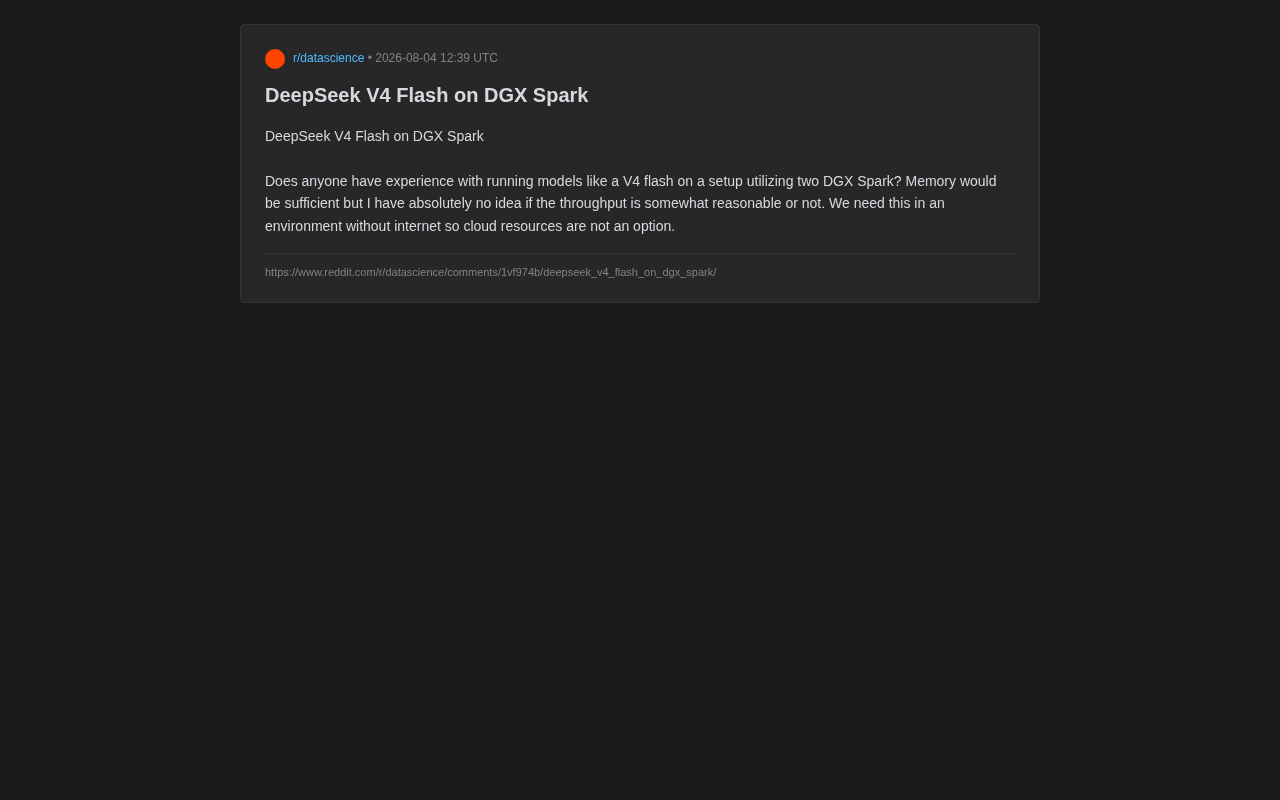
Recently, a highly representative technical discussion appeared on Reddit: a developer wanted to run a large model like DeepSeekAd V4 Flash on a local cluster consisting of two NVIDIA DGX Spark units. The core requirements were twofold — first, their environment has absolutely no internet access, ruling out any cloud resources; second, while the memory capacity appears sufficient on paper, they were uncertain whether actual inference throughput could reach usable levels.
This question may seem niche, but it precisely hits the pain point of local large model deployment today: when data compliance, physical isolation, and security classification become hard constraints, how do you squeeze acceptable performance out of limited local computing resources? Let's analyze this scenario in detail.
DGX Spark Hardware Positioning and Core Specifications
A Desktop AI Supercomputer
DGX Spark is a compact AI computing device from NVIDIA designed for individual developers and small teams. It features the GB10 Grace Blackwell superchip with a unified memory architecture, officially rated to deliver up to 1 PetaFLOP (at FP4 precision) of AI compute power, equipped with 128GB of unified memory (LPDDR5x).
The GB10 Grace Blackwell superchip is NVIDIA's integration of the ARM-based Grace CPU and Blackwell GPU through NVLink-C2C chip-to-chip interconnect technology within a single package. The Grace CPU is based on ARM Neoverse V2 cores, providing energy-efficient general-purpose computing; the Blackwell GPU represents NVIDIA's fifth-generation Tensor Core architecture, introducing FP4 precision support for the first time in a consumer/workstation-class product. The unified memory architecture means the CPU and GPU share the same physical memory pool, eliminating the data copy bottleneck between CPU memory and GPU memory in traditional PCIe architectures. However, LPDDR5x bandwidth (approximately 273GB/s) still falls an order of magnitude short of the HBM3e used in data center products (up to 8TB/s per GPU) — this is precisely the hardware root cause of the throughput bottleneck discussed later.
Its biggest selling point is packing data center-grade architecture into a desktop box, enabling developers to perform inference and even fine-tuning on medium-scale models locally. For scenarios requiring offline operation, it has a natural advantage — it can work independently without any external network connection.
The Significance of Networking Two DGX Spark Units
The original poster mentioned using two DGX Spark units, which corresponds to NVIDIA's ConnectX high-speed interconnect capability designed for this product. ConnectX is NVIDIA's (acquired through the Mellanox acquisition) smart NIC product line, supporting both InfiniBand and Ethernet protocols. In a dual-machine interconnect scenario, ConnectX NICs paired with NVIDIA's NCCL (NVIDIA Collective Communications Library) enable efficient data transfer between GPUs, supporting collective communication primitives such as AllReduce and AllGather.
Once two devices are interconnected via high-bandwidth networking, memory and compute power can be aggregated to host larger models that won't fit on a single machine. Theoretically, the combined unified memory of two DGX Spark units totals approximately 256GB — enough to hold the weights of a quantized medium-to-large model. However, it's worth noting that the interconnect bandwidth between DGX Spark units (estimated at 100-400Gbps) is far lower than the 900GB/s bandwidth provided by NVLink within data center DGX systems. This means that when performing tensor parallelism (splitting computation within a single layer across multiple devices), communication overhead will account for a significantly larger proportion and may become the dominant contributor to inference latency.
Memory Is Sufficient, But Throughput Is the Real Bottleneck
Memory Capacity Does Not Equal Inference Speed
The poster's assessment is accurate: memory capacity is often not the primary bottleneck for local deployment — bandwidth and interconnect latency are. DeepSeek models generally adopt the MoE (Mixture of Experts) architecture, and V4 Flash variants emphasize low-latency, cost-effective inference.
MoE (Mixture of Experts) is a sparsely-activated neural network architecture design. Its core idea is to split the model's feed-forward network layers into multiple parallel "expert" sub-networks, with a learnable gating (Router) network dynamically selecting a small number of experts to participate in computation during each inference pass. For example, DeepSeek V3 has 256 experts but only activates 8 per inference step. This means that while the total parameter count can reach hundreds of billions or even trillions, the actual computation per forward pass is only a fraction of what a dense model would require. This characteristic of MoE architecture reduces sustained compute demands to some degree, but places higher requirements on memory bandwidth and expert routing communication overhead — because all expert weights must remain resident in memory (it's impossible to predict which experts will be activated), and expert routing decisions plus cross-device expert scheduling introduce additional communication overhead.
When a model is split across two devices, cross-device tensor transfers introduce additional latency. DGX Spark's unified memory bandwidth (approximately 273GB/s) is over an order of magnitude lower than data center-grade HBM3e memory (8TB/s class). Therefore, in actual inference, whether single-token generation latency and overall throughput can meet business requirements needs to be verified through actual testing — it's difficult to draw conclusions based on paper specifications alone. As a rough estimate: if model weights after quantization are 150GB, reading through the weights at 273GB/s takes approximately 0.55 seconds, implying a theoretical single-token generation speed of about 1.8 tokens/s — and this doesn't account for computation latency or cross-machine communication overhead.
Quantization Is an Unavoidable Key Step
To run a large model on two DGX Spark units, quantization schemes (such as INT4, FP8, or GGUF-series quantization formats) are almost certainly required.
Model quantization refers to converting neural network weights and/or activation values from high-precision floating-point numbers (e.g., FP32/FP16) to low-precision representations (e.g., INT8/INT4/FP8). GGUF is a quantized model file format defined by the llama.cpp project, supporting multiple quantization levels from Q2 to Q8. Q4 (4-bit quantization) is the community's most commonly used balanced choice, compressing model size to approximately one-quarter of the original FP16. FP8 is a data type natively supported by the NVIDIA Blackwell architecture, which retains floating-point dynamic range expression compared to INT quantization and can typically halve memory usage and computation with almost no precision loss. For MoE models like DeepSeek V4 Flash, if the original parameter count is in the hundreds-of-billions range, Q4 quantization could compress it to approximately 100-150GB — fitting neatly within the 256GB combined unified memory of two DGX Spark units.
Quantization significantly compresses memory usage and improves throughput, but also introduces some precision loss. For scenarios emphasizing inference quality, repeated trade-offs between compression ratio and output quality are necessary. It's worth noting that quantizing MoE models is more complex than dense models — since different experts are activated at vastly different frequencies, some quantization approaches apply different precision strategies to high-frequency and low-frequency experts to achieve a better balance between overall compression ratio and inference quality.
Practical Recommendations for Offline DeepSeek V4 Flash Deployment
Start with Small-Scale Validation Before Scaling Up
For deployments with high uncertainty like this, the safest path is to first run a quantized smaller model on a single device, measure single-machine token throughput and latency baselines, then introduce the second device to observe the gains from multi-machine aggregation versus communication overhead. Avoid jumping straight to full-configuration deployment.
Specifically, start by benchmarking smaller models in the DeepSeek family (such as distilled versions of DeepSeek-R1 or open-source models with similar parameter counts) on a single DGX Spark. Record Time to First Token (TTFT) and generation speed (tokens/s) at different batch sizes to establish a performance baseline before gradually scaling to the full model and dual-machine configuration.
Choice of Inference Framework Is Critical
The inference framework has an enormous impact on performance. Mainstream frameworks like vLLM, SGLang, and TensorRT-LLM differ significantly in their support for MoE models and multi-GPU/multi-machine tensor parallelism.
vLLM is a high-performance LLM inference engine developed at UC Berkeley. Its core innovation is PagedAttention, which manages KV cache through a mechanism similar to OS virtual memory paging, significantly improving memory utilization and batch processing throughput. SGLang, also from the Berkeley team, further optimizes performance for structured generation and multi-turn conversation scenarios on top of vLLM. TensorRT-LLM is NVIDIA's official inference optimization framework, deeply leveraging NVIDIA hardware features for operator fusion, quantization calibration, and automatic kernel tuning — typically achieving the best single-GPU performance on NVIDIA platforms. For DGX Spark deployment scenarios, TensorRT-LLM may have an advantage due to its native optimization for the Blackwell architecture, but its maturity in multi-machine tensor parallelism support and optimization for MoE models needs practical verification. Additionally, llama.cpp, as a lightweight CPU/GPU hybrid inference solution, is also worth testing on DGX Spark's unified memory architecture.
In offline environments, you also need to download and package all frameworks, model weights, and dependency libraries in advance to ensure complete deployment is possible without network access. Using Docker containers or Conda environments for comprehensive dependency encapsulation is recommended, with all component compatibility verification completed in advance in a networked environment.
Define Clear Performance Red Lines for Your Business Scenario
Whether throughput is "reasonable" fundamentally depends on your business requirements for concurrency and response latency. If it's just interactive Q&A for a handful of users, a few tokens per second might suffice; if batch document processing or high-concurrency services are needed, two DGX Spark units may fall short, and you'd need to consider more professional server-class solutions (such as DGX Station with HBM memory or full DGX H100/B200 systems).
A reference metric: the average human reading speed is approximately 3-5 Chinese characters per second (roughly 2-4 tokens), so for single-user interactive scenarios, inference speeds of 5-10 tokens/s typically provide a smooth conversational experience. However, if the scenario involves code generation, long document summarization, or multi-turn Agent calls, user tolerance for latency drops dramatically, often requiring generation speeds above 30 tokens/s to maintain work efficiency.
Conclusion: The Reality of Offline Large Model Deployment
This Reddit post reflects an increasingly common trend: large models are moving from pure cloud to local and edge deployments. In sectors like government, defense, finance, and healthcare where data isolation requirements are extremely stringent, offline deployment isn't optional — it's mandatory. In the financial industry, for example, regulatory authorities in various countries impose strict restrictions on cross-border transmission and third-party hosting of customer data; the defense sector requires computing systems to be physically isolated from public networks. The emergence of desktop AI devices like DGX Spark provides new possibilities for these scenarios — AI inference capabilities that previously required a full server rack can now be deployed in a secure, controlled office environment.
However, whether hardware can handle a specific task can never be determined without actual testing. For the original poster's question, the most honest answer is: memory is most likely sufficient, but throughput can only be determined by running it yourself. This also reminds all teams hoping to deploy large models in constrained environments — paper specifications are just the starting point; stress testing in real scenarios is the basis for decision-making. When planning such projects, it's advisable to reserve at least 2-4 weeks for performance tuning, covering quantization scheme selection, inference framework adaptation, parallelism strategy adjustment, and business scenario simulation.
Related articles

Chain of Thought Isn't Just for AI: How Humans Can Use CoT to Improve Thinking Quality
Chain of Thought isn't just a prompt trick for large models. Starting from a Hacker News discussion, this article analyzes why CoT works for human thinking too, breaks down actionable ways to transfer it, and highlights the key differences between human CoT and machine CoT.
Cloudflare Teams Up with OpenAI: Closi…
Cloudflare Teams Up with OpenAI: Closing the Loop from Vulnerability Discovery to Defense with AI
Cloudflare uses OpenAI Daybreak to investigate security vulnerabilities and generate reviewable remediation plans, while developers use Codex to boost coding efficiency and quality.

Orca Multi-Agent Orchestration in Practice: A Guide to Parallel Collaboration with Claude and Codex
Orca is Stable AI's free open-source agent workbench supporting 34 agents like Claude Code and Codex in parallel. Learn its Git worktree isolation, multi-model orchestration, and mobile management.