Federal Judge Rules Flock License Plate Surveillance System Constitutes Mass Surveillance

Federal judge rules warrantless use of Flock license plate system unconstitutional, calling it indiscriminate mass surveillance.
A federal judge ruled that a sheriff's deputy violated Fourth Amendment rights by accessing a woman's vehicle movement data through Flock's automated license plate recognition system without a warrant. The judge characterized Flock as "indiscriminate mass surveillance," pointing to its blanket collection of data on all passing vehicles regardless of suspicion. Deployed across thousands of U.S. cities via a public-private camera network, Flock captures plate numbers, vehicle types, and colors into a searchable database. The ruling sets an important judicial precedent for the legal boundaries of ALPR technology, signaling that technological convenience cannot override constitutional constraints.
A Single Ruling Ignites the Debate Over License Plate Tracking
A federal judge has ruled that a sheriff's deputy violated a woman's Fourth Amendment rights by using the Flock system to search her license plate without a warrant. In the decision, the judge stated plainly that Flock constitutes "indiscriminate mass surveillance."
This is a weighty statement. It goes beyond calling out a single instance of law enforcement overreach — it raises fundamental questions about the entire operational model of automated license plate recognition (ALPR) technology like Flock's. When a network of cameras blanketing public streets can pull up any vehicle's movement history at any moment, the tension between technological convenience and constitutional rights is brought into sharp focus.
What Is Flock, and Why Does It Raise Red Flags?
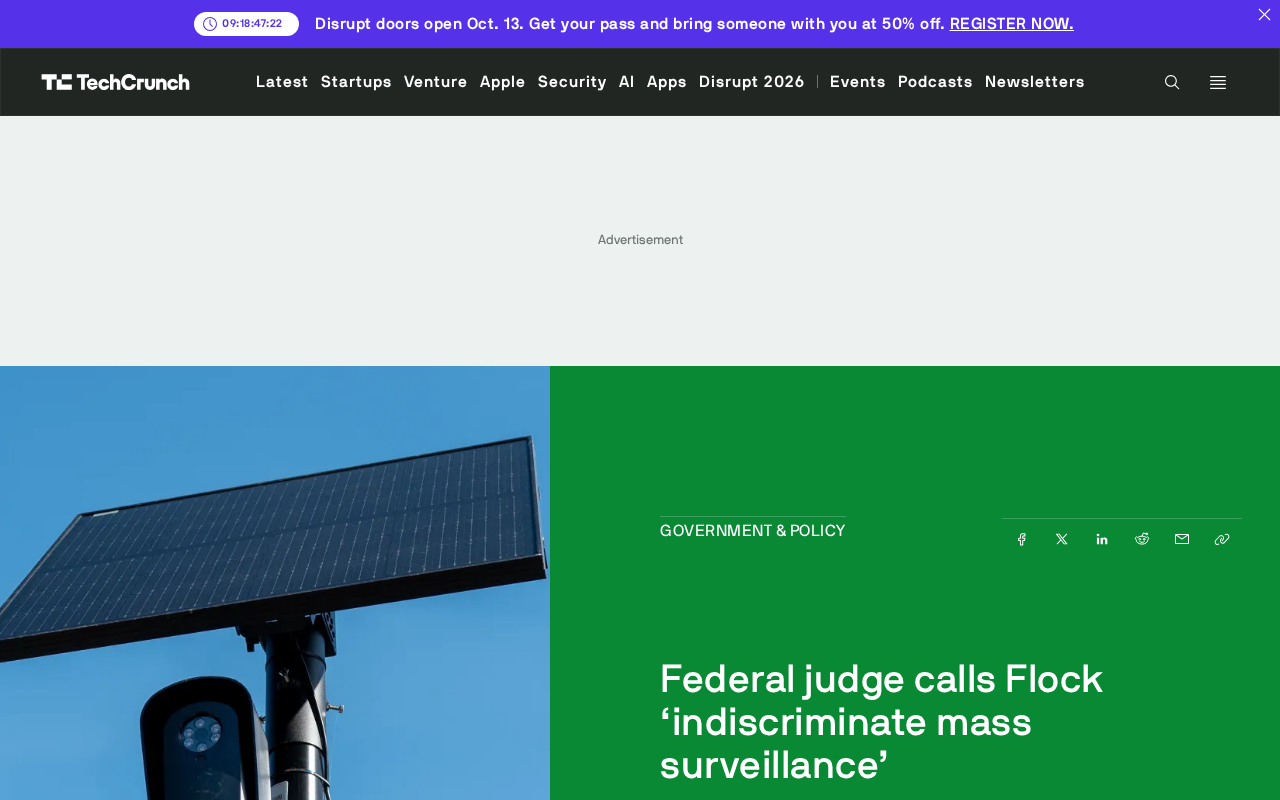
Flock is an automated license plate recognition system that has rapidly spread across police departments and communities throughout the United States in recent years. It uses a wide network of deployed cameras to continuously capture license plates, colors, vehicle types, and other information from passing vehicles, storing that data in a searchable database. Law enforcement officers can enter a plate number and retrieve a historical record of that vehicle's activity across the coverage area.
From a law enforcement efficiency standpoint, systems like this can be genuinely useful for tracking stolen vehicles, locating missing persons, or following up on criminal suspects. The problem is that data collection is "indiscriminate" — it makes no distinction between suspects and ordinary citizens, recording every vehicle that passes by without exception. That is precisely why the judge used the phrase "indiscriminate mass surveillance" to describe it.
Flock Safety was founded in 2017 and is headquartered in Atlanta, making it one of the highest market-share commercial ALPR providers in the U.S. Its business model is notably distinctive: in addition to selling services to police departments, it sells camera equipment extensively to residential communities, homeowners associations (HOAs), and other private entities, then uses data-sharing agreements to fold privately captured data into networks accessible by law enforcement. This means police can effectively leverage privately deployed infrastructure to achieve surveillance coverage far beyond what their own budgets could provide. As of 2023, Flock systems had been deployed in over 4,000 cities across the U.S., covering more than 2,000 law enforcement agencies. This public-private data fusion architecture is precisely why critics view it as far more concerning than traditional police cameras — citizens have no opportunity to know about or opt out of continuous recording of their vehicles by nearby private cameras.
The Fourth Amendment and the Limits of Warrantless Searches
The U.S. Constitution's Fourth Amendment protects citizens against unreasonable searches and seizures, generally requiring law enforcement to obtain a warrant based on probable cause before conducting a search. The crux of this case was that the sheriff's deputy accessed the subject's vehicle movement data through Flock without authorization.
The judge determined this crossed a constitutional line. This means that even when data has already been automatically collected and stored by the system, law enforcement may still need to obtain a warrant before pulling location history tied to a specific individual. The ruling draws a relatively clear boundary between technical surveillance capabilities and legal authorization.
Understanding this case also requires reference to the Supreme Court's landmark 2018 decision in Carpenter v. United States. In that case, the Court ruled 5-4 that the government's warrantless acquisition of historical cell phone location data from telecommunications carriers violated the Fourth Amendment. Chief Justice Roberts, writing for the majority, noted that when technology enables "near perfect surveillance" of an individual's long-term movements, the traditional "third-party doctrine" — the principle that information voluntarily disclosed to third parties is not constitutionally protected — no longer applies. The federal judge's ruling in the Flock case almost certainly draws on the framework established by Carpenter: continuous, historical location data tracking, even when achieved by photographing public roads, may trigger constitutional protections. The underlying logic of both cases runs along the same thread — what is being protected is not a single instance of location exposure, but the comprehensive record of movements that, when aggregated, can reconstruct the full map of a person's life.
The Potential Impact of the Ruling
This case carries significance well beyond the individual facts. As ALPR systems continue to proliferate across communities and police departments nationwide, legal disputes over their legality and proper boundaries have steadily accumulated. A federal judge explicitly characterizing such a system as "mass surveillance" may provide an important reference point for future litigation.
For vendors and law enforcement agencies that deploy and operate these systems, the ruling sends a clear signal: the convenience of the technology does not automatically grant immunity from constitutional constraints. Building compliance mechanisms around data collection scope, access permissions, and retrieval procedures will be critical to whether these surveillance technologies can continue to be used.
It is worth noting that rulings from federal district courts occupy a lower rung in the legal hierarchy — they are not nationally binding, their influence is primarily felt within their respective circuits, and they remain subject to reversal by appellate courts. Nonetheless, even so, the reasoning of such rulings carries significant persuasive value: other courts confronting similar cases often examine and cite compelling district court opinions. Privacy advocacy organizations such as the EFF (Electronic Frontier Foundation) and the ACLU have long monitored ALPR technology for abuse, and have already pushed for legislation in multiple states requiring data retention limits, access restrictions, and audit mechanisms. This ruling will provide more direct judicial backing for those legislative efforts, pushing state and local governments to revisit their existing ALPR usage policies.
Conclusion
Given the limited details available in the original reporting, the specific facts of this case, the jurisdiction involved, and the prospects for appeal remain unclear. But the ruling itself has already articulated the central question of the intelligent surveillance era: when camera networks have the capacity to record everyone's daily movements, technology deployment must be subjected to rigorous constitutional and legal scrutiny. The future of license plate recognition systems will, in large part, be shaped by the accumulated weight of judicial decisions like this one.
Related articles

Cursor Can Now Control Your Computer: AI Agents Can Drive Desktop Apps for Testing
Cursor adds desktop control: AI agents can drive desktop apps like the iOS Simulator to test their own features. We analyze the impact on dev workflows, possible technical approaches, and reliability concerns.

Vibecoding a Custom Inference Engine: High Hopes, Harsh Reality
A Reddit developer shares the real experience of vibecoding a custom inference engine: running GGUF Q4 models in the browser with WebGL2 and GLSL, only to fall into tokenizer debugging hell. This article analyzes the engineering challenges of browser-side LLM inference and why cloning llama.cpp is the more rational choice.

How High Are Anthropic's Early Investor Paper Returns Ahead of IPO?
Anthropic's early investor paper returns draw attention ahead of IPO. This article analyzes sources of book gains, capital structure, pre-IPO games and risks, and implications for the AI startup ecosystem.