Federal Reserve Report: 87% of Respondents See AI as Top Financial Risk

Fed report: 87% of respondents see AI as the top financial risk, creating parallel tension with tech acceleration.
The Fed's Financial Stability Report shows 87% of respondents rank AI as the top financial risk, up sharply from ~50% a few months ago; compute-related debt issuance has reached $680 billion, 5x the full-year 2023 total. Meanwhile, Nvidia's market cap fell below $4 trillion with a 6-week losing streak, its longest since 2012. On the tech side: OpenAI dissolved its standalone robotics team, Cursor disclosed a partner key leak enabling a counterfeit plugin, Google integrated Gemini into Wallet as read-only, Thinking Machines revealed a 4-bit pretraining method completing training in 68 hours, and local inference tool Lauma released 1.0. The article argues tech acceleration and financial anxiety are mutually causal, with Nvidia's first earnings report as the key short-term validation point.
Title
The Federal Reserve's latest Financial Stability Report delivers a somewhat counterintuitive signal: in the eyes of respondents, AI has overtaken traditional concerns like inflation and geopolitics to become the number one financial risk. That said, Nvidia's stock continues to pull back, OpenAI restructures its robotics team, Cursor discloses a security incident, and Google integrates Gemini into Wallet — technological progress and financial anxiety are advancing along the same timeline. According to Bilibili's AI Evening News, there are 7 noteworthy developments this period, analyzed one by one below.
1. 87% of Respondents Rank AI as Top Risk, Compute Debt in Focus
According to the Federal Reserve's Financial Stability Report, 87% of respondents listed AI as a financial risk, ranking it first. Just a few months ago, this figure was only around 50% in a similar survey — a remarkably steep jump in a short period. In other words, market concerns about AI have shifted from "is the technology reliable" to "is the funding chain solid."
The report also notes that debt issuance related to compute has reached $680 billion, five times the full-year total for 2023. This figure is key to understanding the risk sentiment: AI infrastructure expansion is increasingly reliant on debt financing, and if the payback cycle falls short of expectations, leverage pressure will transmit along the compute supply chain. The 87% figure is less a distrust of AI technology itself than a wariness of the "AI capex—debt—valuation" loop.
Compute debt refers to funds raised by companies through bonds, loans, and other debt instruments during the construction of AI infrastructure (especially data centers, GPU clusters, and high-speed networks). Unlike traditional tech companies that expand mainly through operating cash flow, this round of AI arms racing involves enormous capital expenditures — a single large AI data center can cost billions of dollars — and many companies choose to leverage up. Debt financing means fixed interest and principal repayment obligations; if AI business revenue grows slower than expected, debt service pressure emerges and can transmit up and down the supply chain (chip procurement, cloud service contracts). Therefore, the scale and growth rate of compute debt are often viewed as one of the core indicators of AI bubble risk.
2. Nvidia Market Cap Falls Below $4 Trillion, Longest Losing Streak in Over a Decade
Nvidia fell another 2% on Friday, with market cap dropping below $4 trillion. The stock is down nearly 13% this week and has fallen for 6 consecutive weeks — the longest losing streak since 2012. Next Tuesday, interim CEO Cress will deliver the first earnings report, and market attention is understandable.
Compare this with the previous item and the logic becomes clear: compute debt expansion is highly tied to Nvidia's valuation, and the Financial Stability Report's risk warning and the stock's continuous pullback point to the same issue — AI infrastructure pricing is being re-examined. The first earnings report will be a key short-term validation point.
3. OpenAI Dissolves Standalone Robotics Team, Staff Folded into Research and Product
According to an exclusive report by Fortune, OpenAI has dissolved its standalone robotics team, with staff folded into the research and applied departments. OpenAI's response: "This is about accelerating, not giving up."
This statement deserves a close read. General-purpose models like GPT-6 Astra can already be used directly on robots, meaning robotics capabilities can iterate on top of general models without maintaining a separate team. From an organizational design perspective, this downgrades robotics from a "dedicated project" to "a downstream application of general models" — a contraction in the short term, but in the long term a concentration of resources on the models themselves. According to cross-referenced information from Bilibili's AI Evening News and multiple tech media outlets, this adjustment is not an isolated event but part of general-model teams absorbing vertical directions.

Using general-purpose models (like the GPT-6 Astra mentioned) directly on robots means using large pretrained models as the robot's "brain" to handle perception and understanding, task planning, and natural language instruction parsing, rather than training dedicated models for robots separately. The advantage: the general model's multimodal understanding and reasoning capabilities can be directly transferred, so the robotics team doesn't need to rebuild underlying model capabilities and can focus on hardware-related parts like body control and motion planning. This also explains why OpenAI could fold its robotics team into research and product — robotics capabilities are gradually becoming an application outlet for general models rather than a dedicated direction requiring independent organizational support.
4. Cursor Security Incident: Fireworks Leaked Keys and a Counterfeit Plugin
Cursor has published the findings of its security incident investigation. Attackers used keys leaked by partner Fireworks to access internal tools and also planted a counterfeit CloudCode plugin, which was mounted for about 11 hours and may have been installed by up to 5,000 users.
The lesson here is not about Cursor itself but about the supply chain: once a third-party partner's key management has gaps, risk penetrates through to end users. For developers, the trust boundary of the plugin ecosystem needs reassessment — installation source, permission scope, and mount duration should all become default review items. The 11-hour exposure window and 5,000 potentially affected users is a modest but sufficiently cautionary sample.

5. Google Integrates Gemini into Google Wallet
Google has integrated Gemini into Google Wallet, which can analyze spending charts, identify forgotten subscriptions and price hikes, and help plan holiday budgets. Google emphasizes that the capability is read-only and cannot access user funds.
The "read-only" limitation is crucial — it defines the boundary for AI assistants in financial scenarios: analysis yes, execution no. From a product perspective, this positions the large model as an interpretation layer for spending data rather than a transaction agent layer. For ordinary users, surfacing forgotten subscriptions and hidden price increases is a high-frequency pain point, and the practical value of such features often exceeds grand financial narratives.
6. Thinking Machines Reveals Inkling 2 Small Training Secrets
Murati's Thinking Machines has published the training method for Inkling 2 Small: forward computation uses 4-bit precision throughout pretraining, pretraining took only 68 hours, whereas a few months ago the same scale required several weeks. Weights have been open-sourced.
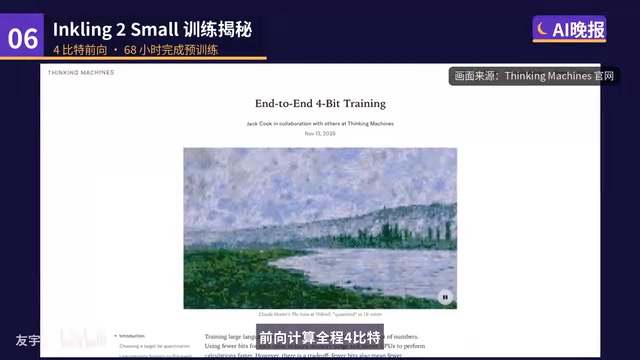
The technical significance: low-precision training is moving from experiment to reproducible engineering practice. The 68-hour vs. "several weeks" comparison is an order-of-magnitude efficiency difference, and open-sourcing the weights lets the community verify directly. If full 4-bit forward computation can be stably reproduced on more architectures, the training cost curve will be significantly rewritten.
4-bit pretraining refers to using 4-bit floating point (rather than the traditional 16-bit or 32-bit) to represent model weights and activations during forward computation. Lower bit width means smaller memory and bandwidth footprint and higher throughput per unit of compute, significantly shortening training time and reducing cost. The challenge is that low precision accumulates numerical errors, which can cause training instability or degraded model quality, requiring specific quantization schemes, scaling strategies, and numerical stability techniques. If full 4-bit forward computation can be stably reproduced across architectures, it means training larger models on the same hardware or completing the same scale in less time — a direct impact on the training cost curve.
7. Local Inference Tool Lauma Releases 1.0
Lauma, an open-source tool for running large models locally, has released version 1.0, supporting over 150 model architectures, with its interface now managed under semantic versioning. DeepSeekAd, Qwen, and Kimi models are all covered.
1.0 and semantic versioning mean the project has moved from "usable" to "dependable." With support for over 150 architectures, it has become a highly compatible layer of infrastructure for local deployment scenarios. For teams wanting to run open-source models locally, standardized version management has more long-term value than new features.
Semantic Versioning (SemVer) is a widely adopted versioning convention with the format "major.minor.patch." Its rules: increment the major version for incompatible API changes, the minor version for backward-compatible feature additions, and the patch version for backward-compatible bug fixes. For a local inference tool, adopting semantic versioning means downstream developers and enterprise users can judge whether an upgrade is safe based on the version number, allowing the tool to be adopted as a production dependency. It marks the transition of an open-source project from an experimental tool to a long-term maintainable infrastructure component.
One Thread: Tech Acceleration and Financial Anxiety Rising in Tandem
Putting the 7 items together reveals two parallel curves. One is the technology side: general models swallowing vertical scenarios (OpenAI robotics team), order-of-magnitude training efficiency gains (Inkling 2 Small), and local inference tools maturing (Lauma 1.0). The other is the financial side: 87% of respondents rank AI as the top risk, compute debt is 5x the full-year 2023 total, and Nvidia has fallen for 6 straight weeks.
The two curves are not contradictory but mutually causal — it is precisely the accelerated expansion on the technology side that has driven up capex and debt levels, amplifying market anxiety about returns materializing. The short-term observation window is Nvidia's upcoming first earnings report, while the longer-term variable is whether general models can convert technological advantage into sustainable commercial returns.
Related articles

Gemini 4 Neon Released: A Balance Between Frontier Intelligence and Efficient Task Execution
Google DeepMind releases Gemini 4 Neon, focused on frontier intelligence and fast end-to-end task execution. This article breaks down its benchmark performance in coding, enterprise analysis, scientific reasoning, and cybersecurity, its four thinking levels, pricing, and safety alignment data.

Is AI the Culprit Behind Global Outages? The Trust Crisis Behind the NSA and FAA Failures
Fourth major failure in five days hits NSA classified network. Microsoft blames a software bug, FAA denies its new AI system, NSA says routine maintenance. Senator Warner suggests AI accelerates vulnerability discovery, leading to rushed fixes — while 39% of Americans already view AI negatively, exposing a deepening trust crisis.

Robot Developer Builds Custom B-rep Kernel with 3,487 Tests
A robot developer builds a custom B-rep geometry kernel with 3,487 tests, exploring why robotics needs dedicated CAD tools and the barriers to building one.