Federated Learning + Temporal Transformer: A New Framework for CAN Bus Anomaly Detection in Vehicles

Temporal Transformer + federated learning enables privacy-preserving CAN bus anomaly detection for connected vehicles.
This arXiv paper addresses the challenge of detecting covert anomalies on vehicle CAN buses by proposing a privacy-preserving framework combining a Temporal Transformer encoder with Federated Lightweight Heads. The attention mechanism captures sequence-level anomalies invisible at the single-message level, while federated learning enables collaborative training across vehicles and ECUs without sharing raw data. The lightweight design targets resource-constrained vehicle hardware, and experiments on open-source datasets demonstrate a strong balance among detection accuracy, operational efficiency, and data privacy.
The Hidden Threat in Automotive Networks
Modern vehicles are no longer purely mechanical products — they are complex systems where dozens or even hundreds of electronic control units (ECUs) work in concert. These ECUs continuously exchange information over the Controller Area Network (CAN) bus, supporting nearly every function from powertrain control to body electronics. Yet this very characteristic — high-frequency, structured, and highly repetitive communication — makes in-vehicle networks a sensitive battleground for cybersecurity.
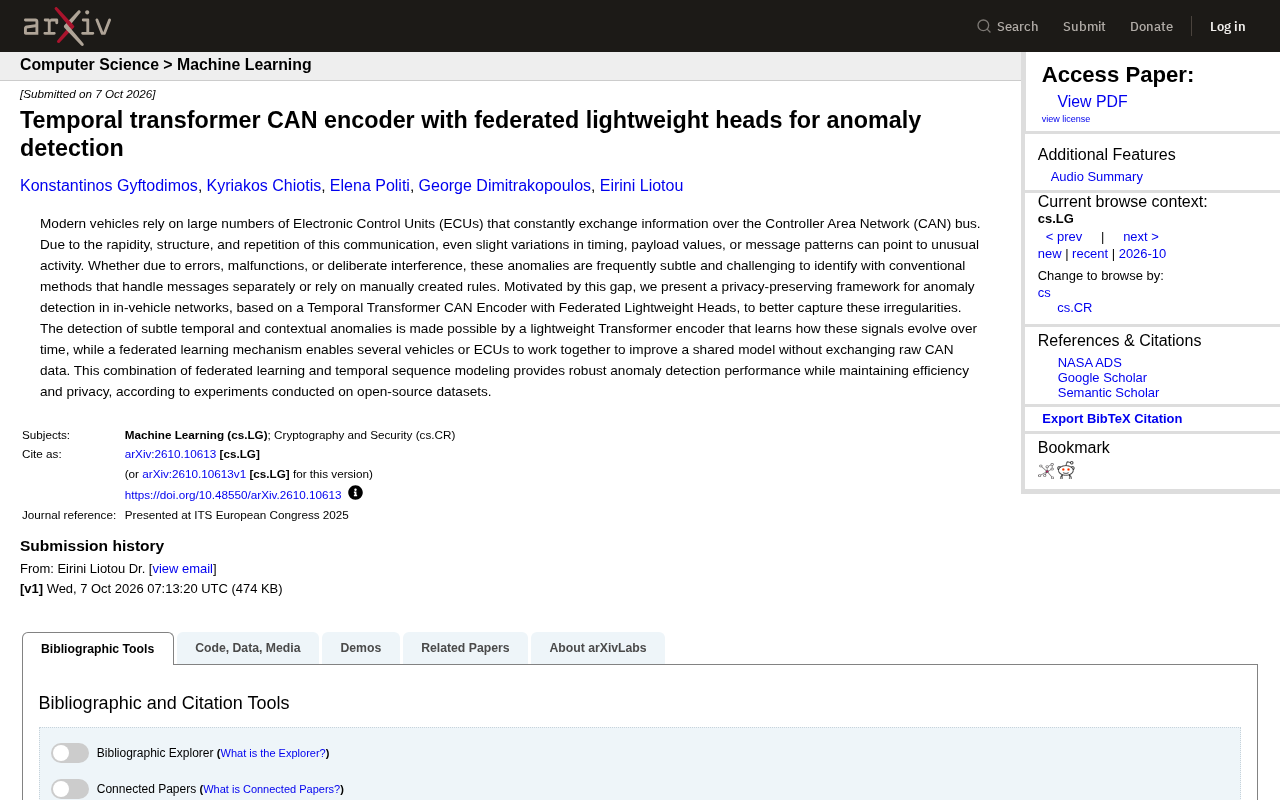
A newly published arXiv paper (arXiv:2610.10613v1) points out that subtle changes in CAN bus message timing, payload values, or frame patterns are often the telltale signs of anomalous activity — whether caused by system errors, hardware faults, or deliberate external interference. The challenge is that such anomalies are typically extremely covert. Traditional approaches either process individual messages in isolation or rely on hand-crafted rules, making it difficult to catch real threats.
The CAN (Controller Area Network) bus was originally designed by Bosch in the 1980s for in-vehicle communication, using a broadcast-based multi-master architecture: all ECUs connected to the same bus can receive every message, and they filter the messages they need based on message IDs rather than addresses. This design is simple and efficient in a closed physical environment, but it also carries inherent security risks — the bus has no native authentication or encryption mechanism, meaning any node that can physically or logically access the bus can send arbitrary frames. As vehicles connect to the outside world via OBD-II ports, Bluetooth, Wi-Fi, and cellular networks, the remote injection of malicious CAN frames is no longer a theoretical concern but a real threat demonstrated in multiple published security studies.
A One-Two Punch: Temporal Modeling and Federated Learning
This research proposes a privacy-preserving anomaly detection framework for in-vehicle networks, built around two core components: a Temporal Transformer CAN Encoder and Federated Lightweight Heads.
Why Use a Transformer for Temporal Modeling
Anomalies on the CAN bus are often not reflected in any single message, but rather hidden in the evolving patterns of message sequences over time. For example, the transmission interval of a particular frame might suddenly change, or a combination of signals might appear in a context never seen during training. The paper employs a lightweight Transformer encoder to learn how these signals evolve over time, leveraging the attention mechanism's natural advantage in capturing long-range temporal dependencies and contextual relationships.
Compared to traditional approaches that process messages one by one, this sequence-based modeling paradigm can identify subtle anomalies where "each individual message looks normal, but the combination is anomalous" — which is precisely the hardest part of attack detection.
The Transformer architecture was introduced by Vaswani et al. in the 2017 paper Attention Is All You Need, originally for machine translation. Its core is the self-attention mechanism: when processing each element in a sequence, the model dynamically computes relevance weights between that element and all other elements in the sequence, capturing dependencies at arbitrary distances in a single forward pass — overcoming the vanishing gradient problem in RNNs/LSTMs that makes long-range dependencies difficult. Applied to CAN bus analysis, this means the model can simultaneously attend to "the payload of the current frame" and "the state of a related signal hundreds of milliseconds ago," without manually setting an observation window as sliding-window methods require. Lightweight Transformers typically reduce computation by cutting the number of attention heads, lowering hidden layer dimensions, or approximating with linear attention — making real-time inference feasible on the embedded processors found in ECUs.
Federated Learning Solves the Privacy Problem
The other key design element of the framework is the federated learning mechanism. Multiple vehicles or ECUs can collaboratively train a shared model without exchanging raw CAN data.
This matters enormously for real-world deployment. Vehicle operational data involves user privacy and manufacturer-sensitive information — centralizing it carries both compliance risks and transmission costs. Federated learning allows each node to train locally and share only model updates, aggregating diverse samples from across vehicles to improve detection capability while keeping raw data firmly on-device.
Federated Learning was proposed by Google in 2017, originally to address privacy concerns in mobile keyboard prediction models. The basic workflow is: a central server distributes a global model; each local node trains on local data and uploads only gradients or model weight deltas; the server aggregates these updates (typically using algorithms like FedAvg to compute a weighted average) and distributes the updated global model — repeating this iteratively. In a connected-vehicle context, a "node" can be a single vehicle, a single ECU, or an entire fleet, with driving data and behavior patterns never leaving local storage. However, federated learning is not without challenges: model updates themselves can still leak statistical properties of the training data (gradient inversion attacks), and large differences in data distribution across vehicles can cause "non-IID" (non-independent and identically distributed) issues, making global model convergence difficult or degrading performance. These are engineering challenges that must be addressed when deploying the approach in real vehicle environments.
Balancing Efficiency, Privacy, and Performance
The design philosophy of this framework can be summarized as "lightweight" and "collaborative." The Transformer encoder is deliberately designed to be lightweight, and the detection heads similarly emphasize low overhead — critical for resource-constrained automotive computing environments. After all, ECUs have far less compute and power budget than data centers; even the most powerful model is useless if it cannot run in real time on the vehicle.
The paper reports that experiments on open-source datasets validated the framework's effectiveness: the combination of federated learning and temporal sequence modeling delivers robust anomaly detection performance while maintaining efficiency and privacy. In other words, this is an attempt to strike a balance among detection accuracy, operational efficiency, and data privacy.
Implications for Automotive Cybersecurity
As connected and intelligent vehicles proliferate, in-vehicle network security is moving from a niche topic to a core industry concern. This research points to a technical direction worth watching:
- Migrating the mature Transformer architecture from natural language processing to CAN bus temporal analysis demonstrates the potential of attention mechanisms for industrial time-series anomaly detection;
- Using federated learning to sidestep the privacy and compliance barriers of data centralization offers a viable path for collaborative security defense across fleets and manufacturers;
- The lightweight design gives the approach real potential for deployment on actual vehicle hardware — not just in a lab setting.
It should be noted that the paper's validation currently relies on open-source datasets, and significant engineering challenges remain before large-scale deployment in real road environments — including on-vehicle compute adaptation, communication overhead in federated training, and generalization against unknown attacks. But as a piece of cutting-edge research, it clearly sketches out the likely technical shape of next-generation in-vehicle anomaly detection systems.
Related articles

Chain of Thought Isn't Just for AI: How Humans Can Use CoT to Improve Thinking Quality
Chain of Thought isn't just a prompt trick for large models. Starting from a Hacker News discussion, this article analyzes why CoT works for human thinking too, breaks down actionable ways to transfer it, and highlights the key differences between human CoT and machine CoT.
Cloudflare Teams Up with OpenAI: Closi…
Cloudflare Teams Up with OpenAI: Closing the Loop from Vulnerability Discovery to Defense with AI
Cloudflare uses OpenAI Daybreak to investigate security vulnerabilities and generate reviewable remediation plans, while developers use Codex to boost coding efficiency and quality.

Orca Multi-Agent Orchestration in Practice: A Guide to Parallel Collaboration with Claude and Codex
Orca is Stable AI's free open-source agent workbench supporting 34 agents like Claude Code and Codex in parallel. Learn its Git worktree isolation, multi-model orchestration, and mobile management.