Feeding Simulation and Operational Evidence Back into Design Models: Closed-Loop Optimization for Cyber-Physical Systems

A new workflow closes the CPS development loop by feeding simulation and operational evidence back into design models.
In CPS development, design-time models' early assumptions are often exposed as incomplete or flawed during simulation and real-world operation, yet no systematic method exists for feeding that execution evidence back into design models. This paper proposes an evidence-driven workflow using the Influence Model as its vehicle, demonstrating through a sign-following robot use case how simulation observations can improve design models across four dimensions: participant pruning, interaction characterisation, influence-function abstraction, and validity-scope annotation. The core value is making the previously implicit, intuition-driven feedback process explicit and traceable. The work primarily validates feasibility in simulation scenarios; integrating operational evidence and scaling to larger systems remain open challenges.
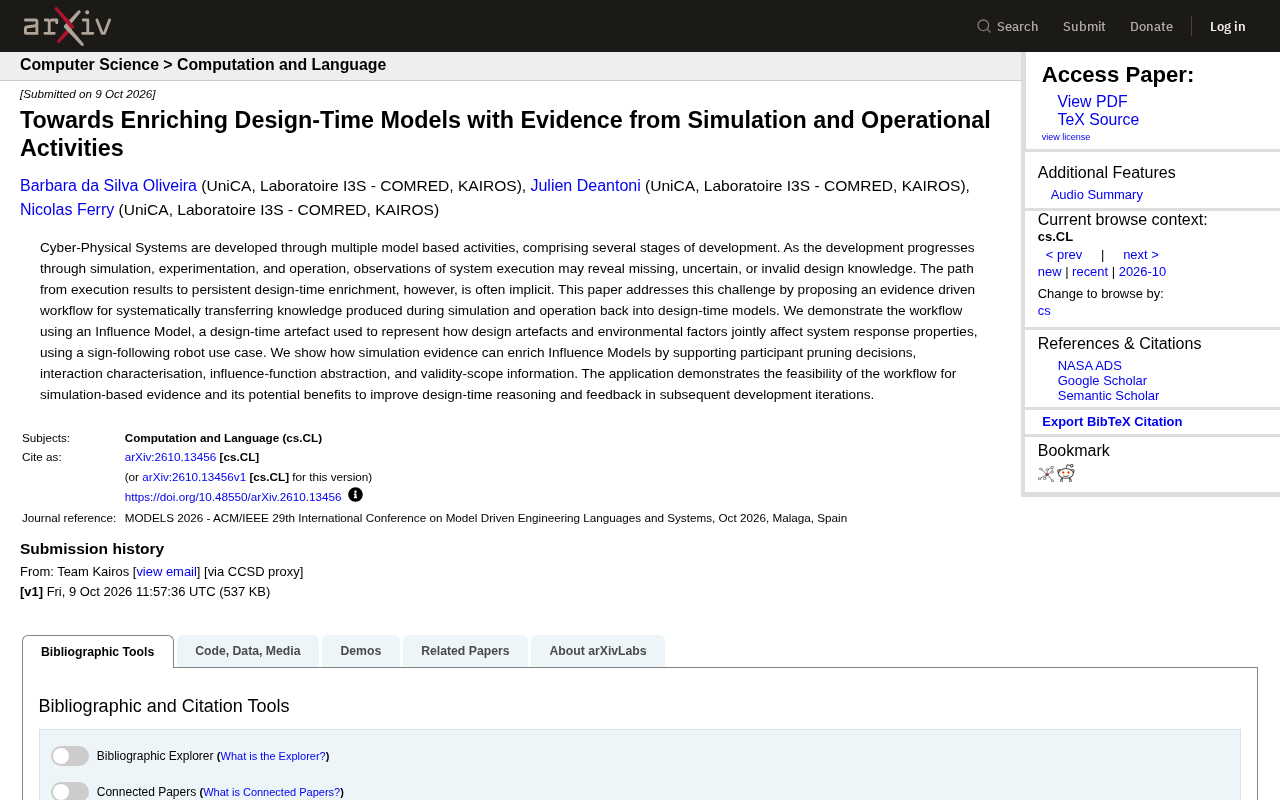
The development of Cyber-Physical Systems (CPS) typically spans multiple model-based activity phases — from design and simulation through experimentation to real-world operation. As development progresses, observational data generated during system execution frequently exposes gaps, uncertainties, or invalid assumptions in the original design-phase knowledge. Yet in practice, the path from execution results back to persistent improvements in design-stage models is often implicit and lacks systematic methodological support. A newly published research paper sets out to fill this gap.
The Root Problem: Disconnected Development Phases
In conventional CPS development workflows, design-time models serve as the starting point, encoding engineers' early assumptions and constraints about system behavior. But once development moves into simulation and operation, vast amounts of valuable execution evidence are generated — system responses in real or simulated environments, interaction patterns, and the actual behavior at boundary conditions.
The problem is that this evidence is difficult to transfer back into design models in a structured way. Development teams tend to adjust designs through experience or informal means, without a clear, traceable "evidence-driven" pathway. This means that design-time reasoning cannot fully leverage the knowledge accumulated in later phases, creating an information gap across development iterations.
Cyber-Physical Systems are complex systems that deeply integrate computation, communication, and physical processes — canonical examples include autonomous vehicles, industrial robots, smart grids, and medical devices. The particular challenge in their development is that real-world uncertainties (sensor noise, environmental disturbances, variations in material properties) are difficult to fully anticipate during early design. Model-Based Engineering (MBE) attempts to address this by using formal models throughout the development lifecycle, but most methodologies still rely on individual engineers' experience when it comes to "feeding operational insights back into design" — there is no standardized information-flow mechanism. This disconnect is especially dangerous in safety-critical systems, where erroneous assumptions left in design models can have serious consequences in real-world deployment.
The Core Contribution: An Evidence-Driven Workflow
The paper's central proposal is an evidence-driven workflow for systematically feeding knowledge from simulation and operational phases back into design-time models. The value of this workflow lies in making the feedback process — previously implicit and intuition-dependent — explicit and structured, so that knowledge transfer becomes both actionable and traceable.
In other words, it attempts to answer a long-overlooked engineering question: when we observe an unexpected system behavior in simulation, how should that observation be translated into a concrete revision of the design model?
The Influence Model as the Practical Vehicle
The research team chose the Influence Model as the demonstration vehicle. An Influence Model is a design-time artifact that represents how design elements and environmental factors jointly affect a system's response properties. Rather than capturing single causal relationships, it models the complex network of multiple interacting factors that shape system behavior.
The paper uses a sign-following robot as a use case to illustrate how the workflow operates. Through this concrete scenario, the research demonstrates that simulation evidence can enrich an Influence Model along four dimensions:
- Participant pruning: Using simulation evidence to determine which design elements have no significant effect on system responses, thereby simplifying the model.
- Interaction characterisation: Clarifying how different elements interact with one another.
- Influence-function abstraction: Abstracting observed influence relationships into reusable functional representations.
- Validity-scope information: Annotating the conditions under which a piece of design knowledge holds, preventing its misapplication outside those bounds.
These four dimensions cover the key aspects of design model refinement — eliminating redundancy, filling in interaction details, and delineating the applicability boundaries of knowledge.
The Influence Model originates from formal requirements and design engineering methods. Its core idea is to treat a system's response properties (such as a robot's line-following accuracy) as a function of multiple "influencing factors" acting together, rather than a simple input-output mapping. This representation is particularly well-suited to CPS scenarios, where physical system behavior is typically determined by the interplay of heterogeneous factors — sensor precision, control algorithm parameters, ambient lighting, surface friction, and more. Compared to traditional causal graphs or decision trees, Influence Models place greater emphasis on "multi-factor interaction under uncertainty" and explicitly annotate each piece of knowledge with its confidence level and applicability preconditions. This makes them a natural vehicle for evidence-enrichment operations: every simulation observation can be mapped to a specific node or connection in the model, ensuring that every revision is traceable and justified.
Significance and Limitations
The value of this work lies in demonstrating the feasibility of feeding evidence back into design within simulation scenarios, and in showing its potential to improve design-time reasoning and the quality of feedback across subsequent development iterations. For complex systems engineering, this kind of closed-loop knowledge management has the potential to reduce design rework and increase model credibility.
That said, the paper currently focuses primarily on the application of simulation evidence; the full integration of operational-phase evidence remains a direction to be further developed. Additionally, the sign-following robot is a single use case, and the scalability of the workflow to more complex, larger-scale CPS systems still requires further empirical validation.
For researchers and engineers focused on Model-Based Engineering and system design methodology, this paper offers a thought framework worth borrowing: design should not be a one-time starting point, but a living artifact that continuously absorbs downstream evidence and iteratively corrects itself.
Related articles

Python 3.15 New Feature: Is the sentinel Type Better Than None?
Python 3.15 adds the sentinel type, using named unique sentinel objects to replace None and bare object(), resolving confusion among missing values, explicit emptiness, and invalid input while avoiding type hint failures.

Deep Learning's Three Architectures and the Universal Approximation Theorem: A Complete Guide to MLPs, CNNs, and Transformers
Explaining the inductive bias differences among MLP, CNN, and Transformer, the existence meaning of the Universal Approximation Theorem (UAT), and the role of Taylor expansion in approximation analysis, while clearing up common misconceptions.

GitLab Emergency Patch Release: Analysis of Critical Security Fixes
GitLab releases critical patch 19.5.1, sparking 355 points of discussion on Hacker News. This article analyzes the background, upgrade steps for self-hosted instances, and verification points to help DevOps teams respond quickly to security updates.