Fewer: A Minimalist Android Launcher That Redefines Focus Through 'Pickups'

Fewer is a minimalist Android launcher that replaces screen time with pickup counts to help you reclaim focus.
Fewer is an Android launcher by indie developer Ali Sarac that reached #7 on Product Hunt. Its core innovation is replacing "screen time" with "pickups" as the primary metric for phone dependency — and further distinguishing purposeful pickups from "for nothing" ones that reflect compulsive checking. The home screen is stripped down to just today's task, pickup stats, and six key apps. It adds friction before time-sink apps and keeps everything fully local with no server, no account, and no ads. Fewer's value lies not in feature depth, but in using design constraints to help users build more intentional phone habits.
Fewer: A Different Way to Measure Phone Addiction
Most digital wellness tools fixate on "screen time," but Fewer takes a more fundamental approach — tracking how many times you actually pick up your phone. This Android launcher, which debuted at #7 on Product Hunt with 104 upvotes and 7 reviews, argues that "pickups" are a far better measure of your relationship with your phone than screen time ever was.
Why Count Pickups Instead of Screen Time
Screen time is a cumulative metric. It tells you how long you used your phone today, but it obscures a far more troubling behavior: the unconscious, repetitive checking. You might have only used your phone for two hours, yet picked it up a hundred times — many of those resulting in nothing more than a blank stare at the screen before putting it back down.
That's exactly what Fewer targets. It splits "pickups" into two categories: times when you actually accomplished something, and times that were "for nothing" — a mindless unlock that led nowhere. The latter is often the real culprit behind fragmented attention and broken focus. Compared to screen time, pickup count more accurately reflects anxious, compulsive checking behavior.
A "Quiet" Home Screen by Design
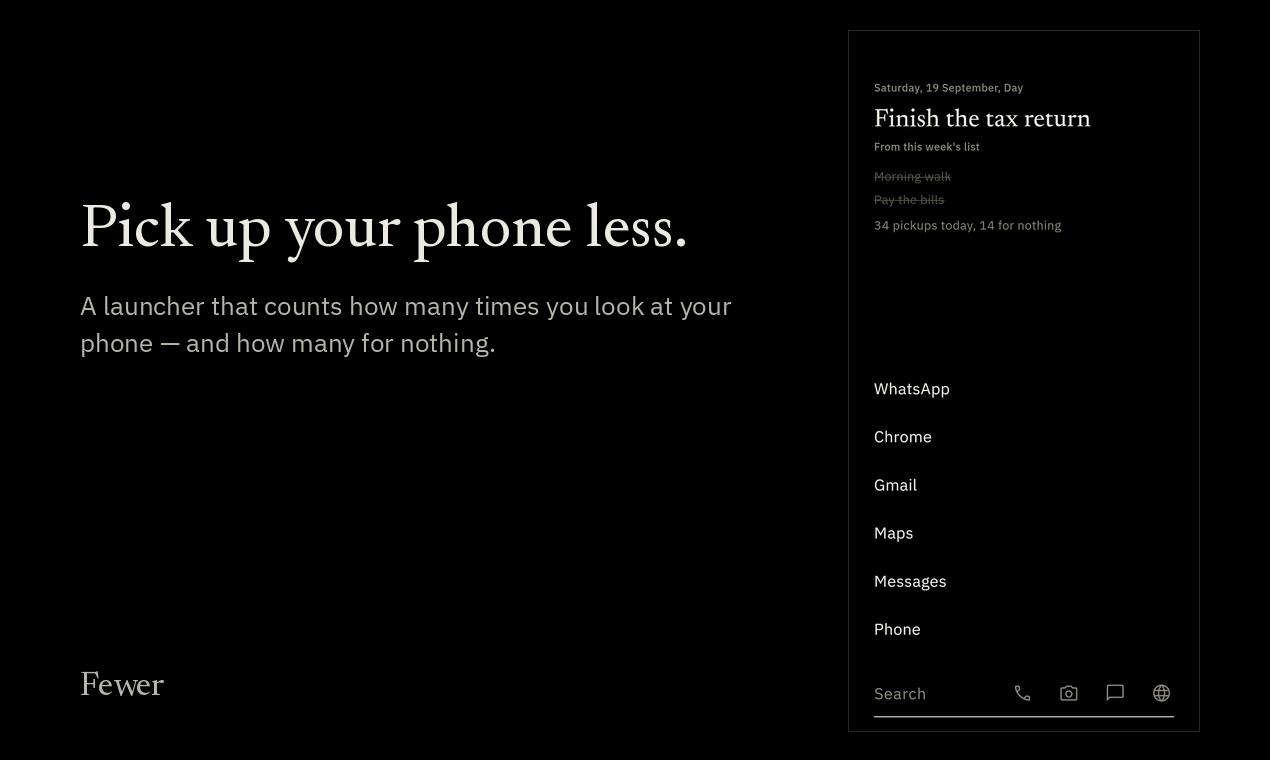
Fewer expresses its philosophy through a deliberately minimal home screen. According to the product description, it displays only three things:
- Today's task: So the first thing you see when you unlock is what you actually need to do — not a flood of notifications;
- Pickup count: Including total pickups and how many were "for nothing";
- Six genuinely useful apps: Not a drawer stuffed with dozens of icons.
This "less is more" design philosophy stands in stark contrast to the information-dense launchers on the market. Rather than helping you use more apps more efficiently, Fewer reduces entry points and visual noise to curb the impulse to open your phone in the first place.
A Pause Before the Time Sink
The product also highlights a key mechanic: Time sinks get a pause — for apps prone to drawing you in, Fewer inserts a brief interruption. This is a form of friction design: right before you mindlessly tap into a social media or short-video app, it gives you a buffer moment to ask yourself: do I actually want to open this right now?
This approach of "adding micro-friction" has been validated in the digital wellness space — even a one-second pause can significantly reduce the rate of impulsive app opens.
"Friction design" is a classic intervention in behavioral design, rooted in behavioral economics research on default options and nudges. The Stanford Persuasive Technology Lab has shown that digital product designers have long worked to reduce friction — one-tap access, autoplay, infinite scroll — all designed to keep users engaged with minimal resistance. "Protective friction" flips this script by deliberately introducing small obstacles: requiring confirmation, inserting a countdown, or simply displaying a prompt. Experimental data suggests that even a 2–3 second confirmation delay can reduce impulsive actions by 20–30%. This works because most unconscious unlocks happen before the prefrontal cortex — the brain's rational decision-making center — has had a chance to engage. A brief pause gives the rational mind a window to intervene.
Privacy First: No Server, No Account, No Ads
Fewer explicitly commits to "No server, no account, no ads." All pickup statistics and task data are processed locally — nothing is uploaded to a server, and no account registration is required.
This matters more than ever. A tool that records your behavioral habits is, by nature, handling highly sensitive personal data. Fewer's fully local approach eliminates privacy risks and removes any advertising incentive — keeping the product logically consistent with its stated mission of helping you use your phone less. It doesn't profit from your attention.
"Local-first" software is a design philosophy that has gained traction in the indie developer community in recent years, systematically articulated by the Ink & Switch research team in their 2019 paper of the same name. Its core premise: user data belongs on the user's device first, with cloud sync as an option rather than the default architecture. For digital wellness tools in particular, local-first is especially important — usage habits, unlock frequency, and task content are as sensitive as health metrics. Once uploaded to a server, that data is vulnerable to breaches, ad profiling, or loss if the company shuts down. The tradeoff is the inability to sync across devices — but for a product like Fewer, whose goal is less usage, that tradeoff aligns perfectly with its values: it doesn't need your data, and it doesn't need you to stay online.
Who Is Fewer For?
Fewer is categorized under Android, Health & Fitness, and Productivity, and was built by indie developer Ali Sarac. It's designed for people who:
- Realize they unconsciously unlock their phone over and over and want to measure and change that habit;
- Are tired of flashy, complex launchers and want a minimal, quiet home screen experience;
- Are privacy-conscious and don't want behavioral data uploaded or used for advertising.
It's not for power users who need heavy multitasking and dozens of shortcuts — but that's precisely the point. Fewer's goal isn't to make your phone use feel better; it's to make it less frequent and more intentional.
Takeaway
Fewer redefines the digital wellness metric by focusing on "pickups" — a measure far more closely tied to compulsive behavior than screen time. Its minimal home screen, pause-before-time-sinks mechanic, and fully local privacy architecture together form a product with a clear and consistent point of view. Its value isn't in feature accumulation — it's in using design constraints to help users reclaim agency over their attention. For anyone genuinely trying to reduce phone dependency, this restrained, intentional approach is well worth trying.
Related articles

Chain of Thought Isn't Just for AI: How Humans Can Use CoT to Improve Thinking Quality
Chain of Thought isn't just a prompt trick for large models. Starting from a Hacker News discussion, this article analyzes why CoT works for human thinking too, breaks down actionable ways to transfer it, and highlights the key differences between human CoT and machine CoT.
Cloudflare Teams Up with OpenAI: Closi…
Cloudflare Teams Up with OpenAI: Closing the Loop from Vulnerability Discovery to Defense with AI
Cloudflare uses OpenAI Daybreak to investigate security vulnerabilities and generate reviewable remediation plans, while developers use Codex to boost coding efficiency and quality.

Orca Multi-Agent Orchestration in Practice: A Guide to Parallel Collaboration with Claude and Codex
Orca is Stable AI's free open-source agent workbench supporting 34 agents like Claude Code and Codex in parallel. Learn its Git worktree isolation, multi-model orchestration, and mobile management.