Fez: A Mac App That Lets Multiple AI Agents Collaborate and Make Decisions Like a Team

Fez is an open-source Mac app enabling multiple AI agents to collaborate in a shared workspace using the decentralized nostr protocol.
Fez is an open-source Mac desktop app built by an independent developer, where multiple AI agents share a workspace and dynamically allocate tasks through collective "room" decision-making rather than relying on a single agent or hard-coded rules. It uses the decentralized nostr protocol for agent communication, eliminating dependence on centralized servers and offering a differentiated path for data autonomy. Unlike developer frameworks such as AutoGPT, Fez targets everyday users as a finished product. Currently in early stages with 79 upvotes on Product Hunt, the concept has drawn interest, but coordination efficiency and practical usability remain to be proven.
What Is Fez
Fez is a Mac desktop application built around a straightforward idea: let multiple AI agents work together as members of the same workspace, with the entire "room" deciding which agent handles which task. It earned 79 upvotes on Product Hunt, landing at #20 for the day, and is listed under categories including Mac, Open Source, Artificial Intelligence, and GitHub.
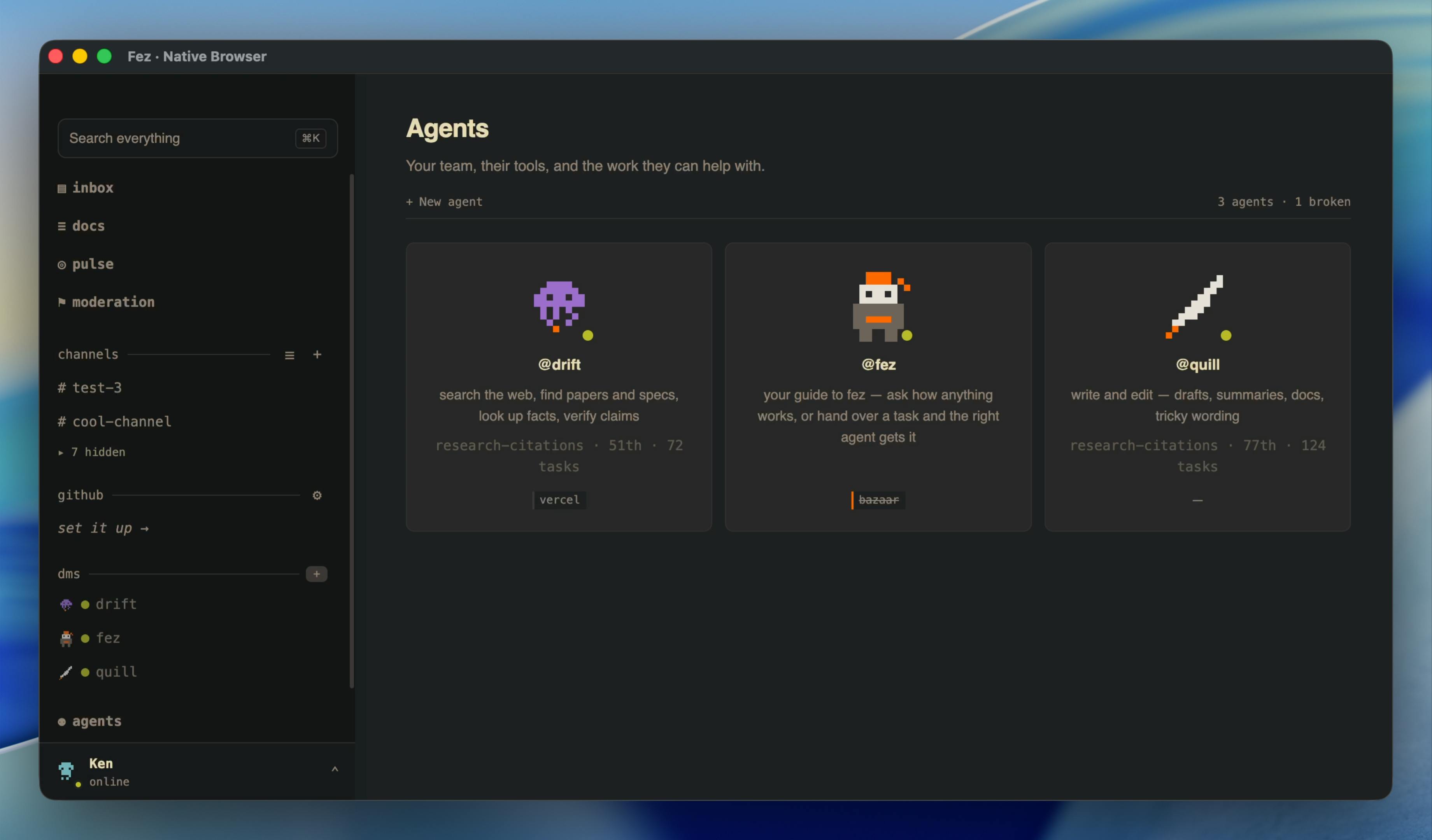
Unlike the single-AI-assistant model common in most products today, Fez aims to bring the human concept of "team collaboration" into AI workflows. Instead of facing a single isolated chat window, you have a group of agents with distinct roles communicating in a shared environment, distributing responsibilities and making decisions together.
The Design Philosophy Behind Multi-Agent Collaboration
What makes Fez particularly interesting is that it hands decision-making authority to the "room" rather than to any single agent. According to the official description, multiple AI agents exist as members of the same workspace, with the collective deciding who takes on what work. This design mirrors how real teams divide labor — tasks aren't hard-coded to specific agents but are dynamically dispatched based on context.
This model addresses a real pain point in current AI applications: a single large model often struggles to juggle complex, multi-step tasks without dropping the ball. Breaking tasks down across multiple specialized agents and integrating results through a coordination mechanism can theoretically improve overall reliability and efficiency. That said, the coordination overhead of multi-agent systems and how to resolve decision conflicts remain core challenges that products like this need to continuously refine.
Multi-Agent Systems (MAS) are a classic research topic in artificial intelligence and distributed computing. The fundamental idea is to decompose complex tasks and distribute them among multiple autonomous agents with different capabilities or roles. Before the rise of large language models (LLMs), MAS were mostly found in academic settings like robotic simulation and game theory. Around 2023, with the widespread adoption of powerful foundation models like GPT-4, "LLM-powered multi-agent frameworks" such as AutoGPT, MetaGPT, and CrewAI emerged rapidly. The core paradigm assigns each agent a role (e.g., "product manager," "engineer," "tester") and completes end-to-end tasks through structured dialogue. The main challenges with these frameworks are that communication costs between agents scale exponentially as the number of agents grows, and when agents produce contradictory outputs, designing an effective arbitration mechanism becomes critical. Fez's collective "room" decision-making mechanism is a design attempt to address exactly this problem.
Built on Decentralized Protocols Like nostr
Fez's technology choices are distinctive — it is built on the nostr protocol (the original description also mentions jev, likely referring to a related technical component). nostr is a decentralized social and communication protocol known for its censorship resistance and user-controlled data.
Building multi-agent collaboration on a decentralized communication protocol like nostr means that message passing between agents doesn't rely on a centralized server. This offers a fundamentally different approach to data sovereignty and privacy compared to mainstream cloud-based solutions. For users who care about data autonomy and want to avoid being locked into a single platform, this is an intriguing direction. However, decentralized architecture can also introduce engineering challenges around latency and state synchronization — how well it performs in practice remains to be seen.
nostr (Notes and Other Stuff Transmitted by Relays) was proposed by developer fiatjaf around 2020. Its core design is remarkably simple: users hold a public-private key pair as their identity, and messages are broadcast and forwarded through independent relay servers that anyone can run. Unlike traditional social platforms, nostr has no central authority that can ban accounts or delete content — identity is controlled by keys, and data is owned by users. The protocol gained widespread attention largely due to censorship controversies following Elon Musk's acquisition of Twitter, and figures like Jack Dorsey publicly expressed support for it. Applying nostr to multi-agent communication means each AI agent can hold its own key pair, with message exchanges between agents routed through a decentralized relay network — eliminating architectural dependency on any single cloud provider. This design is especially appealing to users who want to run AI workflows on local or private infrastructure.
Open Source and Product Positioning
Fez is explicitly labeled as an open-source project and appears under the GitHub category. Being open source means developers can inspect the implementation details of its collaboration mechanisms, and it leaves room for community contributions and derivative development. For an early-stage product exploring the multi-agent collaboration paradigm, open sourcing is both a way to build trust and a mechanism for rapid iteration.
Fez is currently focused on the Mac desktop and was built by an independent developer named ken. With only 1 comment on Product Hunt, it's still at a relatively early stage with a limited community — but 79 upvotes suggest that the "team-style AI collaboration" concept has genuinely caught people's attention.
What to Watch For
Multi-agent collaboration is one of the hottest areas of exploration in AI applications right now. From AutoGPT to various agent frameworks, the industry is searching for effective paradigms to make AI "work in teams." Fez differentiates itself in two ways: it's not a developer framework but a finished desktop product aimed at general users, and it has chosen the decentralized nostr protocol as its underlying communication foundation — something rarely seen among similar products.
For Mac users who want to try out multi-agent workflows and care about data autonomy, Fez offers a hands-on open-source option. Whether it can deliver on its promises around coordination efficiency and real-world usability will require time and user feedback to determine.
Related articles

WorkBuddy Full Guide: How an AI Coworker Takes Over Workplace Automation
What is WorkBuddy? This article analyzes the core capabilities of this full-scenario AI agent: autonomous execution with deliverable results, local file processing, multi-agent parallelism, and workplace automation workflows, helping you judge its essential difference from ordinary AI chat tools.

The Truth About AI Agents: A Hundred Lines of Code + an LLM, Deconstructing the Agent's Underlying Logic
AI agents aren't a new AI species—just a language model plus tools, a loop, and a goal. Here's the underlying logic: how 100 lines of Python hit a 75% fix rate, why the harness beats the model, and Gartner's "agent washing."

AI Agent Deployment: Three Things Developers Should Do
AI Agent deployment doesn't require rushing into multi-agent systems. This article outlines an actionable deployment path and engineering acceptance thresholds for developers, covering human baselines, bounded single-agent scope, and a controlled code-modification loop.