Fi Ultra Review: The First Starlink-Connected Pet Tracker and How Satellite Connectivity Finds Lost Pets

The Fi Ultra is the first Starlink-connected pet tracker, using three-layer GPS/LTE/satellite failover to eliminate dead zones.
The Fi Ultra is the first pet tracker to tap into the Starlink satellite network, using a three-layer GPS → LTE → T-Satellite failover to locate pets nationwide even in signal dead zones. This review examines its direct-to-cell technology, battery-life pressures, U.S.-only coverage, and subscription costs to help you decide if it's worth buying.
When Pet Trackers Connect to Space Networks
A lost pet is one of the most feared scenarios for any pet owner. While traditional GPS-plus-LTE trackers can cover most cities and residential areas, they tend to fail at the moment they're needed most—once a pet wanders into a signal dead zone, whether in remote wilderness or areas beyond cell tower coverage. The Fi Ultra exists precisely to fill this gap.
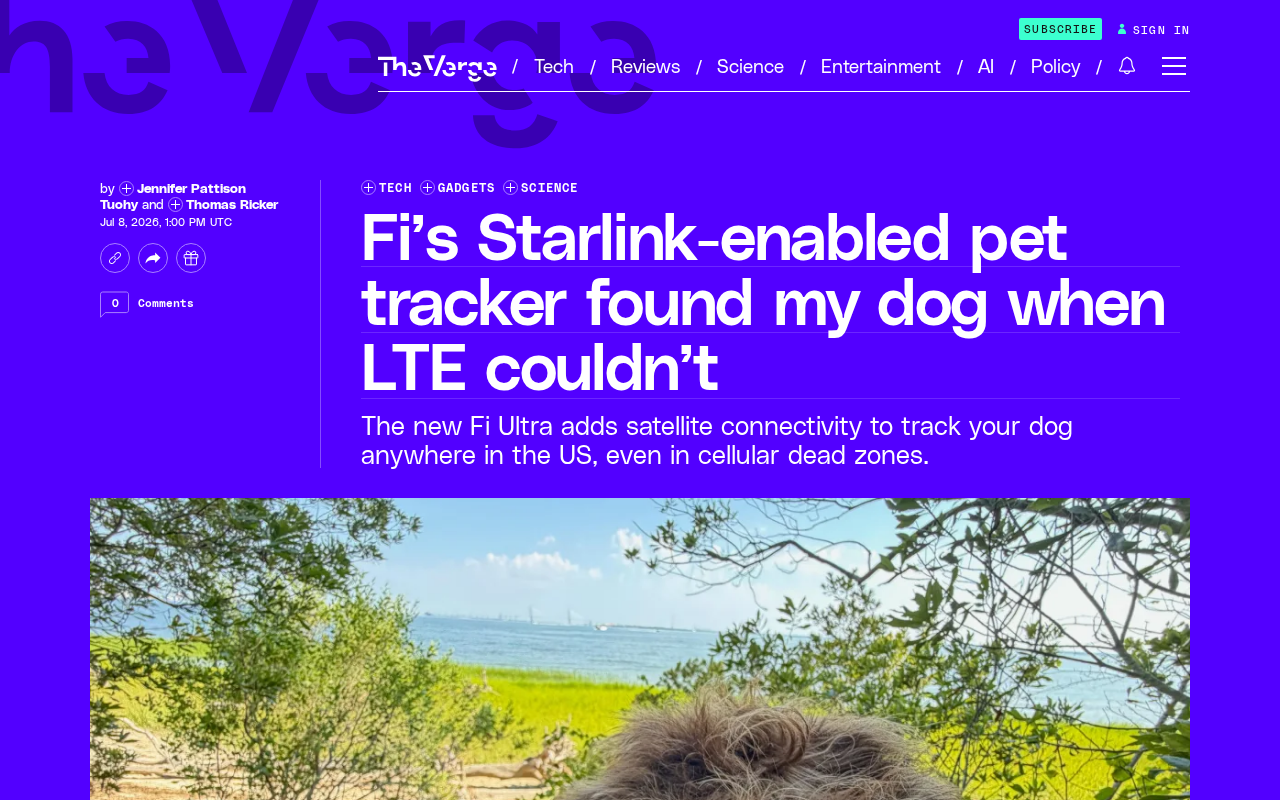
As the first pet tracker to connect to the Starlink satellite network, the Fi Ultra adds a critical new capability on top of GPS and LTE: when the device enters a cellular dead zone, it will automatically fail over to T-Mobile's T-Satellite direct-to-cell service. This means that even in places where terrestrial base stations can't reach, pet owners can still locate their pets in real time across the entire United States, leveraging the low-earth-orbit (LEO) satellite constellation deployed by SpaceX.
Background on LEO satellite constellations: Low-earth-orbit (LEO) satellites operate at altitudes of roughly 200 to 2,000 kilometers. Compared to traditional geostationary orbit (GEO) satellites (at about 36,000 kilometers), their most notable advantage is that signal round-trip time (RTT) drops dramatically from over 600 milliseconds to 20–40 milliseconds. This order-of-magnitude improvement makes real-time interactive applications feasible. By the end of 2024, SpaceX's Starlink constellation had deployed over 6,000 satellites, making it the largest commercial satellite internet network in human history. To maintain continuous coverage, Starlink uses a multi-orbital-plane networking strategy, with orbital planes of different inclinations interweaving to ensure that most areas on Earth have several satellites above the communicable elevation angle at any given moment. The massive scale of the constellation not only provides coverage redundancy but also significantly boosts overall system throughput by increasing frequency-reuse opportunities—this is precisely the physical foundation that supports emerging applications like direct-to-cell.
Three-Layer Network Redundancy: The Logic Behind Always-On Positioning
The core technical highlight of the Fi Ultra is that it builds a multi-layer network redundancy system with a clear positioning priority:
- GPS positioning: Provides precise geographic coordinates and serves as the foundational capability layer;
- LTE cellular network: Serves as the primary data backhaul channel—low cost, low latency;
- Starlink satellite (T-Satellite): Serves as the last-resort fallback, automatically taking over the connection when the first two are unavailable.
The core value of this "automatic failover" design lies in seamless switching—users don't need to manually select a network mode; the device intelligently schedules connectivity based on the real-time signal environment.
Failover and multi-network redundancy design: Failover originated in the telecommunications and data center domains and is one of the core design patterns for building high-availability systems. Its implementation typically relies on three technical components: continuous link health monitoring, a threshold policy that triggers switching, and a session persistence mechanism during the switchover. In enterprise networks, SD-WAN (software-defined wide area network) technology has already standardized multi-link failover. However, miniaturizing and integrating similar capabilities into a consumer-grade wearable chip presents an entirely different set of constraints—chip area, thermal limits, and battery capacity all pose hard bottlenecks. The Fi Ultra needs to simultaneously maintain the parallel operation of a GPS receiver, an LTE baseband, and a satellite communication module within the same device, coordinating their wake and sleep states through resource-scheduling algorithms at the firmware layer. This design philosophy—porting enterprise-grade network reliability concepts into a consumer electronics form factor—represents an important direction in the evolution of IoT device connectivity architecture.
The chip integration challenge for pet trackers: Integrating three wireless technologies—GPS, LTE, and satellite communication—into a device the size of a pet collar involves not just the issue of chip area but, more critically, the challenge of managing RF interference. When three wireless systems operate in parallel within the same device, their respective transmit signals can interfere with each other's receive sensitivity—especially given that satellite signals themselves are extremely weak (ground reception power is typically on the order of -120 dBm) and can easily be drowned out by the transmit signals of the same device's LTE module. Engineering solutions typically include frequency-band isolation, time-division multiplexing (TDMA-style coexistence), and sophisticated RF front-end filter design. Multimode Cat-M/NB-IoT+GNSS SoC solutions introduced by chip makers like Qualcomm and MediaTek in recent years have already hardened some coexistence logic. But the addition of a satellite modem means the Fi Ultra's RF architecture requires further custom design on this foundation—which is why tri-mode integration remains a high-end custom solution rather than a mass-produced standard.
In cities, the device relies mainly on LTE and GPS; once it enters a dead zone, it seamlessly switches to the satellite link. This kind of experience is an important sign that consumer-grade satellite connectivity products are maturing.
Direct-to-Cell: Satellite Communication Is Entering Everyday Life
The T-Satellite service behind the Fi Ultra represents the most important technical trend in satellite communication today—Direct-to-Cell.
In the past, connecting to a satellite network required a dedicated satellite phone or a bulky antenna. But the direct-to-cell technology developed through the SpaceX and T-Mobile partnership allows standard cellular devices to communicate directly with low-earth-orbit satellites, without any additional hardware.
Background on the T-Satellite service: When T-Mobile and SpaceX announced their strategic partnership in 2022, the industry widely regarded it as a long-term technical vision for the post-2025 timeframe. The core of the collaboration is the addition of a dedicated cell payload aboard Starlink Gen2 satellites. This payload operates on T-Mobile's licensed PCS band (1900 MHz), enabling satellites to emulate terrestrial base stations and initiate communication with ordinary LTE devices. These satellites operate in a low orbit of about 525 kilometers, with phased-array antennas covering roughly 1 million square miles of cellular service area on the ground. Notably, direct-to-cell demands extremely high effective isotropic radiated power (EIRP) from the satellites—the satellite antennas must transmit at power levels several orders of magnitude stronger than traditional communication satellites in order to be captured by ordinary handset antennas on the ground. This is the fundamental reason the technology remained conceptual for so long, becoming engineering-feasible only with the arrival of SpaceX's large satellite platforms. The service entered its beta testing phase in late 2024, initially supporting text messaging and limited data, with voice calling capability still evolving. It is within this technology window that the Fi Ultra became the first commercial product to bring T-Satellite capability into the vertical scenario of pet tracking.
The core breakthrough of direct-to-cell technology lies in having satellites emulate the communication protocols of terrestrial base stations (LTE/5G standards), allowing ordinary phones or IoT devices to connect to the satellite network without any hardware modification. Traditional satellite communication requires directional antennas pointed at the satellite, whereas direct-to-cell satellites carry more powerful phased-array antennas capable of capturing the faint signals emitted by ground devices—the satellite plays the role of a "base station in the sky" in orbit.
The protocol compatibility principle behind direct-to-cell: The core challenge of direct-to-cell technology at the protocol layer is: how to have a satellite orbiting at 525 kilometers and moving at roughly 7.6 km/s continuously emulate an LTE base station that appears "stationary" to a ground device. This involves Doppler shift compensation—the satellite's high-speed motion causes the signal frequency to shift, and the satellite side must predict and correct the frequency deviation in real time so that standard ground-based LTE chips can decode normally. In addition, the satellite must dynamically manage timing advance to compensate for the timing errors caused by changes in signal propagation distance. These engineering problems, which barely exist for terrestrial base stations, become computational tasks that must be handled in real time in the direct-to-cell scenario. This is precisely why early LTE standards did not account for satellite access, and why 3GPP did not formally bring Non-Terrestrial Networks (NTN) into standardization until Release 17, defining a protocol adaptation framework specifically for satellite access scenarios.
This technology was originally aimed mainly at emergency text messaging on smartphones, but Fi has cleverly ported it into the vertical application of pet tracking.
It's worth noting that the commercialization of satellite communication is undergoing profound change: from the early Iridium era (1998) when dedicated equipment was required and calls cost as much as $7 per minute, to 2022 when Apple integrated satellite Emergency SOS starting with the iPhone 14, to today's Fi Ultra extending satellite connectivity to pet wearables—the barrier to satellite access is continuously and visibly lowering. Behind this historic shift is a dual driver: new-generation operators like SpaceX dramatically reducing the cost of getting satellites into orbit through bulk launches, and advances in semiconductor technology enabling satellite modem chips to be integrated into consumer-grade devices.
The competitive landscape of direct-to-cell: The T-Mobile/SpaceX partnership is not an isolated case, but part of a multi-party industry race. AST SpaceMobile achieves direct-to-cell by deploying large LEO satellites (each BlueBird-series satellite has a deployed surface area exceeding 700 square meters) and has signed agreements with AT&T and Verizon. Apple leverages Globalstar's satellite network to provide Emergency SOS and roadside assistance texting for the iPhone, expanding to satellite messaging with the iPhone 16 series. Qualcomm, through its Snapdragon Satellite platform, pushes satellite modem capability down to the chip layer, driving the standardization of direct-to-cell in the Android ecosystem. The core of this competition is not just coverage area, but who can first drive down satellite access costs to a subscription price range acceptable to consumers, and replicate those capabilities across a broader range of device categories through standardized chip solutions—pet trackers, child locators, and industrial IoT tags will all be among the next beneficiaries.
The standardization process for non-terrestrial networks: 3GPP (the 3rd Generation Partnership Project), as the core body defining global mobile communication standards, directly shapes the long-term ecosystem trajectory of direct-to-cell technology through its standardization process. Release 17 (frozen in 2022) brought NTN into the formal standard for the first time, defining a protocol adaptation framework for satellites as access nodes. Release 18 further refined the IoT-NTN specification, optimizing the protocol stack specifically for direct-connect scenarios between low-power IoT devices and LEO satellites. The significance of standardization is this: once direct-to-cell capability enters the 3GPP mainstream standard, chip makers like Qualcomm and MediaTek will be motivated to integrate the relevant baseband capability into mass-produced chips. At that point, any device carrying a standard chip will natively support satellite access—which will fundamentally change the current commercial landscape in which the Fi Ultra relies on custom hardware solutions, and may mean that the era of satellite connectivity as a standard feature of consumer electronics arrives faster than expected.
Why Is Pet Tracking an Ideal Landing Scenario?
Pet tracking is almost tailor-made for direct-to-cell technology, for two reasons:
First, extremely low data requirements. Location tracking only requires periodically uploading coordinates, unlike video calls or large file transfers that place high demands on satellite bandwidth. Low data volume means that even in a satellite-connected state, power consumption and operating costs can be kept within a reasonable range.
A comparison of low-power IoT solutions: Before the Fi Ultra chose the direct-to-cell approach, the pet tracking field went through several generations of competing and evolving technical routes. LoRaWAN (Long Range Wide Area Network) is known for extremely low power consumption—a single battery can support years of operation—but its network coverage depends heavily on the geographic density of gateways. LoRa Alliance community gateways are reasonably dense in cities but virtually useless in sparsely populated wilderness. Sigfox, another LPWAN solution, provides a unified operator network, but its infrastructure buildout in the U.S. consistently lagged behind expectations, leaving many rural areas in coverage gaps. The reliability of Bluetooth crowdsourcing solutions (typified by Apple's Find My network) depends entirely on whether other Apple devices are nearby, approaching zero in uninhabited areas. NB-IoT and LTE-M, while carrier-grade LPWAN standards with wider coverage than LoRa, are likewise limited by base station deployment boundaries. Fi Ultra's ultimate choice of an LTE-plus-satellite combination is essentially a systematic breakthrough of the coverage shortcomings of all the above solutions—at the cost of a higher power baseline and operating costs, but in exchange for a genuine promise of "no dead zones." Pet trackers typically manage energy consumption through a sleep-wake cycle: during stationary or low-risk periods, positioning-report frequency is greatly reduced, and the high-power communication module is only woken when an accelerometer detects movement or the user actively queries. The Fi Ultra's actual battery life will largely depend on how deeply its firmware optimizes this dynamic power-scheduling strategy.
Second, lost-pet scenarios closely align with the distribution of dead zones. When a dog runs off into the wilderness or a cat slips into a remote corner, traditional trackers often lose connection at the most critical moment. Satellites' full-area coverage fills precisely this most painful gap—enabling the tracker to truly deliver on "find your pet no matter where it goes."
Must-Read Before Buying: The Real-World Limitations of the Fi Ultra
As exciting as the technical outlook is, the following real-world factors are equally worth noting, as they directly affect the product's actual user experience and value-for-money assessment.
Coverage Area and Response Speed
The T-Satellite direct-to-cell service currently only covers the continental United States; overseas users cannot use this feature for now. In addition, the satellite link has a certain communication latency compared to LTE. While this has limited impact on non-real-time applications like location tracking, users should not expect the same instant update frequency as LTE.
The engineering implications of satellite link latency: Although LEO satellites compress one-way propagation delay to about 20–40 milliseconds, the end-to-end latency of direct-to-cell must also account for ground gateway backhaul, core network processing, and several other stages. The actual user-perceived latency is typically on the order of 100–300 milliseconds. For location tracking applications, this means coordinate updates are not presented instantly, but with a refresh lag of several to tens of seconds—in scenarios where a pet is moving quickly, there may be a discrepancy of hundreds of meters between the displayed position and the actual position. This is an inherent constraint of all satellite-positioning products at the physical level, unrelated to device software optimization.
Battery Life Pressure
The price of a multi-network redundancy design is power consumption. Running the GPS module, LTE module, and satellite communication capability simultaneously poses a considerable challenge for the battery. Frequently triggering satellite connections could significantly shorten battery life in extreme cases—this is one of the key metrics for gauging the Fi Ultra's everyday practicality, pending real-world testing verification.
Subscription Cost and Value for Money
Satellite services typically require an additional monthly subscription fee. Beyond the purchase price of the device itself, satellite connectivity requires ongoing payment to remain active.
- Well suited for: Users who frequently take their pets camping or hiking or who live in remote areas, where satellite assurance has a clear need and offers good value;
- Less suitable for: Users whose pets stay in urban areas long-term and almost never enter signal dead zones, for whom the marginal value of an additional subscription is relatively limited.
The Industry Significance of the Fi Ultra: Space Infrastructure Enters Daily Life
The value of the Fi Ultra may go beyond the product itself. It marks a key turning point: satellite direct-connect technology is moving from "emergency communication" toward "everyday consumer applications."
When even a pet tracker can tap into a low-earth-orbit satellite constellation, it shows that the barrier to satellite communication access is rapidly falling. This trend has a deep industrial logic: as mega-constellations like Starlink continue to expand and satellite manufacturing costs drop dramatically due to mass production, the unit cost of satellite connectivity is moving toward consumer-grade levels. It's foreseeable that more consumer IoT devices in the future—outdoor sports gear, locators for the elderly and children, asset-tracking tags—will incorporate satellite connectivity as a standard-configuration redundancy option.
The industrial logic behind falling satellite manufacturing costs: Traditional communication satellites often cost hundreds of millions of dollars, take years to develop, and deploy only one satellite per launch. SpaceX completely reconstructed this economic model through the Starlink project: adopting a highly standardized flat-panel satellite design, using its in-house Falcon 9 rocket to deploy 60 satellites per launch, and internalizing component costs through vertical integration. It is estimated that the cost of a single Starlink satellite has dropped to around $500,000—far below the per-satellite amortized cost of traditional GEO satellites. This mass-production logic is analogous to Moore's Law in the semiconductor industry—every time output doubles, cost falls proportionally. This downward cost curve ultimately transmits to end-service pricing, making it commercially viable for satellite connectivity to penetrate from high-value professional scenarios like aviation and maritime shipping into the mass consumer market.
For pet owners, the Fi Ultra offers a clear promise: no matter where a beloved pet runs off to, it won't be lost. For the tech industry as a whole, it is yet another vivid footnote to space infrastructure quietly permeating everyday life. Of course, the ultimate value must still be tested over the long term by real users and the market across concrete dimensions like battery life, positioning accuracy, and subscription pricing.
Key Takeaways
- The Fi Ultra is the first pet tracker to connect to the Starlink satellite network, achieving truly dead-zone-free coverage through a three-layer GPS → LTE → T-Satellite failover.
- The underlying direct-to-cell technology allows ordinary IoT devices to connect to satellite networks without dedicated hardware, marking an important milestone in the commercialization of satellite communication.
- Direct-to-cell protocol compatibility depends on key engineering breakthroughs such as Doppler shift compensation, and the NTN standardization in 3GPP Release 17/18 lays the ecosystem foundation for the technology's mass deployment.
- The direct-to-cell arena has already formed a multi-party competitive landscape: SpaceX/T-Mobile, AST SpaceMobile, Apple/Globalstar, and Qualcomm's Snapdragon Satellite each have their positions, and the maturation of standardized chip solutions will be the key inflection point for technology adoption.
- Because of its extremely low data requirements and the high overlap between lost-pet scenarios and dead zones, pet tracking is one of the best early landing scenarios for direct-to-cell technology.
- Real-world limitations include: coverage limited to the continental U.S., inherent satellite link latency, battery-life pressure from running multiple modules in parallel, and the additional subscription fee required for satellite functionality.
- From the Iridium era to the iPhone's satellite SOS to pet trackers, the continuously falling barrier to satellite access reflects a deep industrial trend of space infrastructure penetrating everyday consumer life.
Related articles

Cursor Can Now Control Your Computer: AI Agents Can Drive Desktop Apps for Testing
Cursor adds desktop control: AI agents can drive desktop apps like the iOS Simulator to test their own features. We analyze the impact on dev workflows, possible technical approaches, and reliability concerns.

Vibecoding a Custom Inference Engine: High Hopes, Harsh Reality
A Reddit developer shares the real experience of vibecoding a custom inference engine: running GGUF Q4 models in the browser with WebGL2 and GLSL, only to fall into tokenizer debugging hell. This article analyzes the engineering challenges of browser-side LLM inference and why cloning llama.cpp is the more rational choice.

How High Are Anthropic's Early Investor Paper Returns Ahead of IPO?
Anthropic's early investor paper returns draw attention ahead of IPO. This article analyzes sources of book gains, capital structure, pre-IPO games and risks, and implications for the AI startup ecosystem.