Filament: Galaxy's Open-Source Blazing-Fast Data Replication Engine

Galaxy open-sources Filament, a Go data replication engine covering full, incremental, and CDC in one.
The Galaxy team released Filament on Product Hunt, an open-source data replication engine written in Go, built around moving data via the terminal or AI agents. It folds full loads, incremental replication, and CDC into one engine to avoid fragmented tooling and manual reconciliation. Filament validates Arrow batches at the sink handoff and, where supported, serialized payloads. It runs as a standalone binary or embedded in Go apps, and earned 135 votes and 19 comments on launch day, ranking 2nd.
The data pipeline space has a new player. Filament, released by the Galaxy team on Product Hunt, is an open-source data replication engine written in Go, built around moving data via the terminal or AI agents, with support for full loads, incremental replication, and change data capture (CDC). It picked up 135 votes on launch day, ranking 2nd for the day and sparking plenty of discussion in the developer tools and data categories.
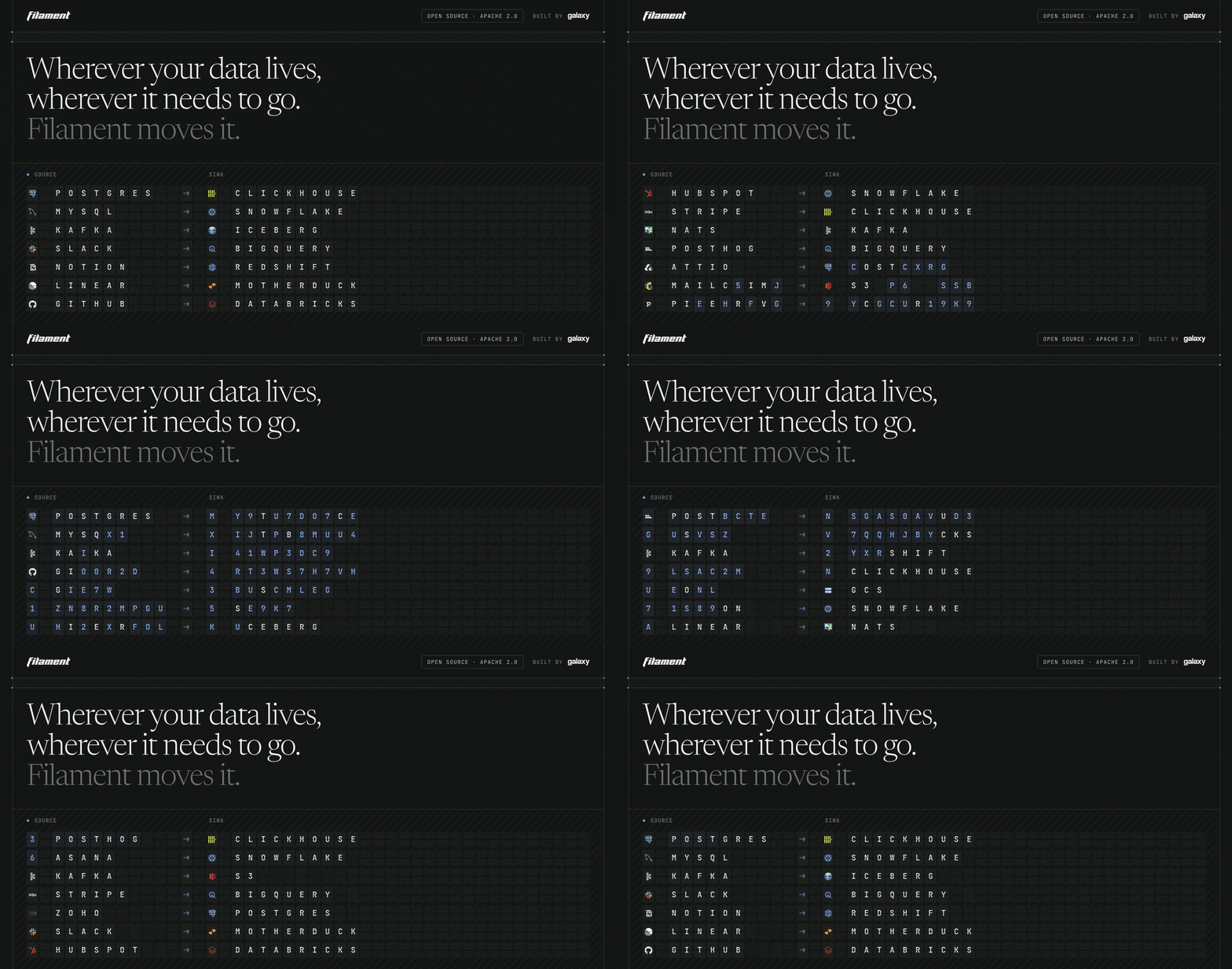
What problem does it solve
Data replication sounds like an old topic, but the pain points in practice are quite concentrated: full migrations are slow, incremental sync easily loses data, and CDC pipelines are complex and hard to verify. Filament's positioning is to fold all three into a single engine rather than making teams stitch together multiple tools.
Being written in Go means it's naturally suited to compiling into a single binary, so deployment doesn't drag along a pile of runtime dependencies. For ops teams this is a real advantage—especially in containerized and edge scenarios, where image size and startup speed are genuine costs.
Three core capabilities: full, incremental, and CDC
Filament explicitly covers three replication modes. Full loads suit initial migration, incremental replication handles day-to-day continuous sync, and CDC captures row-level changes at the source and delivers them to the target in real time. Implementing all three within one engine means configuration and operations interfaces are unified—no need to maintain separate stacks for different modes.
This integrated design is quite valuable in data engineering practice. Many teams start with scripts for full loads and third-party tools for incremental sync, then bring in a CDC component once the business demands real-time behavior—resulting in three systems operating independently, with data consistency propped up by manual reconciliation. Filament tries to eliminate this fragmentation at the architectural level.
Change data capture (CDC) is a technique for reading row-level insert/update/delete events in real time from database logs (such as PostgreSQL's WAL or MySQL's binlog). Compared with timestamp-polling-based incremental sync, CDC can capture deletes, avoid missed rows, and compress latency to seconds or even milliseconds. A typical CDC pipeline consists of a source connector, a change event stream, and a target writer, where resumability and exactly-once semantics are the engineering challenges. By folding CDC together with full and incremental replication into the same engine, Filament means all three can share the same connectors and validation logic, reducing the risk of state inconsistency from stitching together pipelines.
Data validation: double-checking Arrow batches and serialized payloads
Filament makes a notable design choice around data correctness. As data flows through the engine, it validates Arrow batches at the sink handoff and, where the target supports it, further validates the exact serialized payload.
Arrow is the de facto standard for columnar in-memory formats, and using it as the unit of batching means Filament has structured validation capability at the memory level. The "validate serialized payload" step goes further—not only confirming that the logical data matches, but also confirming that the byte stream actually written to the target is consistent. For industries sensitive to data integrity such as finance and healthcare, this kind of validation is a must-have rather than a nice-to-have.
Apache Arrow is a cross-language columnar in-memory format specification that defines how data is laid out in memory (including validity bitmaps, offsets, and buffers), so that different systems can exchange data without serialization/deserialization overhead. An Arrow "batch" (RecordBatch) is a memory block organizing several rows by column, naturally suited to batch validation—schema, nulls, and type consistency can be checked without parsing row by row. Using Arrow batches as the unit of validation is equivalent to taking a structured snapshot comparison before data leaves the engine; the "serialized payload" check targets the actual byte stream when writing to the target (such as a Parquet file or a database wire format). Together they cover consistency at both the logical and physical layers.
Deployment: standalone binary or embedded in a Go application
Filament offers two usage forms. As a standalone binary, it's a command-line tool callable directly from the terminal, matching the product's "move data with the terminal or an agent" pitch. Embedded as a Go library, developers can integrate it into their own applications, using replication as an internal component rather than an external service.
The second form is especially meaningful for platform products. If a SaaS vendor needs to offer data sync within its product, embedding Filament is far more economical than implementing CDC logic from scratch. This also explains why the positioning mentions "agent"—in automated workflows, data movement is becoming a standard action that agents can invoke.
AI agents calling data tools is a current trend in automated workflows: agents trigger data movement tasks through standardized interfaces (such as a CLI, the MCP protocol, or function calling) rather than humans manually running scripts. Filament's pitch of "move data with the terminal or an agent" means its standalone binary form is naturally suited to being invoked by an agent as a subprocess, emitting structured results for the agent to act on. This form requires tools to be idempotent, with predictable exit codes and clear logs—otherwise agents struggle to reliably orchestrate long-running replication tasks. For platform developers, the embedded form allows exposing replication capability as an internal API, which agents can then schedule uniformly.
Open-source strategy and ecosystem position
Filament is released as open source, filed under developer tools and data. Open source is already the mainstream choice in data infrastructure, but what users really need to assess is community activity, documentation completeness, and long-term maintenance commitment. The 19 comments and 135 votes on Product Hunt show it has gained initial attention, but data pipelines are a long-cycle investment, so evaluating a choice still requires watching the pace of subsequent iterations.
Looking at the competitive landscape, the data replication track has both mature commercial products and several open-source projects. Filament's differentiation lies in the combination of the Go ecosystem, native Arrow validation, and embeddability. It may not suit every scenario, but for teams already on the Go stack with high requirements for data consistency, it deserves a place on the evaluation list.
Who is it for
Teams needing database migration, engineers building real-time data sync pipelines, and platform developers who want to embed replication capability in their own products are Filament's most direct target users. If a team already has a mature data integration platform, Filament is more likely to serve as a supplementary tool for specific pipelines than a wholesale replacement.
The out-of-the-box terminal experience lowers the barrier to experimentation, which is one of the key reasons it drew attention on Product Hunt. Adoption decisions for data tools often start with a small-scale proof of concept, and Filament's form fits neatly into this incremental adoption path.
One-line Summary
Galaxy open-sources Filament, a Go data replication engine covering full, incremental, and CDC in one.
Paragraph Summary
The Galaxy team released Filament on Product Hunt, an open-source data replication engine written in Go, built around moving data via the terminal or AI agents. It folds full loads, incremental replication, and change data capture (CDC) into a single engine, avoiding the fragmented multi-tool setups that leave data consistency to manual reconciliation. For validation, Filament checks Arrow batches at the sink handoff and, where supported, further validates serialized payloads, meeting the integrity demands of finance and healthcare. It deploys either as a standalone binary or embedded in Go apps—the former fitting terminal and agent scenarios, the latter helping SaaS vendors productize sync. It earned 135 votes and 19 comments on launch day, ranking 2nd. Its differentiation is the combination of the Go ecosystem, native Arrow validation, and embeddability, making it worth evaluating for Go-stack teams with high consistency requirements.
Related articles

Abnormal Error Rate Spike in Claude Mythos 5.2 and Fable 5.2
Claude Mythos 5.2 and Claude Fable 5.2 show an abnormal spike in request error rates, marked as investigating on the official status page. This article covers the incident overview, practical impact on developers, and recommended responses.

ReAct Runtime Context Trimming: Why Claude Code Acts at 70%
A deep dive into ReAct runtime context trimming: why Claude Code compresses at ~70% usage, why tool calls dominate, why messages must be dropped in pairs, and why codebases don't need RAG.

AI Agent vs LLM: How Cursor and Claude Code Actually Work
An in-depth analysis of the essential difference between AI Agents and LLMs: LLMs generate code suggestions, while Agents modify files and run tests via tool calls. Using a Spring Boot bug fix as an example, it breaks down the workflows, permission control, and verification mechanisms of Cursor and Claude Code.