FinDialogLens: Recovering Missed Trades from Financial Chat Rooms with Event Extraction

FinDialogLens recovers missed trades from bank chat rooms with 92%+ accuracy and 85% cost reduction.
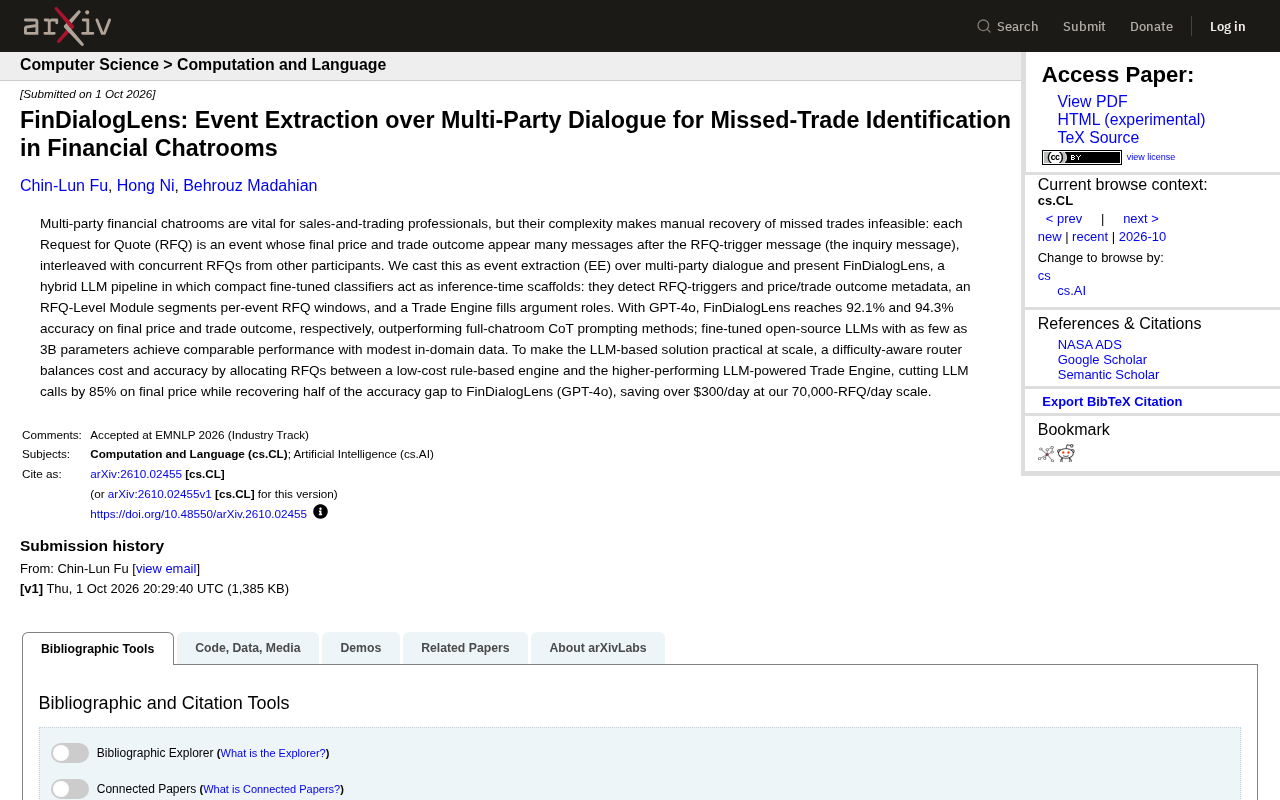
FinDialogLens is an AI system that tackles the missed-trade problem in multi-party investment banking chat rooms by reframing it as event extraction over dialogue. A hybrid pipeline uses lightweight fine-tuned classifiers to detect RFQ triggers and segment conversation windows, while a large LLM Trade Engine fills argument roles within each window. Paired with GPT-4o, the system achieves 92.1% accuracy on final price extraction and 94.3% on trade outcomes, outperforming full-room CoT prompting. Fine-tuned 3B open-source models reach comparable results. A difficulty-aware router cuts LLM calls by 85%, saving over $300/day at 70K RFQs/day scale.
The "Missed Trade" Problem in Financial Chat Rooms
In investment banking's sales-and-trading operations, multi-party financial chat rooms are the core channel for matching quotes and executing trades. But these chat rooms are inherently chaotic: every Request for Quote (RFQ) is an independent event, and its final quote and trade outcome often surface dozens of messages after the triggering inquiry — all interleaved with concurrent RFQs from other participants.
This structure means that once a trade slips through the information flood, manually tracing it back is nearly impossible. FinDialogLens, introduced in a recent arXiv paper, targets exactly this pain point by reframing the problem as Event Extraction (EE) over multi-party dialogue and delivering a practical engineering solution.
Event Extraction (EE) is a classic NLP task: identify specific types of events (triggers) in unstructured text and extract associated arguments — participants, timestamps, locations, outcomes, and so on. For example, from "Alice bought 100 shares of Ping An at 100 yuan," a system must identify a "Trade" event and extract buyer=Alice, price=100 yuan, instrument=Ping An. The challenge in financial dialogue is that trigger messages and result messages are separated by multiple conversational turns, and multiple RFQ events occur concurrently within the same time window — making traditional EE approaches difficult to apply directly.
FinDialogLens's Hybrid Architecture
FinDialogLens centers on a hybrid LLM pipeline where compact fine-tuned classifiers act as "scaffolding" during inference, supporting a large model in completing complex extraction tasks. The system consists of several key modules working in concert:
Classifier Scaffolding
Compact fine-tuned classifiers handle two things first: detecting RFQ trigger messages, and identifying metadata related to quotes and trade outcomes. These classifiers are small and fast at inference time, laying the groundwork for the heavier lifting ahead.
These "fine-tuned classifiers" typically refer to lightweight discriminative models built by supervised fine-tuning on domain-specific labeled data atop a pretrained language model (e.g., BERT, FinBERT). Compared to generative large models, they have far fewer parameters (often in the hundreds of millions), lower inference latency, and manageable deployment costs — but limited generalization on tasks requiring complex reasoning. FinDialogLens's design philosophy is to split tasks by difficulty: classifiers handle well-bounded discriminative subtasks, reserving large-model compute for the core steps that genuinely require semantic understanding and reasoning.
RFQ-Level Segmentation and the Trade Engine
Once the classifiers identify trigger points, the RFQ-Level Module segments the dialogue into discrete RFQ windows, routing each message back to its corresponding event context. The Trade Engine then fills argument roles within each window, reconstructing the complete trade event — including the final price and whether the trade was executed.
This "segment first, then extract" design effectively defuses the mutual interference of concurrent RFQs, allowing the large model to work without getting lost in the full chat room's massive context.
Results: Accuracy and Cost Breakthroughs Together
The numbers reported in the paper are impressive. Paired with GPT-4o, FinDialogLens achieves 92.1% accuracy on final price extraction and 94.3% on trade outcome determination, significantly outperforming Chain-of-Thought (CoT) prompting applied to the full chat room.
Even more notable is the open-source model performance: a fine-tuned open-source LLM with only 3B parameters, given a modest amount of in-domain data, reaches results comparable to the GPT-4o-based approach. This means institutions don't need to rely entirely on expensive closed-source APIs — they can build high-performance trade reconciliation systems in-house.
Chain-of-Thought (CoT) prompting guides large models to output step-by-step reasoning before arriving at a final answer. Research shows CoT significantly improves accuracy on complex reasoning tasks, making it a strong baseline. However, in multi-party financial chat rooms, applying CoT directly to the entire chat content faces two challenges: ultra-long contexts scatter the model's attention, making it hard to pinpoint the target RFQ; and every RFQ consumes a full large-model call, so costs scale linearly with message volume. FinDialogLens outperforms the full-room CoT baseline precisely because its structured segmentation shortens the context each inference step needs to process.
Difficulty-Aware Routing: Making It Actually Viable at Scale
In real-world deployments, cost control and scalable operation determine success or failure. FinDialogLens introduces a difficulty-aware router that dynamically dispatches RFQs between a low-cost rule engine and the high-performance LLM Trade Engine.
Straightforward RFQs go to the rule engine; only complex ones invoke the large model. The result: 85% fewer LLM calls on the final price task, while recovering half the accuracy gap relative to the pure GPT-4o approach.
At the 70,000 RFQs per day scale described in the paper, this design saves over $300 per day in API costs. For a high-throughput trading desk, this is not just meaningful cost savings — it validates the engineering feasibility of the hybrid approach in production.
The core idea behind difficulty-aware routing comes from cascaded classifiers or "early exit" strategies in machine learning: high-confidence, pattern-simple samples get answered quickly, while uncertain or complex samples are passed to a stronger but slower/costlier backend. In practice, a significant proportion of RFQs use standardized quoting formats (e.g., fixed-template interest rate swap inquiries) that rule engines can handle accurately; only RFQs involving multi-round negotiation, conditional pricing, or settlement disputes truly require semantic understanding. The router decides based on classifier confidence scores or explicit complexity features, compressing large-model invocations to the necessary minimum while maintaining overall accuracy.
Implications for Financial NLP
FinDialogLens's value extends beyond a single concrete tool. It demonstrates a transferable paradigm: use small models for structured preprocessing, large models for core reasoning, and routing strategies to balance cost and precision. This layered design leverages LLMs' understanding capabilities while avoiding the steep cost of feeding everything to a large model.
For domains saturated with multi-party dialogue and complex event structures — finance, legal, customer service — this approach of modeling the problem as event extraction and operationalizing it through a hybrid pipeline offers a reproducible reference template. As open-source small models continue to grow in capability, architectures like this are poised to become the mainstream form of AI applications in vertical domains.
Related articles

Understanding DeepSeek in 3 Minutes: The Rise from a Quant Hedge Fund to an Open-Source AI Leader
DeepSeek's history in 3 minutes: from High-Flyer Quant's compute build-up to V2's MLA inference cost cuts, V3's $5.576M training bill, R1's open-source global shock, and V4 with a $7B Series A.

Local Creative Writing Model Showdown: Fine-tuned Qwen3.8 27B Wins, DeepSeek v4.1 Underwhelms
Bilibili creator tests seven local creative writing models: Hemingway and HumanLike Chat based on Qwen3.8 27B perform best, DeepSeek v4.1 is plain, Dongfang Shuo ranks last with confused characters. Includes three test prompts, scores, and usage advice.

Liang Wenfeng's Three Big Bets: Why Did DeepSeek Open-Source Its 82% Gross Margin?
Why did DeepSeek open-source DeepInfer, its 82% gross margin inference framework, and then launch a hundred-billion funding round? An analysis of Liang Wenfeng's three big bets and the open-source strategy.