Firebase AI Logic Integrates Gemini TTS: A Practical Guide to Multi-Speaker Voice Synthesis

Firebase AI Logic integrates Gemini TTS, enabling seamless multi-character audio generation in a single model call.
Firebase AI Logic now supports Gemini TTS models, with the headline feature being multi-speaker voice configuration. Developers can bind character names to specific voices like Orus and Zephyr, prefix each line in the prompt with a speaker name, and the model automatically switches voices — outputting seamless multi-character audio in one call. This eliminates the traditional engineering burden of multiple requests, client-side audio splicing, and timing alignment, making it a major simplification for use cases like audiobooks, language learning apps, and podcast generation.
Firebase AI Logic Gains Text-to-Speech Capabilities
Firebase AI Logic has announced support for Gemini's Text-to-Speech (TTS) models, enabling developers to invoke Gemini's voice generation capabilities directly within the Firebase application framework. For developers who have long wanted to integrate speech features into mobile or web apps, this update significantly lowers the barrier to entry.
In the past, delivering high-quality speech synthesis in an app typically meant connecting to third-party TTS services, managing a separate audio pipeline, or even manually splicing multiple audio segments on the client side. This integration consolidates all of that into the unified configuration of Firebase AI Logic, making voice generation a natural part of the model invocation chain.

Firebase AI Logic (formerly the AI inference layer of Firebase Genkit) is Google's AI model access framework for mobile and web applications. It includes native support for the Gemini family of models and deep integration with services like Firebase Authentication and Cloud Firestore. Developers can invoke Gemini's multimodal capabilities directly on the client or server side via the SDK, without needing to build their own backend inference service or manage API key rotation. By bringing TTS into this framework, voice synthesis now shares the same authentication, quota, and error-handling mechanisms as text generation and image understanding — further reducing the integration complexity of multimodal applications.
The Headline Feature: Multi-Speaker Voice Configuration
The most noteworthy capability in this update is multi-speaker voice configuration. Traditional TTS calls typically only allow you to specify a single voice, but Gemini TTS lets developers map different voices to different speaking roles within a single text prompt.
The approach is straightforward: instead of using a single voice config, you define a multi-speaker voice configuration that maps each character name to a specific voice. For example, in the official demo, the first speaker Jack is mapped to the Orus voice, and the second speaker Jill is mapped to the Zephyr voice.

The advantage of this configuration is that developers don't need to make multiple separate requests and stitch the results together — multi-role voice generation is completed within a single model call.

The voices offered by Gemini TTS are pre-trained acoustic models, each with a distinct pitch, speaking pace, and emotional style. The Orus voice tends to be deep and authoritative, well-suited for narration or formal contexts, while Zephyr is lighter and more natural, fitting for conversational or younger characters. These voices aren't simple audio clips — they are dynamically generated by the model at inference time, allowing intonation to shift naturally based on contextual semantics, without the mechanical quality at sentence endings that traditional TTS often produces. Multi-speaker configuration works by having the model dynamically switch between different sets of acoustic parameters based on character markers within the same inference request. The timing and prosody across all voices are coordinated by the model, ensuring smooth transitions in the final audio rather than jarring cuts.
How It Works: Switching Voices with Prefixes
The mechanism for producing multi-character dialogue is elegantly simple. Developers just need to prefix each line of text in the prompt with the corresponding speaker's name, and Gemini will automatically switch voices, generating a seamless multi-character conversation in a single audio response.
In other words, the model recognizes character markers in the text, dynamically switches voices according to the preset mapping, and outputs a continuous, seamlessly joined audio track. Developers don't need to do any audio editing or track merging on the client side.
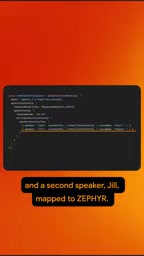
This "text-driven, model-handled" approach delegates the complex audio engineering problem to the model itself, dramatically simplifying the implementation path for developers.
Imagining the Use Cases
Multi-speaker TTS unlocks a wide range of compelling applications:
- Dynamic multi-character narration: Audiobooks, interactive fiction, and game dialogue can give each character a distinct voice, deepening immersion.
- Immersive language learning apps: Simulate realistic conversation scenarios so learners can hear natural exchanges between multiple characters.
- Podcast and audio content generation: Quickly produce audio content in a two-person or multi-person discussion format.
All of these scenarios previously required developers to manage complex audio pipelines themselves or stitch together multiple independent audio tracks on the client side. With Gemini TTS's multi-speaker capability, all of that work is now consolidated into a single model call.
What This Means for Developers
From an engineering perspective, the value of this integration isn't just "one more feature" — it's a reduction in the implementation complexity of voice applications. Developers no longer need to maintain separate audio processing logic or worry about timing alignment across multiple audio segments.
For teams already working within the Firebase ecosystem, this means they can quickly add a voice interaction layer to their apps using familiar development patterns. For developers exploring AI-native applications, multi-speaker dialogue capability opens up new possibilities for product design.
As TTS capabilities become further embedded in mainstream application development frameworks, voice is evolving from a "specialized feature" into a "default option." This is a trend worth watching closely.
Related articles

Chain of Thought Isn't Just for AI: How Humans Can Use CoT to Improve Thinking Quality
Chain of Thought isn't just a prompt trick for large models. Starting from a Hacker News discussion, this article analyzes why CoT works for human thinking too, breaks down actionable ways to transfer it, and highlights the key differences between human CoT and machine CoT.
Cloudflare Teams Up with OpenAI: Closi…
Cloudflare Teams Up with OpenAI: Closing the Loop from Vulnerability Discovery to Defense with AI
Cloudflare uses OpenAI Daybreak to investigate security vulnerabilities and generate reviewable remediation plans, while developers use Codex to boost coding efficiency and quality.

Orca Multi-Agent Orchestration in Practice: A Guide to Parallel Collaboration with Claude and Codex
Orca is Stable AI's free open-source agent workbench supporting 34 agents like Claude Code and Codex in parallel. Learn its Git worktree isolation, multi-model orchestration, and mobile management.