Firecrawl: The AI Web Scraping Powerhouse with 120K Stars — Essential for RAG Development

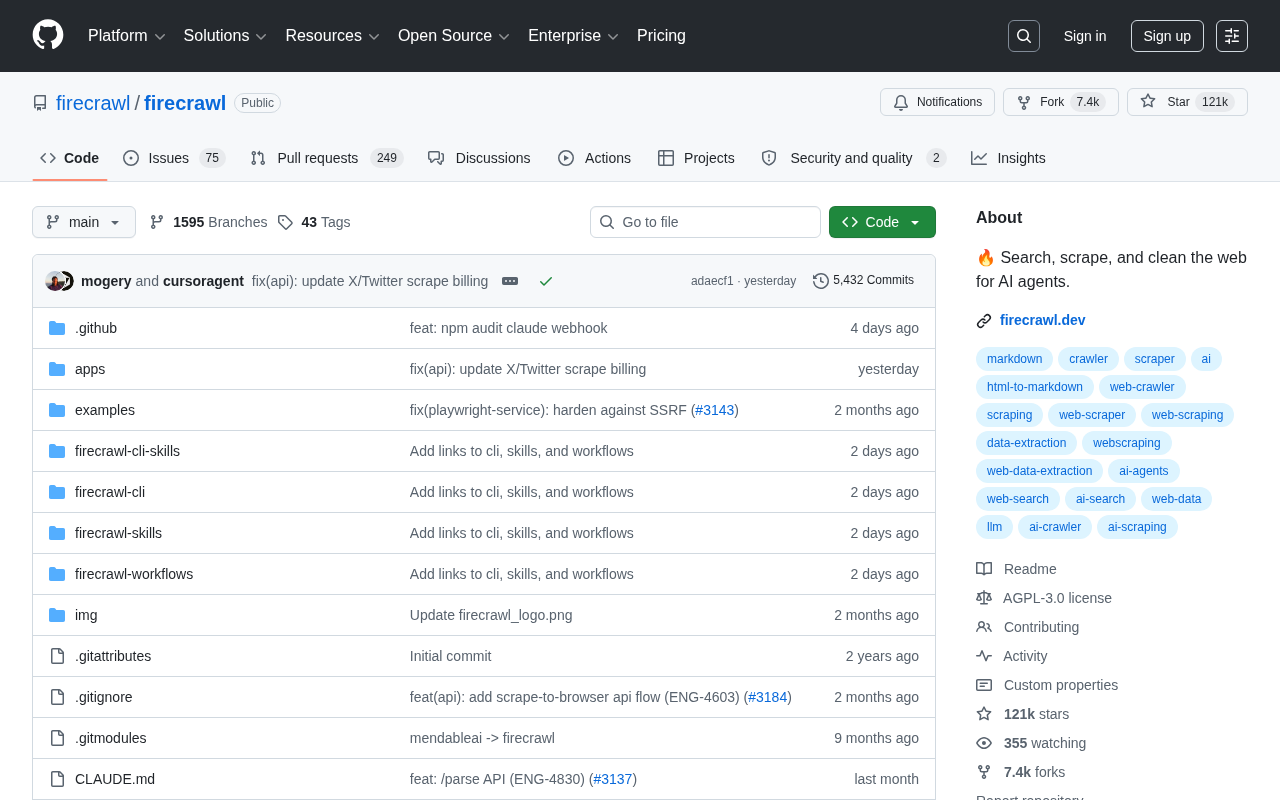
Firecrawl is an open-source web scraping and data cleaning tool built for AI Agents, with 120K+ GitHub Stars.
Firecrawl is a TypeScript-based open-source tool providing web search, scraping, and data cleaning capabilities for AI Agents, with over 120K GitHub Stars. It handles JavaScript dynamic rendering and anti-scraping mechanisms, intelligently converting web content into LLM-friendly Markdown format. With its essential role in the AI Agent ecosystem, exceptional developer experience, and open-source + SaaS business model, Firecrawl has become core data acquisition infrastructure for RAG systems, AI research automation, and more.
What Is Firecrawl? A Scraping Tool Built for AI
Firecrawl is an open-source web search, scraping, and data cleaning tool designed specifically for AI Agents. It has already earned over 120,000 Stars on GitHub, making it one of the hottest projects in the AI infrastructure space. Built with TypeScript and boasting more than 7,300 forks, the project enjoys an extremely active community.
In an era of rapid iteration for large language models and AI Agents, efficiently obtaining structured data from the internet has become a critical bottleneck. An AI Agent refers to an AI system capable of autonomously perceiving its environment, making plans, and executing actions — unlike traditional "question-and-answer" chatbots, Agents possess tool-calling, multi-step reasoning, and autonomous decision-making capabilities. Since 2024, companies like OpenAI, Anthropic, and Google have all positioned Agents as the core direction for next-generation AI products. However, the upper limit of an Agent's capabilities largely depends on how much high-quality external information it can access — and Firecrawl was born to solve exactly this pain point. It's not just a traditional crawler, but a complete data acquisition infrastructure built for the AI era.
Firecrawl Core Features Explained
Intelligent Search: Letting AI Agents Query the Internet Directly
Firecrawl provides powerful web search capabilities, allowing AI Agents to retrieve internet content through a programmatic interface. Unlike traditional search engine APIs, Firecrawl's search results are returned directly in an AI-friendly format, eliminating intermediate data transformation steps. In other words, AI Agents can "search the web" just like humans — but far more efficiently than manual operations.
Web Scraping: Effortlessly Handling JavaScript Rendering and Anti-Scraping Mechanisms
Web scraping is Firecrawl's bread and butter. Modern websites heavily use frontend frameworks like React, Vue, and Angular, where page content isn't written directly in HTML but is dynamically generated by JavaScript in the browser. Traditional scraping tools like BeautifulSoup can only parse static HTML and often retrieve blank content from such pages; Puppeteer and Playwright can simulate browser JavaScript execution, but they're complex to configure, resource-intensive, and require developers to handle anti-scraping strategies themselves. Firecrawl handles all the complex scenarios common in modern web pages — JavaScript dynamically rendered pages, content that requires scroll-loading, and various anti-scraping mechanisms — encapsulating all the underlying complexity behind a clean API. Developers don't need to worry about browser automation details, dramatically lowering the barrier to entry.
Data Cleaning: Automatically Extracting Core Content and Converting to Markdown
This is Firecrawl's killer feature that sets it apart from traditional scraping tools. Raw HTML typically contains substantial noise — navigation bars, ads, footnotes, and other irrelevant elements. Feeding this directly to an LLM not only wastes tokens but degrades output quality. Firecrawl intelligently extracts the core content from pages and converts it into clean Markdown format — precisely the text format that large language models handle best.
Why Markdown? During pre-training, large language models are exposed to massive amounts of Markdown-formatted text (especially from sources like GitHub, technical documentation, and Wikipedia), giving them extremely strong comprehension of Markdown's heading hierarchy, lists, code blocks, and other structures. Compared to raw HTML filled with nested tags and style code, Markdown has higher information density and less noise, significantly reducing token consumption and improving model comprehension accuracy. This is the core reason Firecrawl chose Markdown as its default output format.
Why Did Firecrawl Earn 120K Stars?
An Essential Tool for the AI Agent Ecosystem
As companies like OpenAI and Anthropic push the AI Agent concept toward real-world implementation, an Agent's ability to interact with the external world has become critical. Web pages are the richest information source on the internet, and Firecrawl fills the crucial gap of "AI Agents accessing web pages." Whether it's RAG (Retrieval-Augmented Generation) systems, automated research assistants, or data analysis Agents, they all rely on tools like Firecrawl as their data input layer.
RAG is currently the mainstream technical approach for addressing LLM knowledge staleness and hallucination problems. Its core idea is: before the model generates an answer, first retrieve document fragments relevant to the user's question from external knowledge sources, inject these fragments as context into the prompt, and guide the model to generate answers based on real data. RAG system effectiveness highly depends on the quality and timeliness of data sources, and Firecrawl can scrape and clean web content in real-time, providing high-quality dynamic data input for RAG systems, fundamentally solving the knowledge cutoff date limitation.
Ultimate Developer Experience
Firecrawl provides SDKs for mainstream languages including Python, Node.js, and Go, along with REST API support. Developers can run the entire pipeline from web scraping to structured data output with just a few lines of code. This "out-of-the-box" design philosophy has driven its rapid popularity in the developer community.
A Virtuous Cycle Between Open Source and Commercialization
Firecrawl adopts an open-source model, allowing developers to self-deploy. Meanwhile, the team also offers a hosted cloud service version, providing commercial support for enterprise users seeking stability and scale. This open-source + SaaS model (also known as the Open Core model) is one of the most successful business models in the developer tools space in recent years, with typical examples including GitLab, Supabase, and PostHog. The core logic is: lower the barrier to entry through the open-source version, build community reputation and developer trust, while charging enterprise users for the hosted cloud service with higher availability, security, and technical support. This model allows the project to enjoy the contribution and distribution benefits of the open-source community while generating sustainable commercial revenue to support long-term R&D investment, providing financial backing for ongoing iteration.
Typical Use Cases for Firecrawl
- RAG System Data Source: Provides real-time web data for Retrieval-Augmented Generation systems, ensuring LLMs can access the latest information and breaking free from knowledge cutoff date limitations
- Competitive Monitoring and Analysis: Automatically scrapes competitor websites for product updates, price changes, and other key information to build real-time competitive intelligence systems
- AI Research Automation: AI research assistants automatically search, scrape, and organize web materials on specific topics, dramatically improving research efficiency
- Knowledge Base and Dataset Construction: Scrape and clean content from multiple sources to quickly build enterprise knowledge bases or training datasets
- Intelligent Content Quality Detection: Combine AI capabilities for automated quality auditing and compliance checking of web content
Firecrawl's Position in the AI Tech Stack
Within the overall AI tech stack, Firecrawl sits at the core of the data acquisition layer. It naturally complements mainstream AI orchestration frameworks like LangChain and LlamaIndex. LangChain focuses on building complex AI workflows, providing chain calling, tool integration, and memory management capabilities; LlamaIndex specializes in data indexing and retrieval, excelling at transforming unstructured data into knowledge bases queryable by LLMs. Both require external data input but aren't inherently good at fetching raw data from the internet — this is precisely why Firecrawl complements them. In fact, Firecrawl has been officially integrated by both frameworks as a recommended data acquisition tool: they handle workflow orchestration and reasoning, while Firecrawl handles obtaining high-quality raw data from the internet.
The achievement of 120K Stars reflects not only the developer community's strong endorsement of this tool but also the entire AI Agent ecosystem's urgent demand for high-quality data acquisition capabilities.
As AI Agents move from concept to scaled deployment, infrastructure tools like Firecrawl will play an increasingly critical role. It represents a clear industry trend: The toolchain of the AI era is being redefined, with every component being restructured around the needs of large language models.
Related articles
 Product Reviews
The Programmer's Desk Setup Guide: Building a Workspace That Feels Like Home
Discover how programmers build productive, comfortable workspaces. From multi-monitor setups to ergonomic design, explore the desk philosophy that drives focus and flow.
 Product Reviews
Qoder vs Cursor Real-World Comparison: Which $20/Month AI IDE Is Better?
Hands-on comparison of Qoder vs Cursor AI IDEs: Agent autonomy, human interaction count, and architecture decisions. Qoder needed only 2 interactions vs Cursor's 8.
 Product Reviews
Cursor Cloud Agent Demo: Eliminating Bottlenecks Across the Entire Software Development Lifecycle
Deep analysis of Cursor's Cloud Agent demo showing how cloud VMs, automated test artifacts, and a full-chain control plane systematically eliminate human bottlenecks across the software development lifecycle.