Firedrill: An Open-Source Framework for Safely Testing AI Agents with Stateful Synthetic Tools

Firedrill is an open-source AI Agent testing sandbox using stateful synthetic tools with fault injection and CI integration.
Firedrill is an open-source sandbox framework designed specifically for AI Agent testing. Its core idea is to replace real production services like Gmail, Stripe, and HubSpot with "synthetic tools," letting agents run in a fully controlled environment without risking real data. Unlike simple mocks, it maintains state across calls to faithfully replicate multi-step workflows. It also supports fault injection, dynamic permission changes, and call auditing — elevating tests from checking results to tracing decision logic. With 30+ tool packages and native CI/CD integration, agent behavior validation fits seamlessly into automated delivery pipelines.
When deploying AI Agents to production, one unavoidable challenge is: how do you verify an agent's behavior without connecting to real accounts and live tools? Directly testing against production services like Gmail or Stripe carries obvious risks — accidentally deleted emails, erroneous refunds, or permission leaks are all real possibilities. Firedrill, an open-source project that recently surfaced on Reddit, was built specifically to address this pain point.
What Problem Does Firedrill Solve?
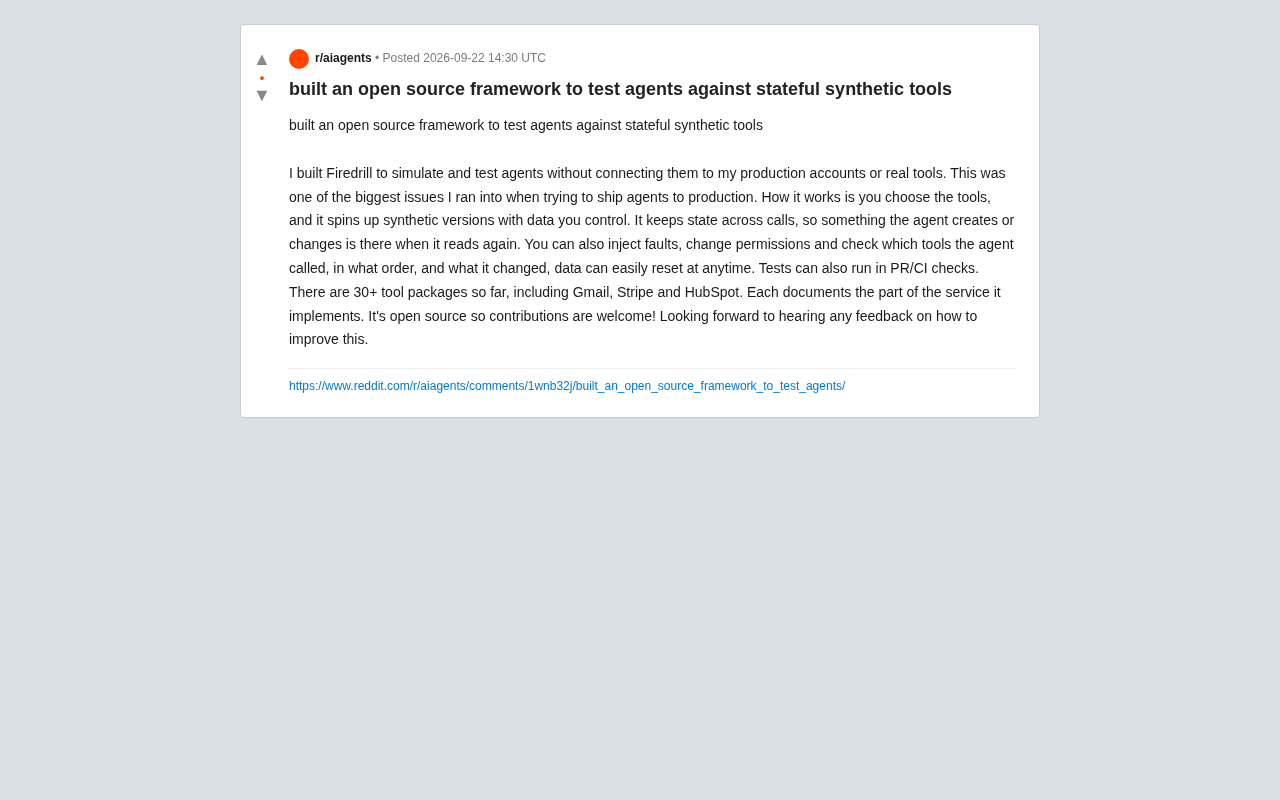
The author mentions in the post that the original motivation behind Firedrill was one of the biggest obstacles they encountered when deploying agents to production: the absence of a safe testing sandbox. The traditional approach is either to connect the agent to real tools and test at your own risk, or to use simple mocks — but the latter rarely captures the complex stateful changes that occur in real-world calls.
Firedrill's approach: you select the tools you need, and it generates synthetic versions of those tools with data entirely under your control. The agent runs in this controlled environment without touching any production data, and the state can be reset at any time after testing.
The Core Feature: Statefulness
The biggest difference from ordinary mocks is Firedrill's stateful design. The author emphasizes that synthetic tools maintain state across multiple calls: whatever the agent creates or modifies will still be there the next time it reads.
This is critical for agent testing. Real business scenarios typically involve multi-step operations — for example, an agent first creates a contact record in HubSpot, then later updates it. If the test tools don't preserve state, these kinds of sequentially dependent workflows simply can't be verified realistically. A stateful synthetic environment brings tests much closer to production conditions, surfacing bugs that only appear when state has accumulated over time.
Fault Injection and Behavior Auditing
Firedrill goes beyond simulating "everything works fine" scenarios. It also provides several capabilities focused on robustness:
- Fault injection: Proactively introduces errors to observe how the agent responds under abnormal conditions — valuable for testing retry logic and fallback strategies.
- Permission changes: Dynamically adjusts tool permissions to verify how the agent behaves under restricted access.
- Call auditing: Inspects which tools the agent called, in what order, and what data was modified.
This auditing capability elevates testing from "is the result correct?" to "is the process reasonable?" For agents — which tend to be relatively opaque systems — being able to trace decision paths and actual operations is key to assessing reliability.
Fault injection is a well-established software reliability testing technique, originating from hardware fault tolerance and now widely used in distributed systems chaos engineering (e.g., Netflix's Chaos Monkey). The core idea is to proactively inject unexpected errors — such as network timeouts, API 5xx responses, or permission denials — to observe system behavior on abnormal paths. For AI Agents, fault injection is especially important: agent decision logic is typically driven by an LLM, and whether it chooses to retry, fall back, or fail silently under error conditions is often impossible to infer directly from code — only actual fault triggering can verify this. Call auditing corresponds to the concept of distributed tracing: recording the inputs, sequence, and side effects of every tool call, making "what the agent did" observable and replayable — the foundation for bringing agent behavior under quality control.
30+ Tools and CI/CD Integration
Firedrill currently ships with over 30 tool packages, covering commonly used services like Gmail, Stripe, and HubSpot. Each package documents which portions of the corresponding service it implements — a transparent approach that helps developers understand the boundaries of what the synthetic tool covers.
More practically, tests can be run directly in PR / CI checks. This means agent behavior validation can be incorporated into continuous integration pipelines just like unit tests, automatically running on every code change and catching agent regressions before they're merged. For teams looking to deliver agents in an engineered, standardized way, this is a pragmatic capability.
CI/CD (Continuous Integration/Continuous Delivery) is the standard delivery paradigm in modern software engineering: every code commit triggers automated builds and tests to ensure changes don't introduce regressions. The challenge of incorporating agent testing into CI/CD is that agent behavior depends on external API calls — traditionally, teams either skip these tests entirely or maintain complex test accounts and environment isolation in their pipelines. Firedrill eliminates the dependency on real external services through synthetic tools, enabling end-to-end agent behavior testing to run automatically at the PR check stage, just like ordinary unit tests. This capability is especially valuable for team collaboration: when multiple engineers are concurrently modifying an agent's prompts, tool-calling logic, or orchestration flow, automated regression detection at the CI layer can intercept behavioral drift before code is merged, preventing issues from reaching production.
What This Means for the Agent Development Ecosystem
As more teams attempt to put LLM Agents into real-world production use, "how to test agents" is becoming a central question in engineering deployment. The non-deterministic nature of agents and their strong dependency on external tools make traditional testing methods difficult to apply directly. Tools like Firedrill fill exactly this gap — providing a controlled, resettable, stateful synthetic environment that gives agents a testing ground that is both safe and close to real-world conditions.
The author states the project is fully open source and welcomes community contributions and feedback. For developers struggling with agent testing challenges, this is a direction worth watching and experimenting with. One caveat: the information in this article comes from a single source — the author's own introduction. The actual stability, completeness of tool coverage, and behavioral fidelity of synthetic tools compared to real services will need to be validated in specific projects.
Summary
Firedrill's value lies in moving "agent testing" closer to an engineering standard: stateful synthetic tools reconstruct real call chains, fault injection and call auditing deepen test coverage, and CI integration automates verification. For teams looking to safely ship agents to production, it offers a path that doesn't require putting real accounts at risk.
Related articles

Felix Rieseberg Personal Homepage
Felix Rieseberg's personal homepage sparks attention on Hacker News. This article covers the Slack engineer's technical background, the rise and fall of nativefier, and the value of a developer homepage as a tech calling card.

@ai-sdk/vue 3.0.306 Patch Release Syncs with [email protected] Update
@ai-sdk/vue 3.0.306 released, synced with [email protected]. A routine patch release for the Vercel AI SDK ecosystem with no public API changes; the Vue adapter layer stays version-aligned with the core package.

Gemini 4 Argon API Launches: The Era of Million-Token Output Begins
Google launches Gemini 4 Argon with sparse MoE architecture, up to 1M output tokens, and a 68.90% Vals Index score, available across API, AI Studio, and the Gemini app.