FireRouter Released: Smart Routing Achieves 98% of Opus Accuracy at 57% Lower Cost

FireRouter routes coding tasks intelligently to hit 98.1% Opus accuracy at 57% lower cost.
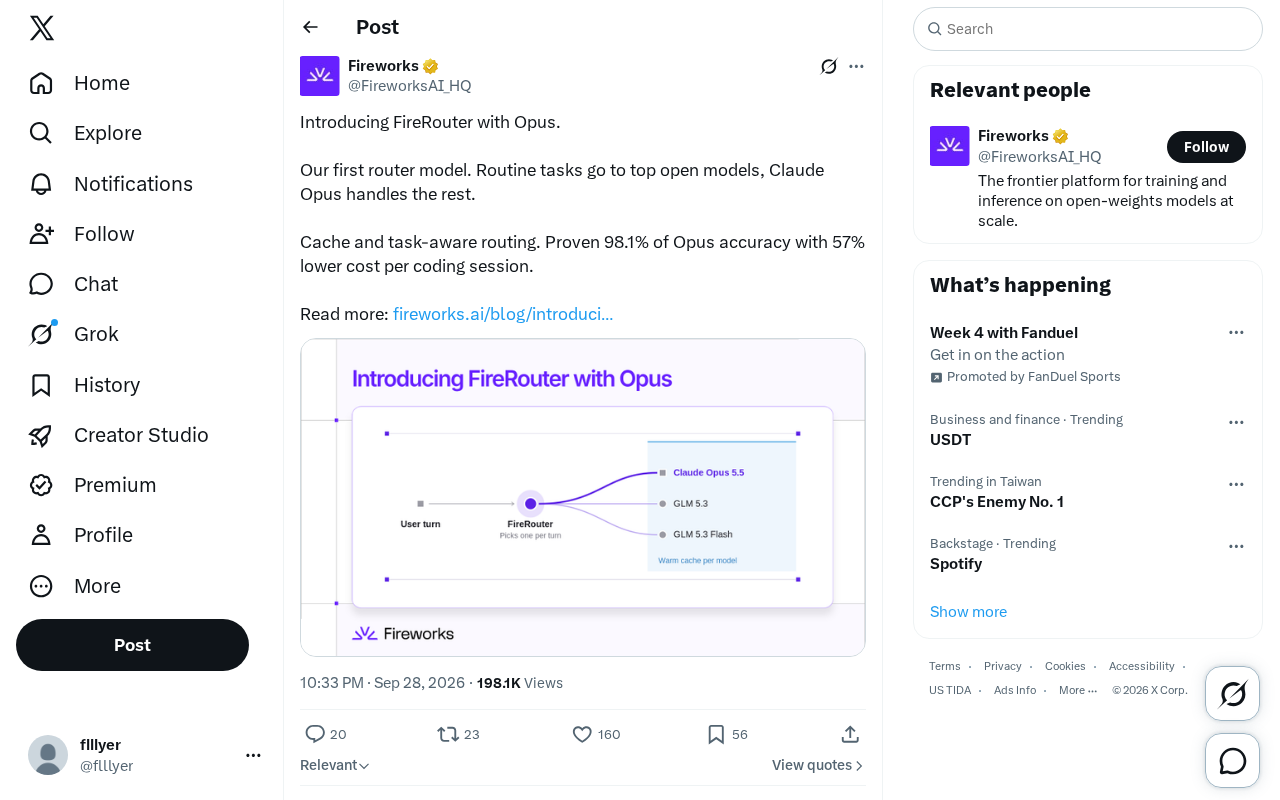
FireRouter is the first model router built specifically for coding tasks, routing routine requests to top open-source models while reserving Claude Opus for high-complexity tasks. Its dual mechanism of task-aware routing and caching delivers 98.1% of Opus accuracy while cutting per-session costs by 57%. The product reflects a growing trend: model orchestration is becoming a standalone engineering category, enabling dynamic model selection at the request level rather than relying on static user configuration.
FireRouter: The First Model Router Built for Coding Tasks
LLM applications are entering a new era of "on-demand scheduling." A routing model called FireRouter was recently released, with a straightforward core idea: route everyday, relatively simple tasks to top open-source models, while reserving complex tasks that require deeper reasoning for Claude Opus. This division of labor lets teams retain the ceiling of a flagship model's capabilities without paying top-tier prices for every single request.
For developers who rely heavily on high-end models for coding assistance, cost has always been a persistent pain point. Models like Opus excel at complex code generation, refactoring, and debugging — but if every request, including formatting, autocomplete, and simple Q&A, goes through Opus, the bill balloons quickly. FireRouter is designed to solve exactly this "sledgehammer for a tack" problem.
Core Mechanism: Cache and Task-Aware Dual Routing
FireRouter's technical highlight lies in its routing strategy, officially described as cache and task-aware routing.
Task-Aware Routing
Task-aware routing means the router first evaluates the nature and complexity of a request before deciding which model to send it to. Routine tasks are directed to high-performing open-source models, while tasks requiring deeper reasoning are handled by Claude Opus. This dynamic assignment based on task type is the key to the system's cost control.
On the technical implementation side, task-aware routing typically relies on a lightweight "classifier" model that runs ahead of the actual task model, quickly scoring or categorizing incoming requests. Common approaches include rule-based keyword matching, fine-tuned small classification models (usually ranging from millions to a few billion parameters), and using embedding vector similarity to assess task complexity. FireRouter's officially described "task-aware" mechanism presumably involves a similar front-end classification step. Notably, the quality of the classifier's judgment directly determines the quality of routing decisions — if the classifier misidentifies a deep architectural design question as a "simple task," the entire cost-saving premise backfires. This is why such systems require continuous monitoring and iterative refinement of classification boundaries in production.
Caching Mechanism
The caching layer further reduces redundant computation. For similar or repeated requests, the system can reuse previous results or context, avoiding repeated calls to expensive models. In real coding sessions, developers frequently ask follow-up questions about the same piece of code — caching delivers especially strong value in these scenarios.
Combined, both mechanisms allow FireRouter to compress overall call costs without significantly sacrificing quality.
Caching in LLM services generally operates at two levels: Semantic Cache and Prompt Prefix Cache (KV Cache). Semantic caching computes embedding vectors for requests, looks up semantically similar requests in a historical store, and returns cached results directly — completely bypassing model inference. Prompt prefix caching is implemented at the model provider level (e.g., Anthropic, OpenAI), reusing already-computed KV states for repeated system prompts or long context segments to reduce token computation. Anthropic's Claude API already supports the latter, billing cached tokens at a discounted rate. FireRouter's caching mechanism is likely a combination of both. In coding sessions — where the same code is discussed repeatedly — the proportion of repeated long context is extremely high, making caching benefits naturally more pronounced.
Key Metrics: 98.1% Accuracy, 57% Cost Reduction
The official core metrics are: FireRouter achieves 98.1% of Opus accuracy on coding tasks while reducing the cost per coding session by 57%.
The significance of these numbers lies in how they quantify the quality-cost tradeoff. In isolation, a 1.9% accuracy loss is nearly negligible — and in exchange, you get close to a 60% cost reduction. For engineering teams that use models at high frequency and scale, this ratio can translate into meaningful differences on a monthly bill.
It's worth noting that the 98.1% figure comes from the publisher's own promotional materials. The specific benchmarks, task distribution, and evaluation setup have not been fully disclosed in publicly available information. Real-world performance still needs to be validated within your own workflows, especially for edge-case complex tasks that heavily depend on Opus's top-tier capabilities.
Why Model Routers Like This Matter
The emergence of FireRouter reflects an increasingly clear trend at the AI application layer: model orchestration is becoming its own product category.
In the past, users made static choices about "which model to use." Now, routers hand that decision to the system to make dynamically at the request level. At its core, this transforms "model selection" from a one-time configuration into a continuously optimized runtime decision.
For developers, this brings several direct benefits:
- Cost control: Expensive models are only invoked when truly needed;
- No capability compromise: Complex tasks still get flagship model quality;
- Open-source and closed-source working in tandem: Top open-source models handle the bulk of the load, with closed-source flagships serving as the quality backstop.
This "open-source as the foundation, closed-source as the reinforcement" combination also reflects the current reality that open-source model capabilities are rapidly approaching closed-source flagships — without this, maintaining 98% overall accuracy while routing large volumes of routine tasks to open-source models would be difficult to achieve.
Model Orchestration refers to the system design paradigm of coordinating task distribution, context passing, and result aggregation across multiple AI models or agents. It is a core component of the broader LLMOps (Large Language Model Operations) field. Beyond routing, orchestration also includes: multi-step chain calls, parallel inference with vote-based merging (Ensemble), and Agent-driven decisions about whether to invoke external tools or sub-models. FireRouter represents the most direct, lowest-latency variant — a single routing decision followed by dispatch, with no multi-round model interactions involved. As pricing gaps between model APIs from providers like Anthropic and OpenAI continue to widen (flagship and lightweight models from the same provider can differ by 10x or more), the routing layer as the "first gate" for cost control is rapidly growing in engineering value.
Use Cases and Caveats
FireRouter explicitly targets the coding session scenario, which is also the basis for its published metrics. It delivers the most value for:
- Teams with high-frequency AI coding assistant usage and large call volumes;
- Engineering organizations that are cost-sensitive but unwilling to compromise on complex task quality;
- Developers looking to mix open-source and closed-source models in their workflows.
That said, there are a few things worth considering before adoption. Routing itself introduces additional classification latency and system complexity. If the task classifier misfires, a problem that should go to Opus might end up with a less capable model, affecting output quality. The real-world benefit therefore depends heavily on how well the routing strategy fits your specific workload.
Summary
FireRouter enters the AI application layer as a "routing model," using task-aware routing and caching to achieve near-Opus accuracy with significant cost savings. The direction it represents — having systems intelligently dispatch different models at the request level — is likely to become a standard component of future AI engineering stacks. As for whether its claimed 98.1% accuracy and 57% cost reduction will hold up in your real-world scenarios, it's advisable to validate within your own workflow at small scale before committing to a full deployment.
Related articles

Should U.S. College Fraternities Be Banned? A Researcher's Incisive Observations
Why not just ban U.S. college fraternities? A researcher finds the key resistance comes from decision-makers' own fraternity identities and schools' "willful ignorance."

Microsoft Discovery: Accelerating Scientific Discovery with AI Agents
Microsoft's Discovery platform runs specialized AI agents to help researchers screen and prioritize the most promising compounds and experimental paths, reducing experiments and accelerating scientific discovery.

Cambridge Heavy Industries Secretly Develops Desktop-Scale Nuclear Fusion Device
Cambridge Heavy Industries is secretly developing a desktop-scale laser-driven nuclear fusion device, targeting the equipment supply market for fusion power plants. This article analyzes its miniaturization technology path, commercialization logic, and unique positioning in the fusion startup wave.