Firetower: Run AI Coding Agents on Your Own Server, Manage from Anywhere

Firetower is an open-source Rust framework for running and managing AI coding agents on your own infrastructure.
Firetower is an open-source, self-hostable framework for running and managing AI coding agents like Claude Code and Codex, designed to address data sovereignty and compliance risks associated with third-party hosted environments. Rather than replacing existing agent capabilities, it provides a deployment and orchestration layer that keeps agents running within your own servers or private network, while enabling cross-device management from desktop and mobile clients. Built in Rust for stability and low resource overhead, it suits teams and developers who prioritize data security, cost control, or remote monitoring of long-running tasks. The project is still in early stages and awaits broader community validation.
Bringing Coding Agents Back Under Your Control
As AI coding agents like Claude Code and Codex become everyday tools for developers, a practical question has emerged: whose machine are these agents actually running on? For teams that prioritize data security, operate under strict compliance requirements, or simply want control over their infrastructure costs, handing off code and context to a third-party hosted environment isn't an ideal arrangement.
The open-source project Firetower offers a straightforward answer — run your coding agents on servers you control, and manage them from your desktop or mobile device at any time. Released by Kevin Piacentini, the project debuted on Product Hunt with 69 upvotes and 9 comments, ranking 18th in the open source, software engineering, and developer tools categories.
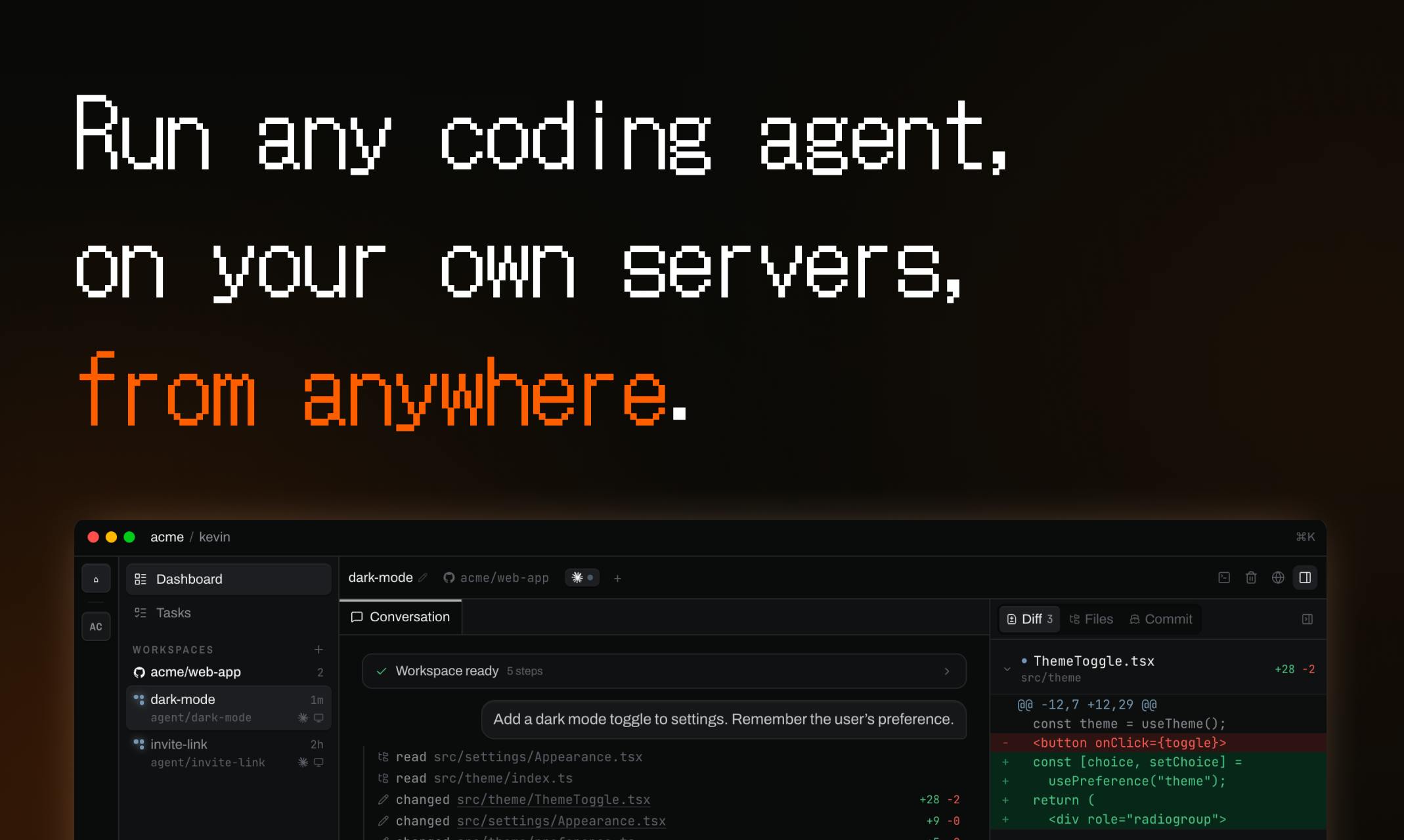
Core Positioning: Self-Hosted + Cross-Platform Management
Firetower's design philosophy can be broken down into three key concepts: self-hostable, open source, and cross-platform control.
It isn't a new coding model — it's a hosting and management layer. Developers can deploy existing coding agents like Claude Code and Codex on infrastructure they own and control, whether that's an on-premises server, a cloud VM, or a personal workstation. In other words, the model capabilities still come from upstream providers, but the runtime environment and data flow are entirely under your control.
Equally valuable is how it handles management. Firetower supports operation from both desktop and mobile clients, meaning you can check on a long-running agent task from your phone during your commute or step in remotely to make adjustments on the fly. For coding tasks that need to run autonomously over extended periods, this "manage from anywhere" experience solves a real pain point of traditional local agents — the moment you step away, you lose visibility and control.
Self-hosting carries particular significance in the AI tooling space. Unlike conventional SaaS tools, coding agents encounter highly sensitive information during execution — codebases, API keys, internal architecture designs. Once that data flows through third-party servers, teams face compounding risks around data residency compliance (GDPR, HIPAA), intellectual property protection, and supply chain security. A self-hosted approach eliminates the "data leaving the perimeter" problem entirely by keeping the full runtime environment within a private network boundary — which is precisely why teams in heavily regulated industries like finance, healthcare, and government tend to favor this kind of architecture.
Why Rust
Firetower explicitly states it's written in Rust — a technical choice worth paying attention to.
As a tool that needs to run persistently, manage multiple agent processes, and handle cross-network communication, stability and resource efficiency are hard requirements. Rust's strengths in memory safety, concurrency, and runtime performance align well with the demands of infrastructure-grade software. Compared to solutions hastily assembled with high-level scripting languages, a Rust-built Firetower should theoretically deliver more reliable performance and lower resource overhead when running as a persistent background service.
This also reflects a broader trend: as AI tools graduate from "toy" to "production tool," underlying engineering quality is becoming a competitive differentiator, not just feature count.
Rust is a systems programming language initially developed at Mozilla Research, with its 1.0 release in 2015. Its most distinctive feature is an "ownership" model that enforces memory safety at compile time rather than runtime — eliminating null pointer dereferences, buffer overflows, and other common memory errors without requiring a garbage collector (GC). This gives Rust programs performance comparable to C/C++ alongside stronger safety guarantees. In the infrastructure software space, Rust has been adopted by the Linux kernel, Android system components, the Cloudflare Workers runtime, and more — establishing itself as a mainstream choice for high-reliability persistent services. For a tool like Firetower that needs to manage multiple agent processes around the clock, Rust's low memory footprint and absence of GC pauses help avoid memory leaks or latency spikes during extended server operation.
Who It's For
Based on publicly available information, Firetower targets several distinct user groups:
- Teams sensitive to data sovereignty: Code and context never leave your own environment, satisfying compliance and security requirements.
- Developers who want to control infrastructure costs: Schedule agents on your own servers without being locked into managed platform pricing.
- Individuals who need to remotely monitor long-running tasks: Cross-platform control lets you keep tabs on agent execution status even while working on the go.
- Open-source enthusiasts: Full ability to audit, modify, and extend the codebase without being locked into a black-box tool.
A Grounded Take: The Reality of an Early-Stage Project
It's worth being candid: publicly available information about Firetower is still limited. It just launched on Product Hunt, and while 69 upvotes signal genuine interest, a mature ecosystem is still some distance away. The breadth of compatibility with existing coding agents, deployment complexity, and real-world stability all need more hands-on user feedback before they can be properly assessed.
For developers who want to try it early, the recommendation is to evaluate the deployment process and management experience on non-critical projects first before deciding whether to integrate it into a production workflow. As an open-source, self-hosted solution, its greatest value lies in returning control to the user — but whether that promise is fully realized depends on continued community investment and iteration.
Summary
Firetower addresses a genuine need that has emerged as AI coding tools go mainstream: enjoying the power of agent automation without giving up control over your infrastructure and data. The combination of open source, Rust-built foundations, and cross-platform management paints a pragmatic and focused picture. For developers who aren't satisfied with purely managed solutions, it's at minimum a new option worth keeping an eye on.
Related articles

Chain of Thought Isn't Just for AI: How Humans Can Use CoT to Improve Thinking Quality
Chain of Thought isn't just a prompt trick for large models. Starting from a Hacker News discussion, this article analyzes why CoT works for human thinking too, breaks down actionable ways to transfer it, and highlights the key differences between human CoT and machine CoT.
Cloudflare Teams Up with OpenAI: Closi…
Cloudflare Teams Up with OpenAI: Closing the Loop from Vulnerability Discovery to Defense with AI
Cloudflare uses OpenAI Daybreak to investigate security vulnerabilities and generate reviewable remediation plans, while developers use Codex to boost coding efficiency and quality.

Orca Multi-Agent Orchestration in Practice: A Guide to Parallel Collaboration with Claude and Codex
Orca is Stable AI's free open-source agent workbench supporting 34 agents like Claude Code and Codex in parallel. Learn its Git worktree isolation, multi-model orchestration, and mobile management.