Fireworks Launches Ember-1: Shorter Reasoning, 40% Fewer Tokens

Fireworks Research's Ember-1 cuts reasoning token usage by ~40% while maintaining top-tier quality, built on Kimi K3.
Ember-1 is a reasoning-efficiency-focused model from Fireworks Research, built on Kimi K3, designed to reduce reasoning token consumption by approximately 40% without sacrificing output quality. Reasoning models are notoriously expensive due to their reliance on lengthy chain-of-thought outputs, and Ember-1 directly targets this pain point. The approach is particularly attractive for high-concurrency, cost-sensitive enterprise use cases. However, performance claims currently come from Fireworks itself, and independent third-party evaluations are still lacking — real-world validation remains necessary.
Ember-1: Making Every Token Count
Fireworks Research has released a new model purpose-built for reasoning efficiency — Ember-1. Its core design goal is straightforward: deliver top-tier output quality while squeezing more value out of every token.
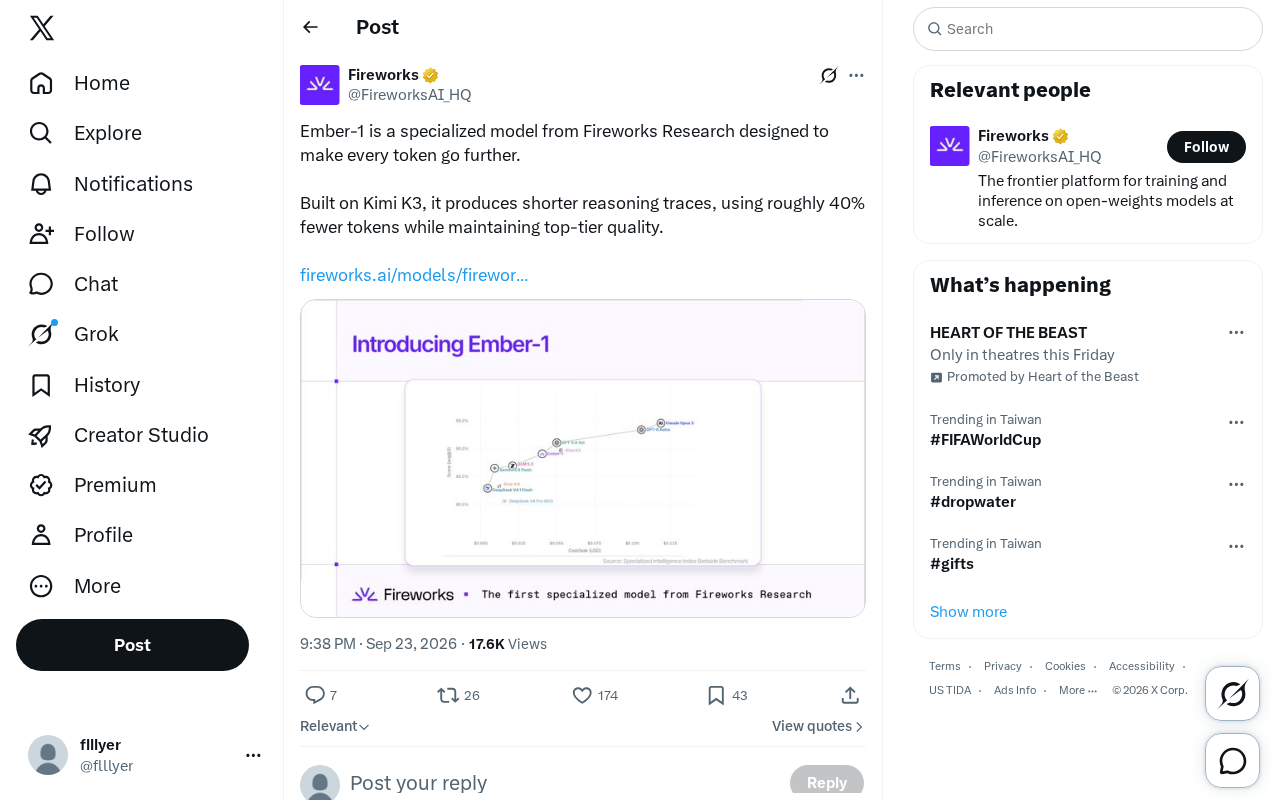
According to the official announcement, Ember-1 is built on top of Kimi K3, and its standout feature is the ability to generate significantly shorter reasoning traces. Compared to similar models, Ember-1 reduces token consumption by approximately 40% on reasoning tasks — without sacrificing first-tier quality.
Why "Shorter Reasoning" Matters
Reasoning models have become one of the hottest topics in the AI industry in recent years. These models improve accuracy on complex tasks by generating longer chain-of-thought outputs — but the trade-off is a sharp increase in token consumption, which directly drives up inference costs and extends response times.
For developers and enterprise users, tokens translate directly to money. A highly capable but verbose model creates substantial cost pressure at scale. Ember-1 targets exactly this pain point: it aims to demonstrate that high-quality reasoning doesn't necessarily require lengthy outputs.
If the claimed ~40% token reduction holds up, it means users can achieve comparable results at lower cost and faster speeds for equivalent tasks. For high-concurrency, cost-sensitive use cases, this kind of efficiency gain carries real practical significance.
Built on Kimi K3
Ember-1 wasn't trained from scratch — it's a specialized optimization built on top of Kimi K3. This approach of fine-tuning an already-strong foundation model for a specific purpose is becoming standard practice in the industry. It allows teams to inherit the base model's general capabilities while deeply refining performance along a particular dimension — in this case, reasoning efficiency.
Fireworks Research positions itself as an expert in inference services and model optimization, and Ember-1 can be seen as a concrete expression of its "efficiency-first" philosophy. It reflects a broader trend: competition in the model space is shifting from raw capability comparisons toward the more pragmatic question of capability per unit cost.
Kimi K3 is a reasoning model released by Chinese AI company Moonshot AI. Since its launch in 2025, it has ranked among the top open-source models on multiple benchmarks, particularly excelling at math and code reasoning tasks. By choosing Kimi K3 as its foundation, Ember-1 inherits a strong base for complex reasoning out of the box. This approach — fine-tuning a powerful open-source model for a specialized purpose — mirrors the logic behind many derivative models in the Meta LLaMA ecosystem: outsource the heavy lifting of base training to well-resourced original developers, while the optimization team focuses on polishing a specific vertical. The result is differentiated competitive positioning at a fraction of the R&D cost.
Balancing Efficiency and Quality
A natural question arises: does compressing reasoning traces come at the expense of accuracy? The conventional wisdom holds that longer chains of thought correspond to more rigorous reasoning. Ember-1's claim — maintaining top-tier quality with fewer tokens — would, if validated by real benchmark testing, provide compelling evidence for the "concise reasoning" paradigm.
For now, these claims come primarily from Fireworks itself, and independent third-party evaluations are not yet available. Developers interested in this model are encouraged to run comparative tests in their actual production environments, paying close attention to whether accuracy on complex reasoning tasks degrades as a result of the reduced token count.
Summary
Ember-1 represents a pragmatic direction in large model development: rather than chasing ever-greater raw capability, it seeks a better trade-off between capability and cost. For teams that need to call reasoning models at scale, purpose-built "token-efficient" models like this may ultimately be more attractive than general-purpose flagships. That said, its real-world performance still needs to be validated through broader independent testing.
Background
The core mechanism behind reasoning models is commonly referred to as Chain-of-Thought (CoT). During inference, the model generates an internal monologue — hidden from the user or collapsible for review — that progressively breaks down the problem, verifies intermediate steps, and arrives at a final answer. This mechanism significantly improves accuracy on complex tasks involving math, logic, and code, but the cost is that the number of tokens generated can be several times — or even tens of times — higher than that of a standard conversational model. OpenAI's o1, for example, can produce internal reasoning chains thousands of tokens long on certain math problems. Since most API services charge based on total input + output token count, the real-world cost of using reasoning models is often far higher than that of standard models with comparable parameter counts. This is the direct motivation behind the growing research focus on reducing reasoning token consumption.
Related articles

Workbuddy for Absolute Beginners: How a Desktop AI Agent Fits Into Real Workflows
A beginner's guide to the Workbuddy desktop AI agent: installation, claiming credits, file management, and building automated workflows—compared with CodeX for fit and cost, helping professionals shift from AI question-askers to AI managers.

OpenAI's New Agent Stack: Computer Use, Decisions API, and Ultra-Fast Workflows
OpenAI Dev Day unveiled a new agent stack: Computer Use outperforms humans, Decisions API delivers ultra-low-latency classification via Luna, Agents API opens the same Computer Use capabilities, and GPT-6.1 Sol costs only one-seventh of Astra. Core updates, benchmark data, and developer insights.

Liang Wenfeng Open-Sources DeepInfo Inference Framework, Takes On U.S. Ban
DeepSeek open-sources its DeepInfo inference framework after its models, featuring GPU/CPU cross-pipelining, small-model prediction with large-model verification, and full Huawei Ascend and NVIDIA chip support—facing the U.S. federal ban head-on. This article analyzes its significance for AI deployment and open-source strategy.