Fireworks Nexus Adds Savings Feature: Quantifying Cost Savings on Open-Source Models

Fireworks Nexus now lets enterprise teams quantify cost savings from open-source models and FireRouter with granular breakdowns.
Fireworks has launched a Savings feature on its Nexus platform, enabling enterprise teams to quantify cost reductions from using open-source models and the FireRouter routing layer. The feature supports per-user and per-model breakdowns, helping managers identify high-consumption sources and guide model selection. The update also adds cache hit rate tracking to help engineering teams optimize prompt design and improve inference efficiency — reflecting a broader shift where cost transparency is becoming a key differentiator for LLM platforms.
Fireworks Launches Nexus Savings Feature
Fireworks has rolled out a new Savings feature for its Nexus platform, with the core goal of helping enterprise teams clearly see how much they're saving by using Fireworks' open-source models and FireRouter. As teams grow increasingly dependent on large model APIs, cost transparency is becoming an increasingly significant management challenge.
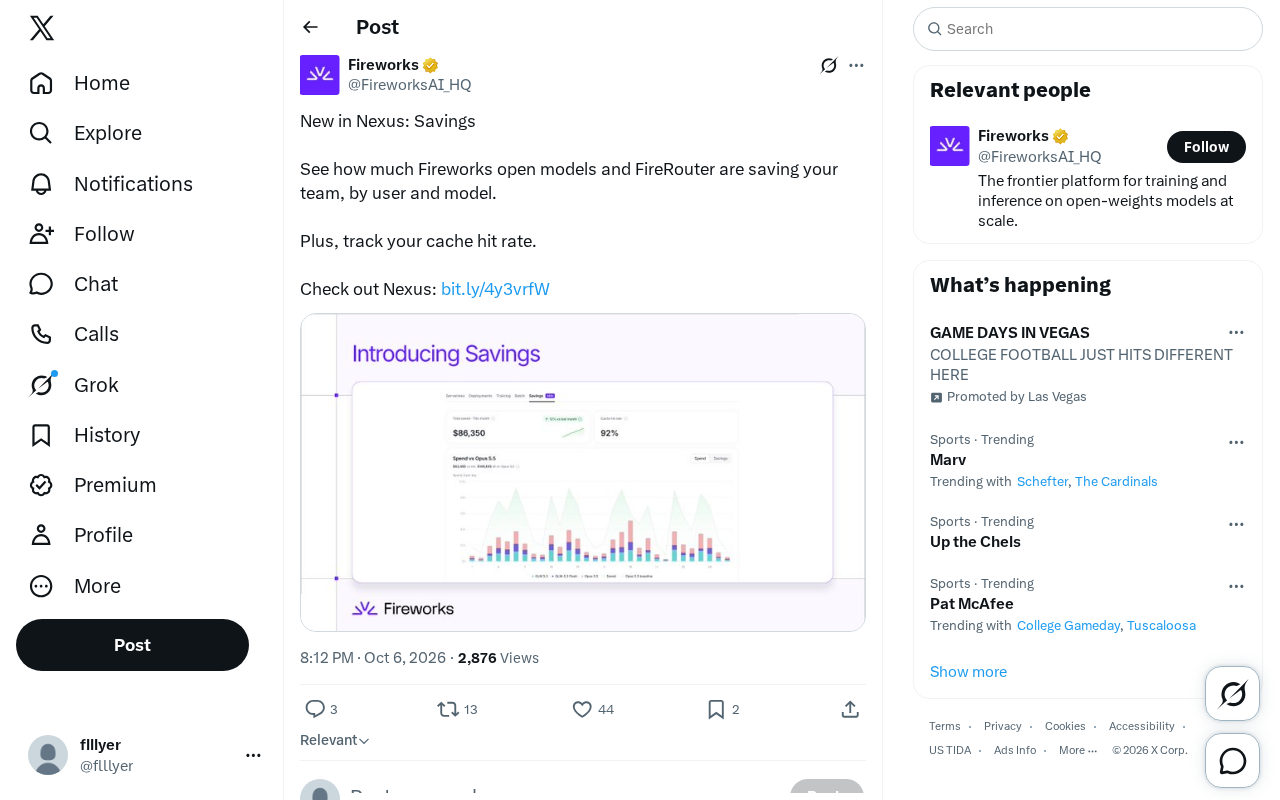
According to the official announcement, the standout aspect of this feature is the granularity of cost visualization — teams can view not only the total amount saved, but also break it down by user and by model. This means managers can clearly see which team members and which models are consuming the most resources, and where cost optimizations are being realized.
Why Cost Tracking Is Becoming More Critical
As enterprises make large-scale LLM API calls in production environments, costs accumulate quickly into a substantial expenditure. Many teams using closed-source commercial models — such as flagship models from major providers — frequently struggle with opaque billing and difficulty attributing costs.
Fireworks' approach is to reduce call costs while maintaining quality through open-source models combined with its own FireRouter routing layer. The Savings feature fills in a critical piece: making those savings quantifiable and trackable. When teams can back up cost-reduction claims with concrete numbers, technical decisions rest on a much stronger foundation.
Two-Dimensional Breakdown: By User and By Model
Breaking down costs by user makes it easier for teams to identify high-consumption individuals, optimize usage habits, or allocate budgets more effectively. Breaking down by model helps engineering teams assess which models offer the best cost-performance ratio, informing future model selection decisions. This multi-dimensional perspective is particularly valuable for teams scaling AI applications in production.
FireRouter is the intelligent routing layer within the Fireworks platform. Its core logic automatically dispatches requests to the most suitable model based on the task type, complexity, and latency requirements — rather than routing every request to the same (and typically most expensive) flagship model. For example, simple classification or summarization tasks can be routed to smaller, more efficient models, while complex reasoning tasks are directed to more capable ones. This "on-demand routing" strategy can dramatically reduce the average cost per call without significantly impacting overall quality. FireRouter is what gives the Savings feature its substantive source of savings — if all requests went through the same model, any cost comparison would be meaningless.
Cache Hit Rate Tracking
Beyond the core cost savings functionality, this Nexus update also introduces cache hit rate tracking.
Cache hit rate is a key metric for measuring inference efficiency. When repeated or similar requests hit the cache, the system avoids running a full model inference cycle, reducing both latency and compute costs. By incorporating cache hit rate into the monitoring dashboard, teams can proactively optimize their prompt design and request patterns to improve cache utilization — creating a closed loop from API calls all the way to cost management.
In LLM inference scenarios, caching typically refers to two mechanisms: KV Cache (Key-Value Cache) and Semantic Cache. KV Cache stores the intermediate computation results (i.e., the Key/Value matrices from the Attention layers) generated when the model processes identical prompt prefixes. When a new request's prompt prefix exactly matches a cached one, the system can skip that redundant computation and reuse the cached state. Semantic cache goes a step further, using vector similarity matching to find semantically similar historical requests — enabling cache hits even when the text isn't identical. For enterprise applications with fixed prompt structures and long system prompts — such as customer service bots or code assistants — KV Cache hit rates can be remarkably high, theoretically reducing per-inference costs by more than 50%. Exposing cache hit rate as an observable metric therefore helps engineers intentionally design prompt structures — for example, front-loading fixed content and maintaining consistent request prefixes — to maximize cache benefits.
What This Means for Enterprise Users
Overall, the launch of Nexus Savings reflects a broader trend: competition among large model platforms is expanding beyond raw model performance into the realm of operational and cost management tooling.
For teams using the Fireworks platform, features like this lower the bar for internal cost accounting and reporting. Engineering leads no longer need to manually piece together billing data to demonstrate AI ROI to management. For enterprises evaluating different inference providers, transparent cost tracking itself has become an important factor in the decision-making process.
Interested teams can explore this new Nexus feature through the official portal. It's worth noting that this article is based on Fireworks' brief official release announcement — for specific feature details and billing logic, the official documentation should be considered the authoritative source.
Related articles

Chain of Thought Isn't Just for AI: How Humans Can Use CoT to Improve Thinking Quality
Chain of Thought isn't just a prompt trick for large models. Starting from a Hacker News discussion, this article analyzes why CoT works for human thinking too, breaks down actionable ways to transfer it, and highlights the key differences between human CoT and machine CoT.
Cloudflare Teams Up with OpenAI: Closi…
Cloudflare Teams Up with OpenAI: Closing the Loop from Vulnerability Discovery to Defense with AI
Cloudflare uses OpenAI Daybreak to investigate security vulnerabilities and generate reviewable remediation plans, while developers use Codex to boost coding efficiency and quality.

Orca Multi-Agent Orchestration in Practice: A Guide to Parallel Collaboration with Claude and Codex
Orca is Stable AI's free open-source agent workbench supporting 34 agents like Claude Code and Codex in parallel. Learn its Git worktree isolation, multi-model orchestration, and mobile management.