First Look at Gemini 4 Argon: Google's New Model Takes Aim at Complex Workflows and Software Engineering

Google teases Gemini 4 Argon with a focus on complex workflows, cyber defense, and software engineering.
Google has proactively unveiled an early preview of its next-generation model, Gemini 4 Argon, getting ahead of mounting social media speculation. Positioned as a frontier-capable model, it emphasizes three key areas: complex workflows, cyber defense, and software engineering. Google reports the model is already seeing broad internal use — from everyday coding to quantum computing research — with positive feedback. However, this preview remains strategically limited: benchmark scores, model architecture, release timelines, and pricing have yet to be disclosed, and genuine capability assessments will require third-party validation after the full official launch.
Google Offers Early Preview of Next-Generation Model Gemini 4 Argon
Speculation about Google's next-generation model has been swirling across social media, and the company has chosen to get ahead of the buzz with an early preview. The model in question is Gemini 4 Argon, which Google is positioning as a next-generation large model with frontier-level capabilities.
The signal Google wants to send is clear: this isn't a routine version update, but a meaningful leap forward across several key capability dimensions. Three areas are specifically highlighted — complex workflows, cyber defense, and software engineering.
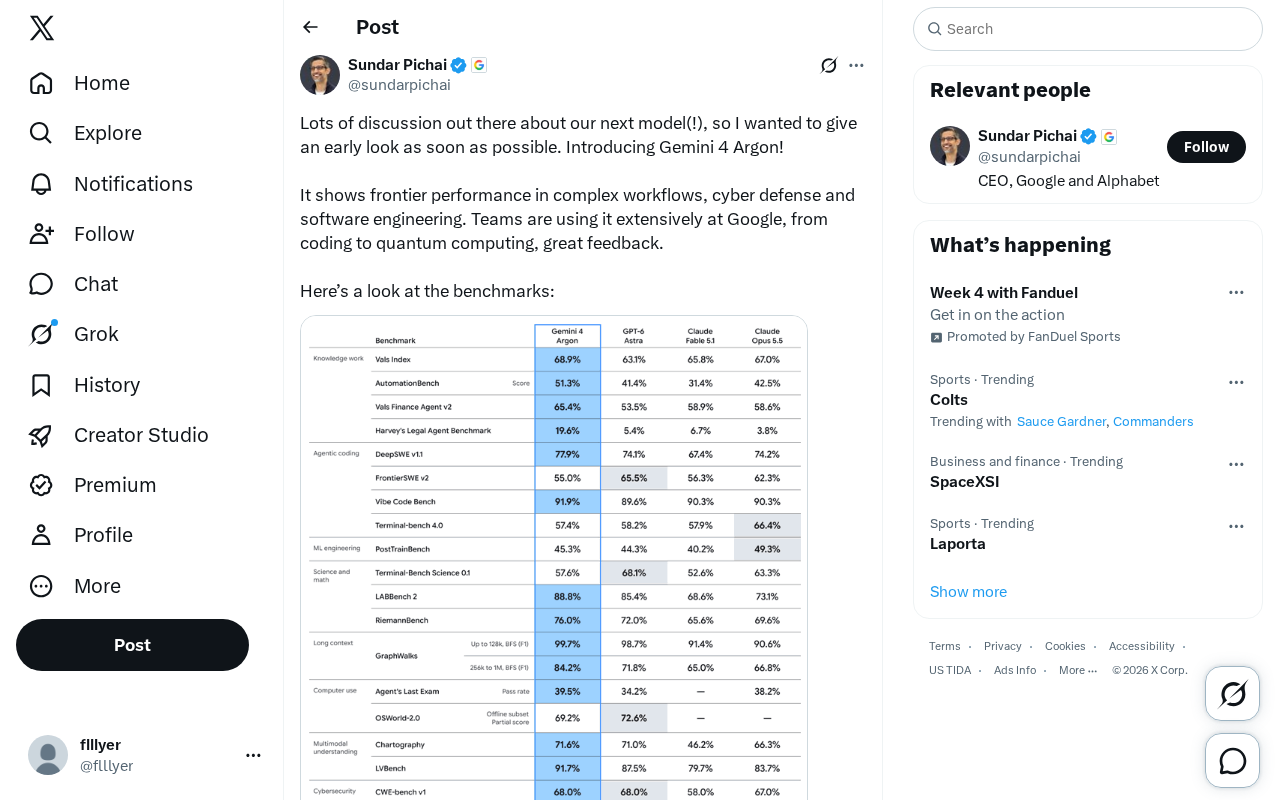
It's worth noting that this kind of "advance teaser" is itself a strategic move. In the fiercely competitive large model space, releasing signals early lets a company respond to external speculation while claiming the narrative before an official launch. That said, the information currently available remains limited — more details will have to wait for the full official release.
Three Core Capability Areas
According to official statements, Gemini 4 Argon demonstrates frontier-level performance in the following domains:
Complex Workflows
Modern enterprise and development environments increasingly rely on models to handle multi-step, cross-tool task chains. "Complex workflow" capability generally refers to a model's ability to maintain contextual consistency across long task sequences, autonomously invoke tools, and execute tasks end-to-end. This is also the central battleground in today's AI agent competition.
The rise of AI agents marks a major inflection point in large model competition over the past two years. Early large models primarily interacted in a simple question-and-answer format. The agent paradigm, by contrast, requires a model to proactively plan task steps, call external tools (such as search engines, code executors, and database interfaces), and dynamically adjust its course of action based on intermediate results — ultimately completing a full objective autonomously. This places much higher demands on long-context understanding, instruction tracking, and self-correction. OpenAI, Anthropic, Google, and other major players are all investing heavily in agent capabilities as a core differentiator, and a model's ability to handle complex workflows directly determines its value in enterprise automation scenarios.
Cyber Defense
Singling out cyber defense as a dedicated capability area is one of the more notable choices in this preview. It may indicate that the model has been specifically optimized for threat detection, vulnerability analysis, security response, and related use cases. As AI is increasingly deployed on both sides of the attack-defense equation, defensive capability is becoming a new competitive frontier for major AI labs.
AI's role in cybersecurity is increasingly double-edged: attackers are already using large models to generate more convincing phishing content, automate vulnerability scanning scripts, and assist in writing malicious code, while defenders are leveraging AI for log anomaly detection, threat intelligence analysis, and automated incident response. Listing "cyber defense" as a dedicated model capability area suggests Google may have conducted targeted training data curation and capability reinforcement for this domain, rather than relying on general-purpose generalization. This framing also aligns closely with the business of Mandiant — the prominent cybersecurity firm Google acquired in 2022 — and deep integration between the two could well be a key factor behind this capability.
Software Engineering
Coding and software engineering ability is a hard benchmark for measuring a large model's practical value. Google mentioned that the model has already been widely used internally across tasks ranging from everyday coding to quantum computing, with positive feedback reported. Large-scale internal usage is typically an important validation step before a model is released to the public.
Internal Testing: From Coding to Quantum Computing
Google revealed that internal teams have been actively using Gemini 4 Argon across a broad range of applications — from routine coding tasks to cutting-edge quantum computing research. This "eat your own dog food" approach is common in the tech industry: it helps refine the model in real-world conditions while also providing credible talking points for external communication.
The mention of "great feedback" signals team confidence in the model, but it should be viewed with appropriate perspective — internal feedback tends to carry a degree of subjectivity. A genuine capability assessment will require public benchmark results and third-party validation. Google has indicated that benchmark data will be released, and that will be the critical reference point for outside observers.
Dogfooding — using your own product before releasing it to the public — is a classic approach to quality validation in tech, drawn from the phrase "eat your own dog food." For large models, the value of large-scale internal dogfooding lies in surfacing issues that lab benchmarks struggle to catch: consistency degradation over extended use, misinterpretation of edge-case instructions, or instability in tool-calling behavior. Quantum computing is a particularly noteworthy use case mentioned here — it's a highly specialized field with extremely demanding requirements for reasoning precision. If the model genuinely provides meaningful assistance in quantum algorithm research, it would serve as compelling evidence of strong scientific reasoning capability. But again, independent verification from external researchers will be essential before drawing firm conclusions.
How to Approach This Preview Rationally
A degree of healthy skepticism is warranted when evaluating early announcements like this. What can be confirmed: Google has proactively disclosed the name and general positioning of its next-generation model, highlighted three focus areas — complex workflows, cyber defense, and software engineering — and shared details about internal usage.
What remains unclear is equally substantial: specific benchmark scores, model parameter scale and architecture, developer and public access timelines, pricing strategy, and direct comparisons against competing models all await official disclosure.
As competition in the large model space enters an increasingly intense phase, every major player is accelerating its pace. Gemini 4 Argon's early unveiling reflects Google's continued commitment to the field and signals that the next round of capability competition is about to begin. For AI practitioners tracking these developments, the real thing to watch will be the complete data and real-world performance that Google brings to the table at the official launch.
Related articles

Chain of Thought Isn't Just for AI: How Humans Can Use CoT to Improve Thinking Quality
Chain of Thought isn't just a prompt trick for large models. Starting from a Hacker News discussion, this article analyzes why CoT works for human thinking too, breaks down actionable ways to transfer it, and highlights the key differences between human CoT and machine CoT.
Cloudflare Teams Up with OpenAI: Closi…
Cloudflare Teams Up with OpenAI: Closing the Loop from Vulnerability Discovery to Defense with AI
Cloudflare uses OpenAI Daybreak to investigate security vulnerabilities and generate reviewable remediation plans, while developers use Codex to boost coding efficiency and quality.

Orca Multi-Agent Orchestration in Practice: A Guide to Parallel Collaboration with Claude and Codex
Orca is Stable AI's free open-source agent workbench supporting 34 agents like Claude Code and Codex in parallel. Learn its Git worktree isolation, multi-model orchestration, and mobile management.