First Verse: Deep Dive into a Poetry Community Platform Committed to Human Creation

First Verse bets on human-created poetry as a differentiator in the age of AI-generated content.
First Verse is a poetry community platform launched on Product Hunt that positions itself around content written and read by real people. In an era of AI content saturation, it offers daily curated poems, voice recitation features, email subscriptions, and direct tipping for poets. While its early traction is modest, the platform represents a broader trend of valuing human authenticity and explores the creator economy model in a niche literary space.
When Algorithms Flood Everything, Why Do We Need Human-Created Poetry
At a time when generative AI has infiltrated nearly every corner of content creation, a product called First Verse quietly debuted on Product Hunt. Its positioning is simple and clear: the best destination for new poetry written and read by real people. In an era where AI can generate hundreds of rhyming works in a second, a platform insisting on "human creation" feels both retro and avant-garde.
Generative AI refers to artificial intelligence systems capable of autonomously generating new content based on training data. Representative technologies include OpenAI's GPT series, Anthropic's Claude, Google's Gemini, and other large language models. These models learn statistical patterns and semantic structures of language by training on massive text corpora, enabling them to generate everything from business copy to literary works in seconds. By 2025, a significant proportion of new internet content is estimated to be AI-assisted or entirely AI-generated — a trend that is profoundly reshaping the supply-demand dynamics of the content ecosystem. It's against this backdrop that a poetry platform committed to purely human creation takes on special significance.
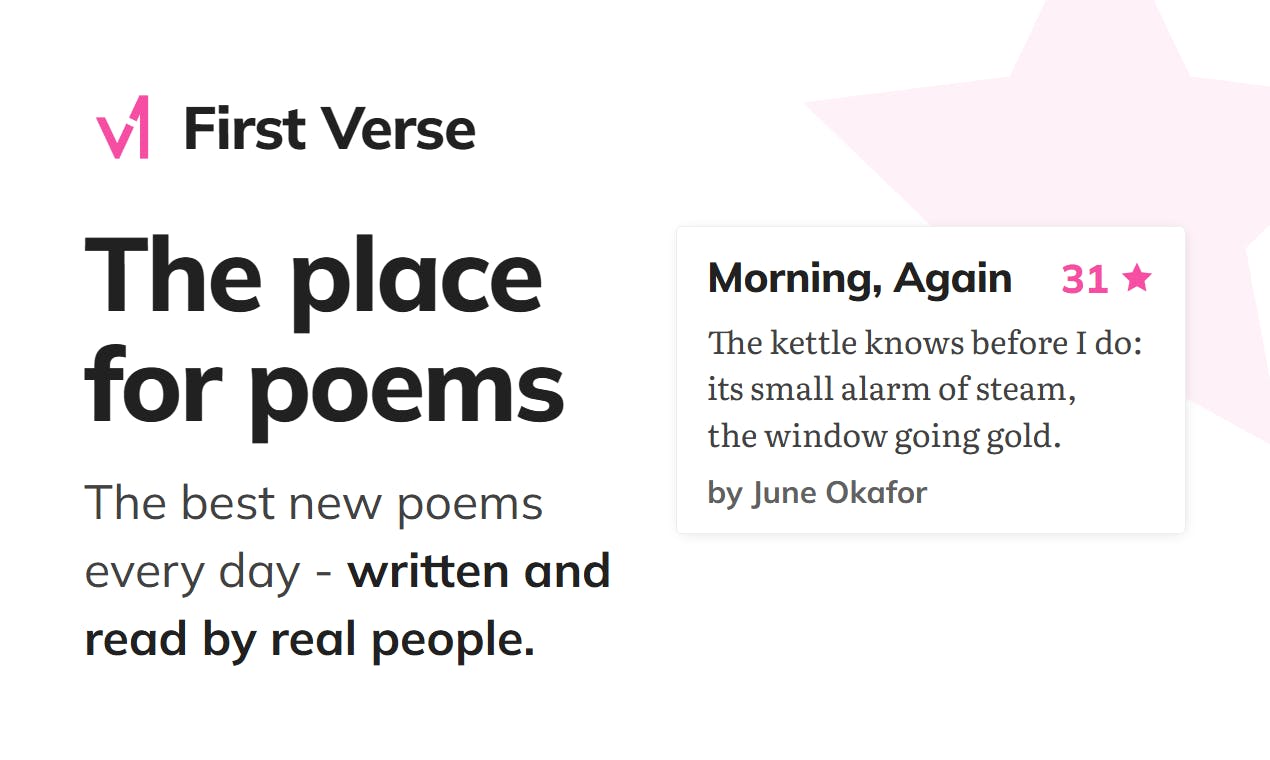
First Verse was built by creator Andrew Tye and is categorized under Writing, Tech, and Community. While its current vote count (7 votes) and ranking (#14) aren't particularly impressive, the product philosophy it represents deserves examination within broader industry trends.
It's worth noting that Product Hunt, one of the world's most well-known platforms for discovering and sharing new products, was founded by Ryan Hoover in 2013 and later acquired by AngelList. Entrepreneurs and product developers "launch" on Product Hunt to gain early user attention and upvote support. The platform's upvote mechanism and daily rankings serve as important indicators of a new product's initial market traction. Top-ranked products often receive significant exposure and early users, making Product Hunt a crucial channel for cold-starting tech products. While First Verse's current numbers aren't outstanding, many later-successful products also had modest launches — what matters is whether they can subsequently find their core user base.
Product Core: A "Slow Community" for Poetry
Three Core Features Analyzed
First Verse's product logic is clear, built around "people" rather than "algorithms":
- Discover the best new poems daily: The platform curates quality poetry each day for readers to browse and appreciate.
- Publish and be heard: Creators can upload their work and even present it through recitation — the "warmth of voice" that pure-text AI-generated content struggles to replicate.
- Email subscription for trending poems: Users can subscribe to have popular poems delivered directly to their inbox, fostering a slow-paced reading habit.
- Tip the poet: Readers can directly tip poets they enjoy, creating a creator incentive loop.
In the "publish and be heard" feature, voice plays a unique role. Although AI voice synthesis technologies (such as ElevenLabs and OpenAI's TTS) can already generate remarkably realistic human voices, the emotional fluctuations, breathing rhythms, pause handling, and spontaneity carried by a real person reading poetry still constitute a kind of "voiceprint fingerprint" that's difficult to perfectly replicate. Poetry reading as a performing art form has a long tradition in the English-speaking world — from Dylan Thomas's studio recitations to the contemporary Spoken Word movement, voice has always been an indispensable dimension of the poetry experience. By making recitation one of its core features, First Verse is essentially leveraging voice as an additional proof layer of human authenticity.
This design connects the three elements of "content — community — monetization," with the tipping mechanism in particular providing independent poetry creators with a small but direct income path.
The "Real People" Differentiation Signal
The product tagline repeatedly emphasizes written and read by real people. In the current context, this statement itself is a clear product stance — positioning "non-AI-generated" as the core differentiator, directly addressing the public's growing anxiety about content authenticity.
Industry Perspective: The Return to Content Authenticity Amid the Anti-AI Wave
Human Original Content Is Becoming a Scarce Resource
With the proliferation of large language models, the internet is flooded with machine-generated text. Poetry, as an art form highly dependent on personal experience, emotion, and linguistic intuition, is precisely the domain where AI can most easily "mimic the form while missing the spirit." First Verse's emergence is essentially a bet on a trend: when AI content becomes oversaturated, the scarcity and credibility of human originals will appreciate in value.
This aligns with the rising "human-verified content" movement in recent years. Whether it's social platforms labeling AI-generated content or creator communities emphasizing original identity, the market is repricing the "human" label.
On the technical front, the C2PA (Coalition for Content Provenance and Authenticity) alliance — co-founded by Adobe, Microsoft, BBC, and other institutions — is developing content provenance standards that record creation history through digital signatures and metadata. At the platform governance level, the EU AI Act requires labeling of AI-generated content, and platforms like Meta and YouTube have begun marking AI usage in content. However, for text content, there is currently no reliable technical means to 100% distinguish human creation from AI generation — including detection tools like GPTZero, which still have significant false positive rates. This means that verifying "human creation" relies more on community trust and honor systems rather than technical enforcement. This also poses a long-term challenge for platforms like First Verse in establishing credibility.
The Tipping Economy and Niche Creator Ecosystem
First Verse's tipping feature simultaneously gives it creator economy attributes. Poetry is a classic long-tail, niche field where traditional publishing channels are extremely unfriendly to ordinary creators. A platform that lets readers directly tip poets can theoretically lower the monetization threshold for creators, forming a micro but genuine creative incentive loop.
The Creator Economy refers to the economic ecosystem built around independent content creators, encompassing content creation, distribution, community operations, and monetization. According to SignalFire estimates, the global creator economy exceeds $100 billion in scale with over 50 million participants. Tipping, as a direct monetization method distinct from ad revenue sharing and subscriptions, has the core advantage of establishing an intermediary-free economic relationship between creators and audiences. Platforms like Buy Me a Coffee, Ko-fi, and Patreon have already validated this model's viability among specific creator groups. However, research shows that tipping revenue distribution is extremely uneven — a small number of top creators receive most tips, while long-tail creators typically earn minimal income. This represents a structural challenge for tipping economies in niche fields.
That said, whether such a tipping model can achieve scale depends on the platform's ability to aggregate enough dedicated readers willing to pay — always the biggest challenge in niche verticals.
Poetry publishing has long occupied the margins of the literary publishing industry, a reality that provides important context for understanding First Verse's raison d'être. In the traditional publishing system, poetry collections yield extremely low commercial returns — even well-known poets typically see first print runs of only 1,000-3,000 copies, far below novels or non-fiction works. For emerging poets, publication channels primarily depend on literary journal submissions (acceptance rates typically below 5%) and self-publishing. Digital platforms have opened new possibilities for poetry creators: the "Instapoetry" movement on Instagram (with figures like Rupi Kaur) demonstrated poetry's viral potential on social media; newsletter platforms like Substack have also provided poets with direct-to-reader distribution channels. First Verse can be seen as a continuation of this digitization trend, though its focus on the poetry vertical and community building distinguishes it from general-purpose content platforms.
Sober Assessment: First Verse's Opportunities and Concerns
Potential Advantages
- Clear value proposition: Championing human originals amid AI content saturation — a positioning that's clear and timely.
- Lightweight product form: Write, read, subscribe, tip — features aren't bloated, making it easy for users to get started.
- Strong community attributes: Poetry creators are inherently a high-stickiness, high-emotional-investment group, conducive to forming loyal users.
Real Challenges
- Scaling difficulty: Poetry inherently has a limited audience — how to break out of the small circle to achieve user growth is key.
- Lack of "human" verification mechanism: Without strong verification mechanisms, how the platform can truly guarantee content isn't AI-generated remains an open question. As noted earlier, existing AI text detection tools (such as GPTZero, Originality.ai, etc.) still have significant false positive rates, particularly for AI content that has been manually polished, which is even harder to detect. This means First Verse may need to rely on community reporting, creator identity verification, creation process records, and other auxiliary measures to maintain platform content purity.
- Monetization ceiling: Tipping models in niche fields typically generate limited revenue, making it difficult to sustain long-term platform operating costs.
- Modest early data: The current 7 votes and #14 ranking indicate the product is still in its very early stages, with market validation still needed.
Conclusion: A Product Experiment in "Human Touch"
First Verse may not become the next breakout hit, but the question it raises is valuable: In an era where AI can write everything, where does the meaning of human creation lie? Poetry is an ideal testing ground — it cannot be measured by efficiency, only moved by resonance.
For practitioners following creator economy and content authenticity trends, First Verse is a small sample worth watching. It represents a "going-against-the-grain" product philosophy: when technology makes content cheap, insisting on making content "expensive and sincere" again is itself a form of differentiated competitive advantage.
Key Takeaways
Related articles

Chain of Thought Isn't Just for AI: How Humans Can Use CoT to Improve Thinking Quality
Chain of Thought isn't just a prompt trick for large models. Starting from a Hacker News discussion, this article analyzes why CoT works for human thinking too, breaks down actionable ways to transfer it, and highlights the key differences between human CoT and machine CoT.
Cloudflare Teams Up with OpenAI: Closi…
Cloudflare Teams Up with OpenAI: Closing the Loop from Vulnerability Discovery to Defense with AI
Cloudflare uses OpenAI Daybreak to investigate security vulnerabilities and generate reviewable remediation plans, while developers use Codex to boost coding efficiency and quality.

Orca Multi-Agent Orchestration in Practice: A Guide to Parallel Collaboration with Claude and Codex
Orca is Stable AI's free open-source agent workbench supporting 34 agents like Claude Code and Codex in parallel. Learn its Git worktree isolation, multi-model orchestration, and mobile management.