Firstmate: Orchestrating AI Agent Team Collaboration Through a Single Entry Point

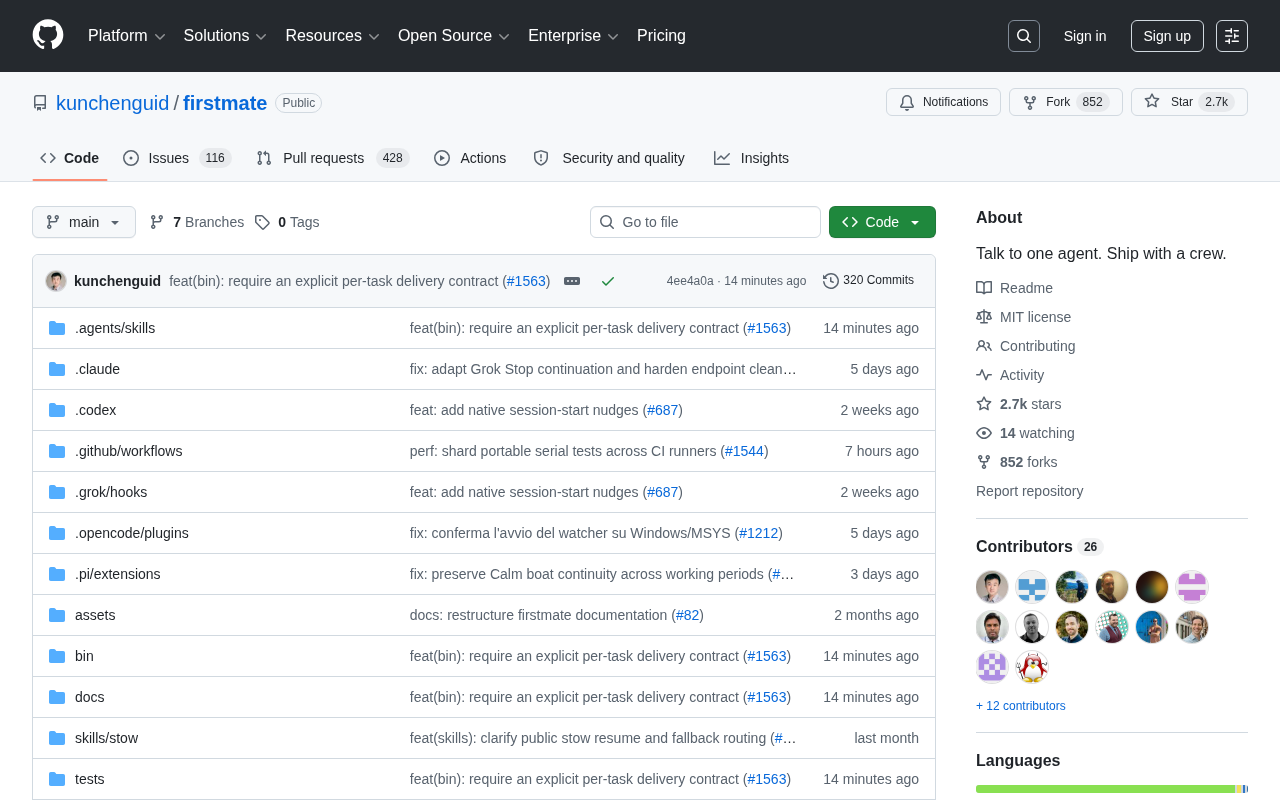
Firstmate orchestrates specialized AI agent teams through a single conversation interface for end-to-end software delivery.
Firstmate introduces a "Talk to one agent, Ship with a crew" paradigm for AI-assisted development, where a single master agent orchestrates a team of specialized AI agents to handle the full delivery pipeline. This article explores the technical foundations of multi-agent workflow orchestration, compares it to projects like AutoGPT and MetaGPT, and examines real-world challenges including error propagation, reliability, and token costs.
From a Single Conversation to Agent Collaboration
In today's landscape of proliferating AI coding tools, a new product philosophy is emerging—Firstmate proposes a core value proposition: "Talk to one agent. Ship with a crew." Behind this concise slogan lies a key shift in AI-assisted development: moving from single-point human-machine interaction to multi-agent collaborative workflows.
For developers, the past interaction model with AI coding assistants was typically one-on-one: you ask a model a question, and it returns a code snippet or suggestion. Firstmate attempts to redefine this relationship—users only need to communicate with one "master agent," while the actual work is carried out by an entire "crew" composed of agents with different specializations working behind the scenes.
The Orchestration Layer: Making Complex Multi-Agent Collaboration Simple
A Single Entry Point Reduces Cognitive Load
The most noteworthy aspect of Firstmate's design philosophy is how it hides complex multi-agent orchestration behind a unified conversational interface. This addresses a core pain point in deploying Multi-Agent Systems (MAS): cognitive load.
Multi-Agent Systems (MAS) represent an important research direction in distributed artificial intelligence, tracing back to distributed AI research in the 1980s. In MAS, multiple autonomous agents collaborate, compete, or negotiate to accomplish complex tasks that a single agent cannot handle alone. Each agent possesses independent perception, decision-making, and execution capabilities while interacting with other agents through communication protocols. In the era of large language models, MAS has gained new vitality—LLM-powered agents are no longer limited to predefined rules but possess natural language understanding, reasoning and planning, and tool-calling capabilities, enabling more flexible and adaptive inter-agent collaboration.
When developers need to simultaneously coordinate code writing, testing, code review, documentation generation, and other workflows, management costs skyrocket if each step requires separate configuration and integration with different AI tools. Firstmate's approach lets users face only one "captain" (playing on the product name Firstmate, a nautical metaphor for "first mate"), which then dispatches the entire crew.
From Prompt Engineering to Workflow Orchestration
The technical essence of this model is upgrading "prompt engineering" to "workflow orchestration." The master agent needs to understand the user's overall intent, decompose tasks into subtasks, distribute them to sub-agents with different capabilities, then integrate results and present them to the user. This process involves complex mechanisms like task planning, state management, and inter-agent communication—all of which remain transparent to the end user.
From a technical evolution perspective, Prompt Engineering is a technique for guiding large language models to produce desired outputs through carefully designed input text. Its limitation is that it's essentially still single-turn or few-turn human-machine interaction, making it difficult to handle complex tasks requiring multi-step, multi-role collaboration. Workflow Orchestration borrows from orchestration patterns in microservice architectures, introducing DAG-style (Directed Acyclic Graph) task scheduling, state machine management, and event-driven mechanisms. In the AI domain, frameworks like LangGraph and AutoGen already provide infrastructure for building agent workflows, supporting control flow patterns such as conditional branching, loops, and parallel execution. Firstmate encapsulates these underlying capabilities into a product experience that developers don't need to be aware of.
Industry Trends in Multi-Agent Collaboration
Why Choose an "Agent Team" Over a "Super Model"
The direction Firstmate represents echoes an important industry consensus: rather than pursuing a single omnipotent monolithic model, it's better to build collaborative systems composed of multiple specialized agents. This approach has been extensively explored in open-source projects like AutoGPT, MetaGPT, and CrewAI.
Specifically, AutoGPT (released March 2023) was the earliest autonomous AI agent project to gain widespread attention, enabling GPT-4 to autonomously set sub-goals, execute tasks, and iteratively improve. MetaGPT (August 2023) went further by simulating a software company's organizational structure, setting up roles like product manager, architect, and engineer, and constraining inter-agent collaboration through standardized document outputs (such as PRDs and design documents). CrewAI provides a lightweight framework that allows developers to quickly define agent roles, goals, and tools, and orchestrate collaboration through sequential or hierarchical approaches. These projects collectively validated the feasibility of multi-agent collaboration but also exposed common issues like hallucination accumulation and context window limitations—challenges that Firstmate needs to solve at the product level.
The benefits of specialized division of labor are obvious:
- The agent responsible for architecture design can use stronger reasoning models
- The one handling code completion can use faster models
- The one managing testing can integrate specialized testing frameworks
Through proper role division, the overall system's efficiency and reliability can potentially surpass a single large model's "solo performance." This approach is essentially analogous to "microservice architecture" in software engineering—splitting a monolithic application into multiple services with single responsibilities, achieving decoupling and collaboration through clearly defined interfaces.
A Delivery-Oriented Product Positioning
Interestingly, the word "Ship" in the product slogan is telling. It implies that Firstmate's goal isn't just to assist with writing code, but to cover the complete delivery pipeline from requirements to release. This differentiates it from many AI tools that stop at "code suggestions"—the real value lies in helping teams get products "out the door," not just generating code snippets.
A Sober Look: Real-World Challenges of Multi-Agent Collaboration
It should be objectively noted that Firstmate is still a very early-stage product. While multi-agent collaboration often looks impressive in demos, several real-world issues in complex projects warrant developer caution:
-
Error Propagation and Amplification: In real projects with multi-agent collaboration, error propagation between agents and context loss remain industry-level challenges. An error in one step can be amplified across the entire workflow. In multi-agent systems, Error Propagation is a systemic risk. Since large language models inherently suffer from hallucination—generating content that appears reasonable but is actually incorrect—when one agent's erroneous output is accepted as trusted input by downstream agents, errors propagate and even amplify along the workflow chain. This is similar to the "garbage in, garbage out" principle in software engineering, but more insidious in AI systems because erroneous outputs often appear completely correct in syntax and format. Current mitigation strategies include introducing validation agents, setting up human checkpoints, and using formal verification tools to validate critical outputs.
-
Reliability Challenges: The accuracy of task decomposition and the consistency of sub-agent outputs directly affect final delivery quality.
-
Token Cost Considerations: Multiple agents working in parallel means higher token consumption. How to balance effectiveness with cost is a question this category of products must answer. Tokens are the basic unit of measurement for how large language models process text, with mainstream APIs currently charging by input and output token count. In multi-agent systems, each agent's inference call generates token consumption, and inter-agent communication (typically passing context in natural language) can multiply total token usage several times over. For a typical code generation-review-fix loop involving 3 agents each performing 2 rounds of interaction, token consumption can be 6-10x that of a single call. Optimization strategies being explored in the industry include: using different-sized models for tasks of different complexity (model routing), compressing context passed between agents, and caching intermediate results.
Insights and Reflections for Developers
Regardless of whether Firstmate itself succeeds, the "single entry point, team collaboration" model it represents is likely an important direction in AI coding tool evolution. Several points are worth developers' consideration:
From AI Assistant to AI Team Member: Future AI development tools may no longer be "assistants" but more like "team members" to whom tasks can be delegated. The focus of human-machine collaboration will shift from "how to write good prompts" to "how to design good workflows and acceptance criteria." This transformation means developers' core competencies will further migrate from "coding ability" toward "system design ability" and "quality control ability"—you'll need to think like a tech lead about task decomposition, defining acceptance criteria, and designing rollback strategies, rather than writing code line by line like an executor.
The Value of Abstraction Layers Becomes Increasingly Apparent: Whoever can encapsulate the complexity of multi-agent collaboration most elegantly and reliably is more likely to win developer favor. Historically, from assembly language to high-level languages, from manual memory management to garbage collection, from bare-metal deployment to container orchestration, every successful abstraction layer upgrade has dramatically reduced developers' cognitive burden and unleashed productivity. The multi-agent orchestration layer is likely to become the next critical abstraction.
Maintain Both Technical Sensitivity and Critical Thinking: Products in this category are still in rapid iteration and validation phases. It's recommended to pilot them in small scopes within real projects and validate their effectiveness before building deep dependencies.
Conclusion
With "Talk to one agent, Ship with a crew," Firstmate succinctly captures the next-stop vision for AI-assisted development—a simplified interaction interface backed by a collaborating team of specialized agents. This is both an ingenious product design choice and a reflection of the broader industry trend moving from monolithic models toward multi-agent collaborative systems. Whether it can deliver on its promise remains to be seen, but the direction itself is worth continuous attention from every developer interested in AI-powered programming.
Related articles

Birdbuddy Nook Review: A Smaller, Cheaper Smart Bird Feeder
Birdbuddy renames the CES 2026 Birdbuddy 2 Mini to Birdbuddy Nook, a smaller, cheaper smart bird feeder. We analyze its AI bird ID, market positioning, and open questions.

Why Engineers Should Walk into Capitol Hill: A Frontline Technologist's Practical Guide to Policy Advocacy
Software engineer Nikhil Jathar shares lessons from two IEEE-USA Congressional Visit Days: how technologists can prepare clear asks, leverage organizational backing, and earn Capitol Hill staff trust with technical expertise to shape STEM education and open-source AI policy.

AI Agents Visiting Websites: Yelp Charges, JPMorgan Blocks—Who Should Decide Access?
Yelp charges AI agents, JPMorgan blocks them, Shopify offers a configurable switch. Three attitudes reveal one judgment: admission is a business decision, not bot rules' job.