Fish Releases Drama 3: A 35B3A MoE Text-to-Speech Model That Tops the TTS Charts

Fish releases Drama 3, a 35B3A MoE TTS model with 4-bit quality near the original, runnable on DGX Spark.
The Fish team has released the text-to-speech model Drama 3, featuring a 35B total/3B activated MoE sparse architecture and dubbed the "new TTS king." It runs well on the DGX Spark, with hardware requirements lower than the parameter count suggests. Its 4-bit quantized version performs very close to the original, making local deployment of a 35B-class TTS on consumer hardware possible. Fish offers an online demo and model downloads on Hugging Face. The article sees Drama 3 as representing a new approach of using sparsely activated large models to capture complex speech patterns while controlling inference costs, with strong engineering feasibility and enthusiastic community response.
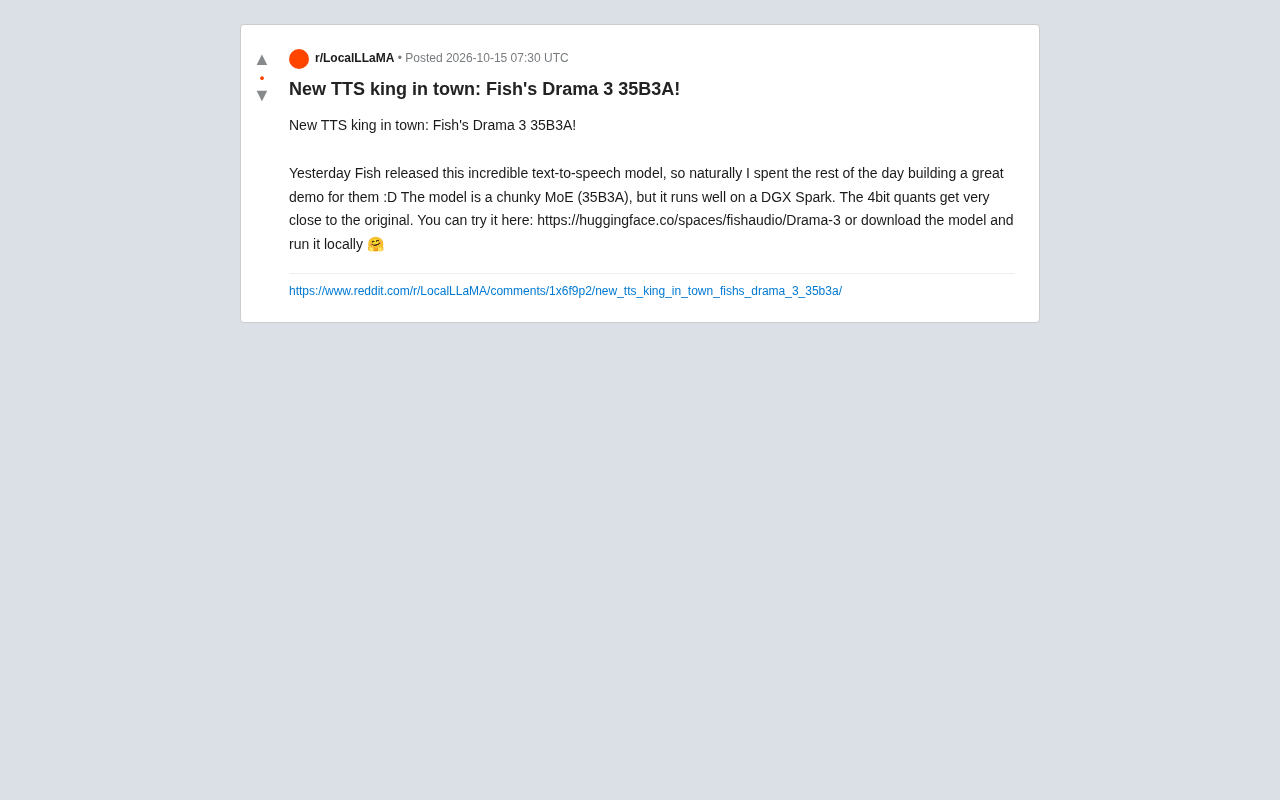
The text-to-speech field has welcomed a heavyweight contender. The Fish team has released a brand-new TTS model called Drama 3, built on a MoE architecture with 35B total parameters and 3B activated parameters, and the community is already calling it the "new TTS king."
Core Specifications of Drama 3
Drama 3's most striking feature is its model architecture. 35B3A means the model has 35 billion total parameters, but thanks to its Mixture of Experts (MoE) design, only about 3 billion parameters are activated per inference. This sparse activation strategy allows the model to retain large-capacity knowledge while significantly lowering inference costs.
According to the publishers, the model runs well on the DGX Spark, indicating that its hardware requirements are not as steep as the parameter count might suggest. For developers and researchers hoping to deploy high-quality TTS locally, this is a signal worth paying attention to.
MoE (Mixture of Experts) architecture is a sparse-activation neural network design: the model contains multiple independent "expert" subnetworks plus a gating network (router). During each forward pass, the gating network dynamically selects a small number of experts to participate in computation based on the input, while the rest remain inactive. As a result, the model's total parameter count determines the knowledge capacity it can hold, while the activated parameter count truly reflects the computational cost of a single inference. Taking Drama 3's 35B3A as an example, 35B means the total weight volume is enormous and can cover rich speech patterns, while 3B means each token only involves roughly three billion weights in actual computation, keeping memory usage and latency far below a traditional dense model of comparable scale. This approach was first validated in natural language processing by Switch Transformer, GShard, and others, and is now being migrated to the speech synthesis domain.
Quantized Version Approaches Original Model Quality
For the open-source model community, the quality of quantized versions has always been a key concern. Drama 3 delivers a satisfying answer here — the 4-bit quantized version performs very close to the original model.
This means users can run this 35B-class TTS model on consumer-grade hardware without sacrificing too much speech quality. For local deployment scenarios, this greatly lowers the barrier to entry.
4-bit quantization refers to compressing model weights from the 16-bit floating-point format (FP16/BF16) commonly used during training into 4-bit integer representations, typically retaining only a small number of scaling factors to reduce precision loss. The direct benefit is that memory usage drops to roughly a quarter of the original, allowing 35B-class models to be loaded on consumer-grade GPUs or even a single workstation. The quality of quantization is generally judged by comparing outputs with the original FP16 model: in speech synthesis, similarity metrics and subjective audio naturalness scores (such as MOS) are commonly used. If the MOS drop of the 4-bit version is within a perceptible threshold, it is considered to "approach the original model's quality." Mainstream quantization schemes include GPTQ, AWQ, GGUF, and others, which perform group quantization based on weight distribution characteristics, achieving a good balance between compression rate and fidelity.
Try It Now and How to Get It
The Fish team provides an online demo space on Hugging Face, where users can try Drama 3's speech synthesis directly in the browser. The model is also available for download and supports local running.
- Online demo: fishaudio/Drama-3 on Hugging Face Spaces
- Local deployment: Model weights are available for download, with 4-bit quantization support
- Hardware reference: Runs smoothly on DGX Spark
A New Variable in the TTS Competitive Landscape
In recent years, text-to-speech technology has undergone a transformation from traditional concatenative synthesis to neural network end-to-end generation. The introduction of large language model techniques has brought qualitative leaps in naturalness, emotional expression, and prosody control for TTS.
Drama 3 enters the TTS race with a MoE architecture, representing a new approach: using sparsely activated large models to capture complex patterns in speech while controlling inference costs. If 4-bit quantization can indeed maintain quality close to the original model, the engineering feasibility of this solution will be significantly enhanced.
The community response has been enthusiastic, with some users building demo applications for it the same day. This rapid response also reflects the strong demand in the open-source community for high-quality TTS tools.
DGX Spark is a compact desktop-class AI computing device launched by NVIDIA, featuring chips related to the Grace Blackwell architecture, positioned for local development and inference rather than data-center-grade training clusters. Its significance lies in bringing large-model inference — which previously required multi-GPU servers — down to the form factor of a personal workstation. For latency-sensitive real-time tasks like TTS, whether the DGX Spark's memory capacity and bandwidth can support efficient decoding of a 35B model is a key reference for judging Drama 3's deployment feasibility. Notably, the official statement only says it "runs well" without providing hard metrics such as real-time factor (RTF) or concurrency numbers, so actual deployment still requires users to benchmark for their specific scenarios.
Summary
The core highlights of Fish Drama 3 come down to three points: its 35B3A MoE architecture design, quality retention under 4-bit quantization, and runnability on devices like the DGX Spark. For developers and researchers following the evolution of speech synthesis technology, this model is worth trying out firsthand.
One-line Summary
Fish releases Drama 3, a 35B3A MoE-architecture TTS model with 4-bit quantization quality approaching the original, runnable on DGX Spark.
Paragraph Summary
The Fish team has released the text-to-speech model Drama 3, built on a sparse MoE architecture with 35B total parameters and 3B activated parameters, dubbed the "new TTS king" by the community. The model runs well on the DGX Spark, with hardware requirements lower than the parameter count suggests. Its 4-bit quantized version performs very close to the original model, making local deployment of a 35B-class TTS on consumer hardware possible. Fish offers an online demo space and model downloads on Hugging Face. The article argues that Drama 3's entry into the TTS race with a MoE architecture represents a new approach — using sparsely activated large models to capture complex speech patterns while controlling inference costs — with strong engineering feasibility and an enthusiastic community response.
Related articles

Workbuddy for Absolute Beginners: How a Desktop AI Agent Fits Into Real Workflows
A beginner's guide to the Workbuddy desktop AI agent: installation, claiming credits, file management, and building automated workflows—compared with CodeX for fit and cost, helping professionals shift from AI question-askers to AI managers.

OpenAI's New Agent Stack: Computer Use, Decisions API, and Ultra-Fast Workflows
OpenAI Dev Day unveiled a new agent stack: Computer Use outperforms humans, Decisions API delivers ultra-low-latency classification via Luna, Agents API opens the same Computer Use capabilities, and GPT-6.1 Sol costs only one-seventh of Astra. Core updates, benchmark data, and developer insights.

Liang Wenfeng Open-Sources DeepInfo Inference Framework, Takes On U.S. Ban
DeepSeek open-sources its DeepInfo inference framework after its models, featuring GPU/CPU cross-pipelining, small-model prediction with large-model verification, and full Huawei Ascend and NVIDIA chip support—facing the U.S. federal ban head-on. This article analyzes its significance for AI deployment and open-source strategy.