Fitbit Edge Launches: A New Choice for Screen Minimalists

Google launches Fitbit Edge, positioned between Air and Pixel Watch 5, emphasizing less screen and low intrusiveness.
Google has officially confirmed the Fitbit Edge, a tracker positioned between the Fitbit Air and Pixel Watch 5, targeting users tired of smartwatches but unwilling to give up notifications. The article analyzes the Edge's positioning, the user group for "screen minimalism," its differentiation from competitors, and market uncertainties. The Edge keeps essential screen interactions but cuts redundant features, reflecting Google's push toward more restrained technology in digital health. Its success hinges on whether users will pay for "a little less screen" and whether pricing is reasonable. Official details are still limited.
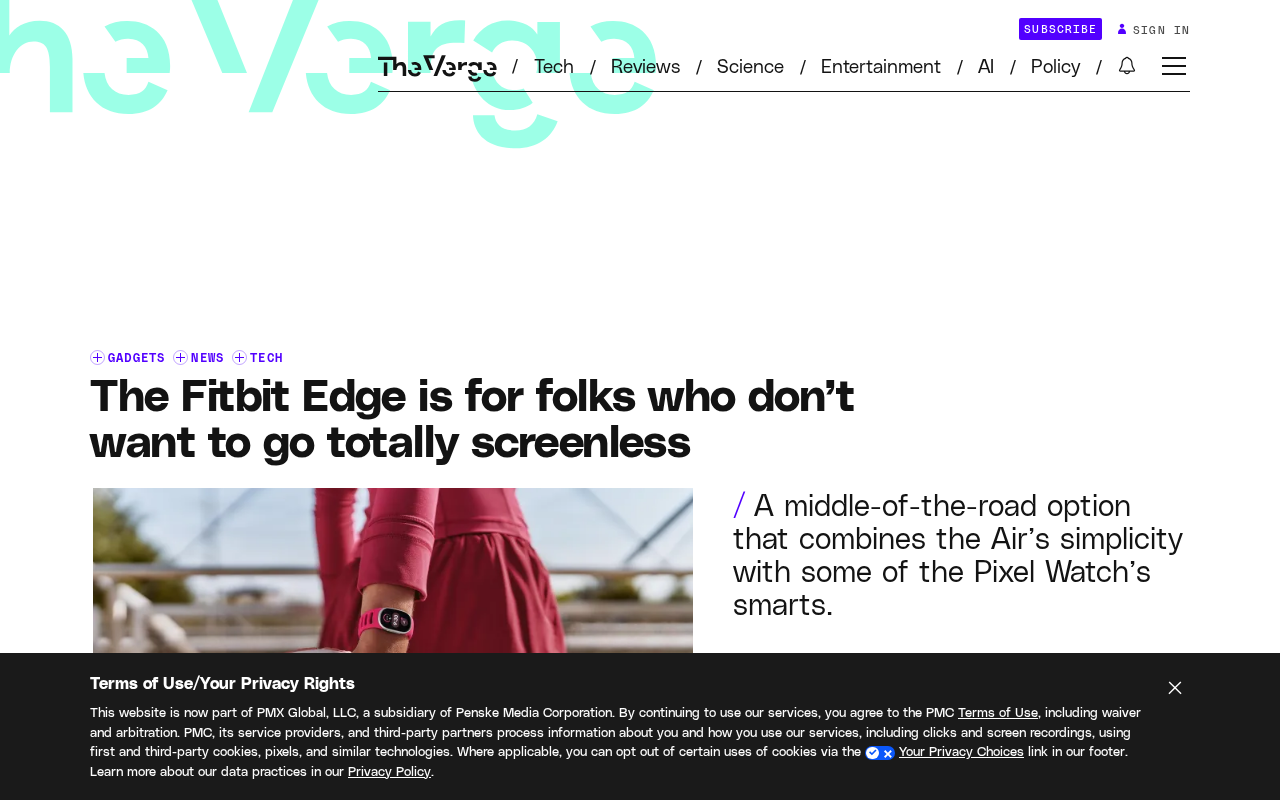
The Fitbit family has welcomed a new member. Google has officially confirmed the existence of the Fitbit Edge, a tracker positioned between the recently launched Fitbit Air and the more capable Pixel Watch 5, targeting users who are tired of smartwatches but unwilling to give up notifications entirely.
Product Positioning: Filling the Gap Between Air and Pixel Watch 5
The arrival of the Fitbit Edge is no accident. In Google's current wearable lineup, the Fitbit Air focuses on lightweight health tracking, while the Pixel Watch 5 delivers a full smartwatch experience. There's a clear gap in demand between the two: users who want more features than the Air offers, but don't want to bear the screen burden and price threshold of the Pixel Watch 5.
The Edge sits precisely in this space. The naming itself offers a clue—"Edge" suggests a boundary state, neither fully screen-free minimalism nor a full embrace of the all-feature smartwatch.
Screen Minimalism: An Overlooked User Group
"Smartwatch fatigue" is becoming a real phenomenon. Many users have found that the ever-glowing screen on their wrist doesn't improve efficiency—it becomes a new attention sinkhole. Notifications, messages, and health reminders bombard them in turn, turning a device meant to serve people into a burden that needs managing.
But giving up screens entirely is equally impractical. For users who need to receive key notifications and check fitness data, a completely screen-free tracker means constantly pulling out their phone—a fragmented experience. The Fitbit Edge attempts to find a balance in this contradiction: retaining essential screen interactions while cutting the redundant features that exhaust users.
"Smartwatch fatigue" is a concept that has gradually gained traction in the wearable device space in recent years, referring to the psychological burnout or even aversion users develop from prolonged exposure to constant notifications, health reminders, and screen stimulation from wrist devices. This concept is closely tied to the broader "Digital Wellbeing" movement—which advocates that technology should serve human attention rather than consume it. Research shows that frequent notification interruptions lead to attention fragmentation and increased anxiety, and wearable devices are precisely the "notification source" closest to the body. As a result, some users have begun turning to screen-free bands or minimalist trackers in exchange for lower cognitive load. The Fitbit Edge is a transitional product designed for this group, and its challenge lies in this: the screen can't be completely eliminated, or notification functionality fails; yet it can't be too rich, or it repeats the mistakes of the smartwatch.
Differentiation Strategy from Competitors
There's no shortage of wearables on the market that emphasize "less screen" or "no screen," but most products swing to the other extreme—either eliminating the screen entirely or making it so small it's nearly unusable. The Fitbit Edge's approach seems more pragmatic: the screen exists, but its role is strictly limited.
This thinking aligns with Google's overall direction in digital health in recent years. From Digital Wellbeing to Wear OS notification management optimization, Google has been trying to make devices more "restrained." The Fitbit Edge can be seen as an extension of this philosophy at the hardware level—not keeping users away from technology, but integrating technology into daily life with lower intrusiveness.
Wear OS is the operating system Google built specifically for smartwatches. Its predecessor was Android Wear, and after merging with Samsung's Tizen in 2021, it has been jointly maintained by Google and Samsung. Wear OS supports notification syncing, voice assistants, health data integration, and a third-party app ecosystem, and serves as the software foundation for the Pixel Watch series. Google has continuously strengthened notification management capabilities on Wear OS, such as allowing users to silence specific apps and set focus mode periods—consistent with the "restraint" philosophy emphasized by the Fitbit Edge. It's worth noting that Fitbit devices typically run Fitbit OS rather than full Wear OS, so there will be trade-offs in app extensibility and notification handling logic. Understanding this helps determine whether the Edge is a "stripped-down version" of Wear OS or a new form independent of both product lines.
Market Prospects and Uncertainties
Whether the Fitbit Edge succeeds depends on one key question: are users really willing to pay for "a little less screen"? Against the backdrop of slowing smartwatch market growth, this niche demand does exist, but how large the scale is remains unknown.
Another variable is price. The price range between the Fitbit Air and Pixel Watch 5 isn't wide, and the Edge's pricing strategy will directly determine whether it survives in the gap or becomes a bridge connecting the two product lines.
Currently, Google has disclosed limited information, and the Fitbit Edge's full specifications, battery performance, and specific feature list are still awaiting further official announcements.
One-line Summary
Google launches Fitbit Edge, positioned between Air and Pixel Watch 5, emphasizing less screen and low intrusiveness.
Paragraph Summary
Google has officially confirmed the existence of the Fitbit Edge, a tracker positioned between the Fitbit Air and Pixel Watch 5, targeting users tired of smartwatches but unwilling to give up notifications. The article analyzes the Edge's product positioning, the user group corresponding to "screen minimalism," its differentiation strategy from competitors, and the uncertainties of its market prospects. The Edge retains essential screen interactions but cuts redundant features, reflecting Google's overall direction of making technology more restrained in digital health. Its success depends on whether users are willing to pay for "a little less screen" and whether the pricing strategy is reasonable. Currently, official information is limited, and full specifications, battery life, and feature lists are still awaiting announcement.
Related articles

Chain of Thought Isn't Just for AI: How Humans Can Use CoT to Improve Thinking Quality
Chain of Thought isn't just a prompt trick for large models. Starting from a Hacker News discussion, this article analyzes why CoT works for human thinking too, breaks down actionable ways to transfer it, and highlights the key differences between human CoT and machine CoT.
Cloudflare Teams Up with OpenAI: Closi…
Cloudflare Teams Up with OpenAI: Closing the Loop from Vulnerability Discovery to Defense with AI
Cloudflare uses OpenAI Daybreak to investigate security vulnerabilities and generate reviewable remediation plans, while developers use Codex to boost coding efficiency and quality.

Orca Multi-Agent Orchestration in Practice: A Guide to Parallel Collaboration with Claude and Codex
Orca is Stable AI's free open-source agent workbench supporting 34 agents like Claude Code and Codex in parallel. Learn its Git worktree isolation, multi-model orchestration, and mobile management.