Five Cloud Computing Trends for 2027: Agentic AI and AI-Optimized Infrastructure Lead the Way

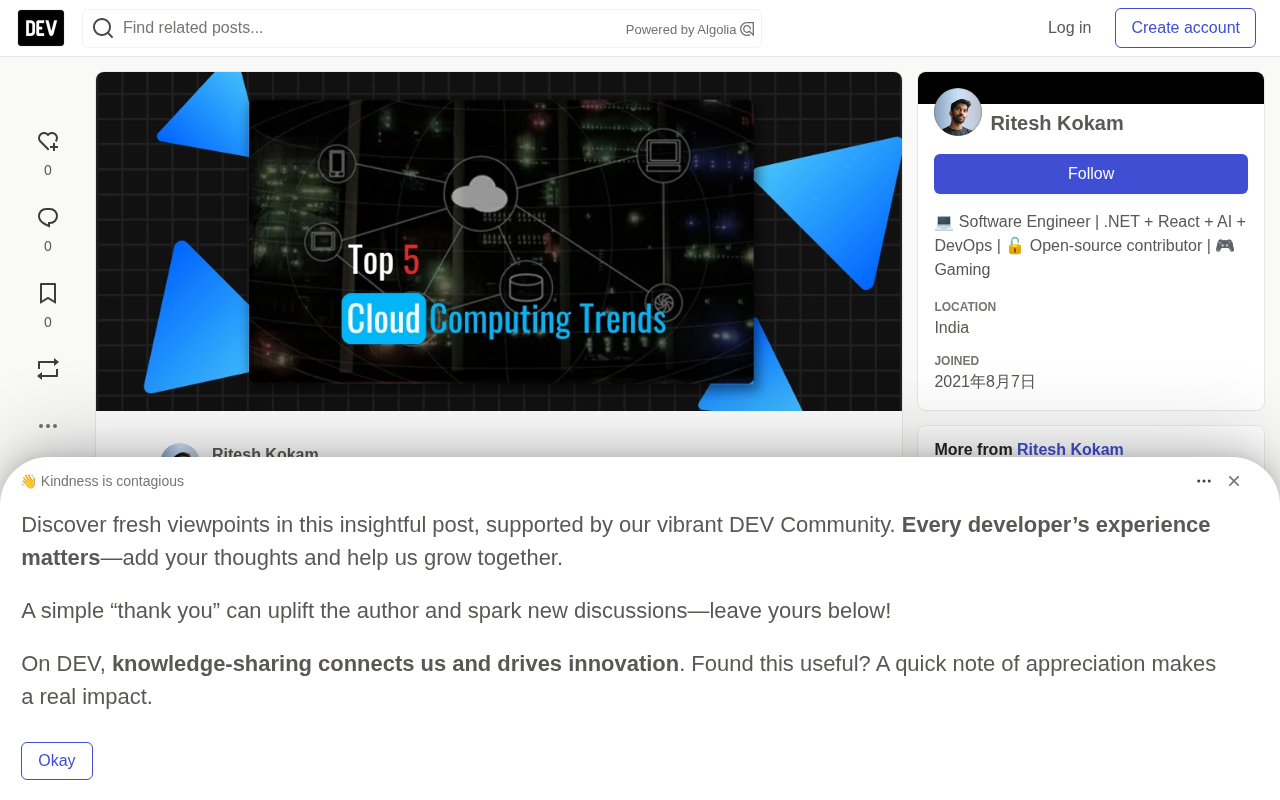
Cloud computing in 2027 evolves around five lines: Agentic AI, AI-optimized infrastructure, hybrid cloud sovereignty, platform engineering, and FinOps.
Drawing on Gartner, CNCF, FinOps Foundation, and IEA data, this article outlines five cloud computing trends around 2027: Agentic AI-driven autonomous operations, AI-optimized infrastructure, hybrid cloud and data sovereignty, cloud-native platform engineering, and sustainable cloud computing with FinOps. The core judgment is that cloud computing is shifting from "moving to the cloud" to "getting the most out of the cloud," with AI workloads as the core variable reshaping compute, deployment, and cost governance.
Five Cloud Computing Trends for 2027: From Infrastructure Delivery to Intelligent Adaptive Platforms
Cloud computing's center of gravity is shifting from "moving to the cloud" to "getting the most out of the cloud." As AI workloads enter production environments at scale, enterprises' requirements for compute architecture, deployment models, development approaches, and cost governance are undergoing substantive change. Drawing on data from Gartner, CNCF, the FinOps Foundation, the International Energy Agency, and other sources, cloud computing around 2027 will evolve along five main lines: Agentic AI-driven autonomous operations, AI-optimized infrastructure, hybrid cloud and data sovereignty, cloud-native platform engineering, and sustainable cloud computing with FinOps. These trends do not exist in isolation—they interlock. AI drives up compute demand, compute demand forces cost and energy governance, and governance requirements in turn shape deployment architecture.
Trend One: Agentic AI and Autonomous Cloud Operations
What generative AI changes is how content is produced and information is processed, while what Agentic AI changes is "who executes the task." These systems can autonomously plan tasks, invoke tools, execute multi-step workflows, and complete operations under varying degrees of human oversight. Cloud platforms happen to provide the compute and elastic infrastructure needed to support such intelligent systems.
Real-world use cases concentrate on the operations side: automated cloud monitoring, infrastructure troubleshooting, resource allocation optimization, and assisting software development teams. When AI agents can modify system configurations and access sensitive data, access control, human oversight, and security policies become non-negotiable baselines. When evaluating Agentic AI, the real dividing line for enterprises is not model capability but whether the governance framework keeps pace with the agent's degree of autonomy.
The core difference between Agentic AI and generative AI lies in the level of autonomy. Traditional AI assistants typically respond to single-turn prompts, whereas AI agents possess goal decomposition, tool invocation, memory, and reflection capabilities, allowing them to chain multiple steps together to complete tasks with minimal human intervention. In cloud operations scenarios, this means an agent can autonomously read monitoring metrics, pinpoint anomalies, call APIs to adjust resource configurations, and even trigger rollbacks. The industry commonly uses "levels of autonomy" frameworks to evaluate such systems: from fully manual operation to fully autonomous execution, there are multiple levels including suggestion, approval, and limited autonomy. When implementing, enterprises typically start with low-risk, reversible tasks and gradually expand agent permissions, while putting audit logs, permission boundaries, and human circuit-breaker mechanisms in place.
Trend Two: AI-Optimized Cloud Infrastructure
AI workloads are reshaping cloud providers' hardware roadmaps. Demand for GPUs, AI accelerators, high-speed networking, and scalable storage continues to climb, and cloud providers are expanding AI infrastructure accordingly to support model training, inference, and other compute-intensive tasks. The next wave of evolution includes more efficient AI processors, faster model inference, optimized data pipelines, and infrastructure designed for specific workloads.
According to Gartner, public cloud spending in India will reach $17.5 billion in 2026, driven in part by demand for AI-ready infrastructure and application modernization. For enterprises, the key challenge is finding the balance among compute performance, cost, and reliability—choosing the right hardware, cloud services, and AI models is what enables faster results without significant overspending. As AI projects move from experimentation to production, the importance of AI-ready infrastructure will become even more pronounced.
"AI-ready infrastructure" refers to cloud environments pre-optimized for both training and inference workloads, typically including GPU/accelerator clusters, high-bandwidth low-latency networking (such as InfiniBand or high-speed Ethernet), parallel file storage, and an orchestration layer that supports model scheduling and compute partitioning. Training workloads emphasize large-scale parallel compute and data throughput, while inference workloads focus more on unit cost, latency, and elastic scaling. The AI-specific instances, managed training platforms, and inference optimization services that cloud providers have launched in recent years are essentially rearchitecting general-purpose cloud resources into forms oriented toward AI workflows. When evaluating this type of infrastructure, enterprises need to distinguish between "can run AI" and "optimized for AI"; the latter typically means higher hardware density and more fine-grained resource scheduling capabilities.
Trend Three: Hybrid Cloud, Multi-Cloud, and Data Sovereignty
The criteria by which enterprises choose where to deploy applications are changing: no longer the inertia of a single deployment model, but a comprehensive trade-off among performance, cost, regulatory requirements, and security. Hybrid cloud combines public cloud services with private infrastructure, while multi-cloud draws on services from multiple cloud providers—both can deliver flexibility when the strategy is clear. The importance of data sovereignty is rising in tandem, as enterprises want stronger control over where data is stored and processed.
This combination helps meet compliance requirements, ensure business continuity, and support applications that require local processing. The cost is increased operational complexity. Before expanding cloud environments, enterprises should first establish consistent security policies, monitoring systems, identity management, and workload placement strategies—otherwise multi-cloud can easily devolve into multiple fragmented operational silos.
Trend Four: Cloud-Native Technologies and Platform Engineering
Containers, Kubernetes, microservices, and infrastructure as code continue to shape modern application architecture. According to a January 2026 survey by the Cloud Native Computing Foundation (CNCF), 82% of surveyed container users are running Kubernetes in production—Kubernetes has in effect become the operating system for AI.
Parallel to cloud-native adoption is platform engineering. Enterprises are building internal developer platforms that let teams request infrastructure, deploy applications, and use approved tools through standardized workflows. This approach boosts developer productivity, reduces redundant work, and embeds security practices into the software delivery process. As applications and AI workloads grow increasingly complex, cloud-native platforms play the role of maintaining consistency, scalability, and operational reliability.
Platform Engineering is a distinct discipline that evolved from DevOps practices, whose core output is the Internal Developer Platform (IDP). An IDP encapsulates infrastructure requests, environment configuration, deployment pipelines, observability, and security policies into a standardized, self-service service catalog, enabling developers to complete delivery without directly manipulating underlying cloud resources. Compared with the traditional "ops team does it for you" model, platform engineering delivers operational capabilities to development teams in a productized way, preserving self-service efficiency while ensuring policy consistency. Gartner has listed it as one of the key technology trends for the coming years, and its maturity is typically measured by metrics such as platform adoption rate, developer self-service rate, and change failure rate.
Trend Five: Sustainable Cloud Computing and FinOps
As cloud usage expands, infrastructure costs, energy consumption, and environmental impact are coming into management's view. FinOps (cloud financial operations) helps enterprises understand and optimize technology spending, and AI-driven monitoring and automation can identify idle resources, forecast costs, and recommend more efficient configurations.
This trend is especially critical for AI workloads. A 2026 survey by the FinOps Foundation shows that 98% of respondents are managing AI-related spending. Sustainability is another rising priority: an April 2026 report from the International Energy Agency noted that data center electricity consumption grew 17% in 2025. Enterprises' responses include right-sizing infrastructure, reducing idle resources, improving utilization, and incorporating energy efficiency assessment alongside performance and cost. The goal is to make cloud environments more sustainable in both financial and environmental dimensions while improving business outcomes.
FinOps (Cloud Financial Operations) is a collaborative framework spanning finance, technology, and business, aimed at maximizing value under the cloud's variable spending model. Its core practices include cost visibility and allocation, budgeting and forecasting, resource optimization, and unit economics analysis. The FinOps Foundation divides its operation into three iterative phases—"Inform, Optimize, Operate"—and promotes open cost data specifications such as FOCUS to address inconsistent multi-cloud billing standards. As AI workloads drive up unit compute costs, FinOps's focus is expanding from pure billing optimization to AI spend attribution, model inference cost accounting, and energy efficiency metric management, becoming a key mechanism connecting technical decisions with financial accountability.
Consensus and Divergence Across Multiple Sources
Looking across multiple independent sources, three judgments are cross-corroborated: AGI-ready infrastructure, Kubernetes as the operating system for AI, and AI spend governance. Gartner's spending forecasts, CNCF's production adoption rates, and the FinOps Foundation's spend management percentages point from the market, technology, and financial angles respectively toward the same direction—AI has become the core variable in cloud evolution.
Divergence mainly appears in judgments about pace. Some views hold that Agentic AI's autonomous operations will spread rapidly, while others emphasize that the maturity of security and governance frameworks is the decisive factor, and that human oversight will remain indispensable in the short term. The original text's position on this point is relatively balanced: it acknowledges that AI agents can improve operational efficiency while explicitly listing access control and human oversight as preconditions. When planning, the more prudent approach for enterprises is to treat Agentic AI as a gradual layering of capabilities rather than a one-time replacement.
The Logic of Trade-offs in Enterprise Implementation
The original conclusion is worth quoting: success depends on choosing technologies that solve real business needs, not on embracing every new innovation. Enterprises that combine cloud modernization with security, cost optimization, and effective governance are more likely to sustain innovation and competitiveness. Cloud computing's positioning is shifting from infrastructure delivery to an intelligent, adaptive, and efficient foundation for digital transformation.
For most organizations, the pragmatic path is to first shore up governance capabilities—unified security policies, cross-environment cost visibility, and platformized delivery processes—and then introduce AI-optimized infrastructure and Agentic capabilities on that foundation. If the order is reversed, technology investment can easily become a new source of complexity.
One-line Summary
Cloud computing in 2027 will evolve along five main lines: Agentic AI, AI-optimized infrastructure, hybrid cloud sovereignty, platform engineering, and FinOps.
Paragraph Summary
Drawing on data from Gartner, CNCF, the FinOps Foundation, the International Energy Agency, and other sources, this article outlines five cloud computing trends around 2027: Agentic AI-driven autonomous operations, AI-optimized infrastructure, hybrid cloud and data sovereignty, cloud-native platform engineering, and sustainable cloud computing with FinOps. The core judgment is that cloud computing is shifting from "moving to the cloud" to "getting the most out of the cloud," with AI workloads becoming the core variable reshaping compute architecture, deployment models, and cost governance. Cross-corroboration across multiple sources confirms three points of consensus—AI-ready infrastructure, Kubernetes as the operating system for AI, and AI spend governance—with divergence mainly over the pace of Agentic AI adoption. Enterprises should first shore up governance capabilities such as unified security policies, cost visibility, and platformized delivery, then introduce AI-optimized infrastructure and agent capabilities, to avoid technology investment turning into new complexity.
Related articles

JobRunner MCP Server: AI Agents Can Now Fix Failed Java Jobs
JobRunner launches an open-source MCP server enabling AI agents to view cluster status, diagnose failures, and recover Java jobs—incident response from any cloud coding environment or existing agent.

MLAI Digital Launches 9 Security Agents: MCP Server Safeguards the Full Lifecycle of Agentic AI
MLAI Digital launches Security MCP Server with nine built-in specialized security agents covering vulnerability discovery, attack simulation, prompt injection detection, API and infrastructure assessment, and accelerated remediation—embedding security validation across the full Agentic AI lifecycle from development to production.

Running Isaac Lab on H100 GPUs: Exploring Better Approaches
Exploring optimization methods for running Isaac Lab on NVIDIA H100 GPUs, including MIG configuration, mixed precision, TensorRT acceleration, and community experience to improve robotics simulation and reinforcement learning efficiency.