Flash Next Experience Sparks Excitement: Qwen4 Family Becomes Community Hot Topic

Reddit users praise Flash next, anticipate Qwen4 and the 27B model, while debating the knowledge ceiling of small models.
The Reddit community is abuzz over the "Flash next" model, with users reporting that hands-on experience exceeds expectations and that version iteration has delivered significant agentic capability leaps, while eagerly awaiting the Qwen4 family. Discussion centers on the next 27B model—users hope for stronger design-task training and larger N-gram mechanisms and expert counts. Meanwhile, calmer voices note small models' inherent knowledge bottleneck, the difficulty of compensating for weight-scale limits via agentic progress, and real deployment constraints. Overall consensus: progress is tangible, but boundaries remain—and the debate itself reflects the open-source community's vitality.
The Reddit community has recently been buzzing with heated discussion around the "Flash next" model, with users eagerly anticipating the upcoming Qwen4 family. From hands-on experience to technical speculation, this discussion reflects the delicate balance small models must strike between agentic capability and knowledge reserves.
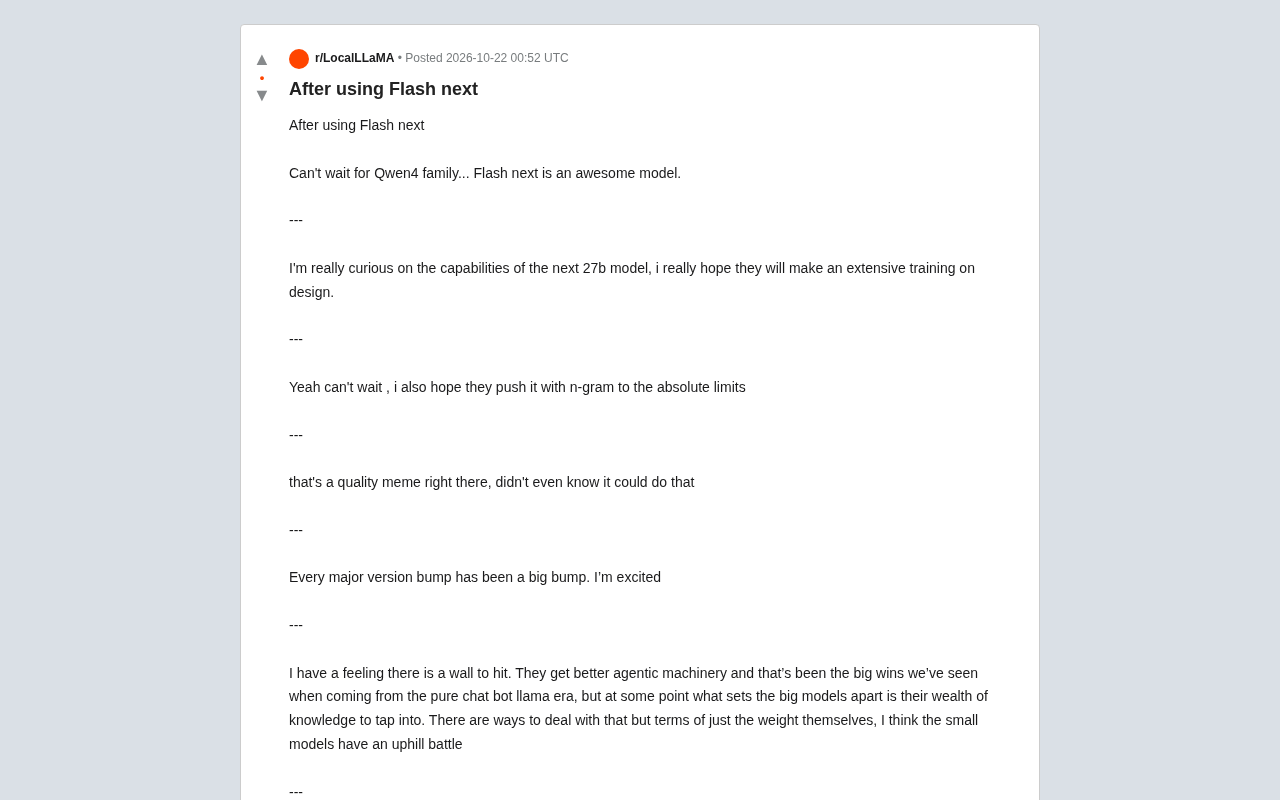
Flash Next: A Stunning "Out-of-the-Box" Experience
The original poster opened by saying outright, "Can't wait to use the Qwen4 family... Flash next is an awesome model," which quickly struck a chord. Multiple users chimed in with similar sentiments, with one describing the model's performance as a "quality meme"—they hadn't even expected it to generate such high-quality content. This kind of genuine feedback from frontline users is more convincing than any benchmark test.
Judging from the tone of the conversation, Flash Next's iteration has delivered remarkable results. One user noted that "every major version update is a huge leap forward," suggesting that this series of models has maintained a steady pace of improvement across versions. This accumulation of consistently positive experiences is the underlying reason for the community's enthusiasm.
Imagining the Next 27B Model: Design and N-gram as Key Terms
In the discussion, users raised specific expectations for the capabilities of the "next 27B model." One user explicitly stated, "I hope they train heavily on design," reflecting market demand for model performance on creative and design tasks. Another added, "I hope they push N-gram to the limit," pointing to the model's potential in capturing local patterns.
N-gram, as a foundational mechanism of language models, has often been downplayed in recent large models, but community users clearly value its contribution to generation coherence and detail fidelity. Some users also expressed hope that "Qwen4 Flash Next will have a larger N-gram table or more experts," hinting at continued interest in architectural scaling—more experts mean greater capacity, but the accompanying deployment challenges cannot be ignored.
Technical Background on N-gram and "More Experts"
N-gram refers to a sequence of N consecutive tokens in text, and traditional statistical language models are built on modeling the local co-occurrence probabilities of such sequences. Although modern large models have replaced explicit N-gram counting with attention mechanisms, the term "N-gram table" is often used in the community as a general reference to a model's ability to memorize and reproduce high-frequency phrases and fixed collocations—the larger the table, the broader the coverage of local patterns, and generally the better the coherence and detail fidelity during generation. "More experts" points to the Mixture-of-Experts (MoE) architecture: the model consists of multiple feed-forward sub-networks (experts), with only a few activated per token, thereby controlling per-inference compute while scaling up parameter count. More experts mean greater total capacity and broader knowledge coverage, but also bring deployment challenges such as VRAM usage, load balancing, and communication overhead—this is the technical source of the community's "can't fit it in" concern.
The Small Model's "Knowledge Wall" and the Agentic Capability Trade-off
Not all voices were blindly optimistic. One user coolly pointed out, "Feels like it'll hit a wall": although advances in agentic machinery have brought about a leap from the pure chatbot era to practical agents, "what ultimately makes large models stand out is their rich knowledge reserves." They argued that small models have an inherent bottleneck in knowledge breadth, and even if mitigated through technical means, the limitations of the weights themselves remain difficult to overcome.
This view garnered some agreement—one user worried that "something that big won't fit," directly pointing to the contradiction between model scale and deployment feasibility. But the discussion did not descend into pessimism; more people chose to remain rational while hopeful: the agentic capability gains from version leaps are visible, while improvements in knowledge density require smarter training strategies.
What Agentic Machinery Means
Agentic capability refers to a model's ability to autonomously complete tasks as an "agent," including multi-step planning, calling tools and APIs, reading and writing files, and self-correcting based on intermediate results—rather than merely doing single-turn Q&A. It relies more on reinforcement learning during post-training, standardized tool-calling formats, and context management strategies, and can therefore often yield significant improvements on models with relatively limited parameter counts. This explains the core tension in the discussion: agentic capability can be rapidly improved through training methods and scaffolding, while the breadth and density of world knowledge are largely determined by the scale of pre-trained weights and are difficult to supplement through fine-tuning. Small models therefore often exhibit the characteristic of "knowing how to do things but knowing little"—easily hitting a ceiling when faced with tasks requiring obscure facts or long-tail knowledge.
Community Consensus: Progress Is Real, but Boundaries Remain
Across multiple discussion threads, the community's assessment of Flash Next shows a clear consensus: hands-on experience exceeds expectations, and the agentic improvements from version iteration are tangibly real; at the same time, high hopes are placed on the next 27B model, especially regarding design capability and the N-gram mechanism. The point of divergence is whether small models can break through the ceiling of knowledge reserves—optimists see room for architectural innovation, while the cautious remind us of physical limits.
This diversity of voices is precisely what demonstrates the vitality of the open-source model community. Flash Next's success lies not only in technical metrics but in the fact that it makes users willing to spend time discussing, anticipating, and even debating it. When a model can inspire such specific imagination and criticism, its influence has already transcended the tool itself.
According to feedback from multiple users in the Reddit community, the Qwen4 family has already shouldered enormous expectations before its release, and Flash Next, as the "advance guard" version, has successfully paved the emotional road for future products. As for whether the 27B model can deliver satisfactory results on design tasks and N-gram scaling, only the official reveal will tell.
One-line Summary
Reddit users praise Flash next, anticipate Qwen4 and the 27B model, while debating the knowledge ceiling of small models.
Paragraph Summary
The Reddit community has engaged in heated discussion around the "Flash next" model, with users generally reporting that hands-on experience exceeds expectations and that version iteration has brought significant agentic capability leaps, while expressing strong anticipation for the upcoming Qwen4 family. The discussion focuses on the next 27B model, with users hoping for stronger training on design tasks and for the N-gram mechanism and expert count to be pushed to larger scales. At the same time, calmer voices point out that small models have an inherent bottleneck in knowledge reserves—advances in agentic machinery cannot fully compensate for the knowledge density limitations imposed by weight scale—and deployment feasibility is also a real constraint. Overall, the community consensus is that progress is tangible and real, but boundaries still exist, and the diverse debate itself reflects the vitality of the open-source model community.
Related articles

Is the Agent Harness Dead? Cursor's Early Engineer Breaks Down the Real Architecture of AI Coding Agents
Cursor early engineer Jediah breaks down the real architecture of the agent harness: why "the harness is dead" is only half right, how the data flywheel lets the harness obsolete itself, and how Grokbot, software factories, and primitive design open new frontiers for agents.
Python Visitor Pattern and Better Alternatives Explained
A deep dive into Python's visitor pattern and four alternatives: method pattern, pattern matching, dictionary mapping, and functools.singledispatch. Choose the best decoupling design by change frequency.

357 Days of Deep Experience: Why Omarchy Made Me Stop Distro-Hopping
A 357-day deep dive into Omarchy: 59-second install, out-of-the-box audio and GPU support, the Quattro QuickShell rewrite migration pains, and why Arch users should try it.