Flat Rate CDN Is Here: A Look at Vercel's Predictable Billing for Pro Teams

Vercel launches a flat-rate CDN for Pro teams with predictable billing and automatic viral traffic protection.
Vercel has introduced Flat Rate CDN for Pro teams, replacing traditional usage-based billing with a fixed monthly fee to address cost uncertainty in content delivery. The service features three core capabilities: predictable pricing, premium global network performance via distributed edge nodes, and automatic handling of viral traffic spikes — ensuring costs stay within budget even during unexpected surges. Specific pricing tiers and traffic caps have not yet been publicly disclosed.
Vercel Launches Flat Rate CDN for Pro Teams
Content Delivery Networks (CDNs) have traditionally operated on a pay-as-you-go model, which means sudden traffic spikes often come with the risk of skyrocketing bills. Vercel's newly launched Flat Rate CDN addresses this pain point by offering Pro teams a more predictable cost structure.
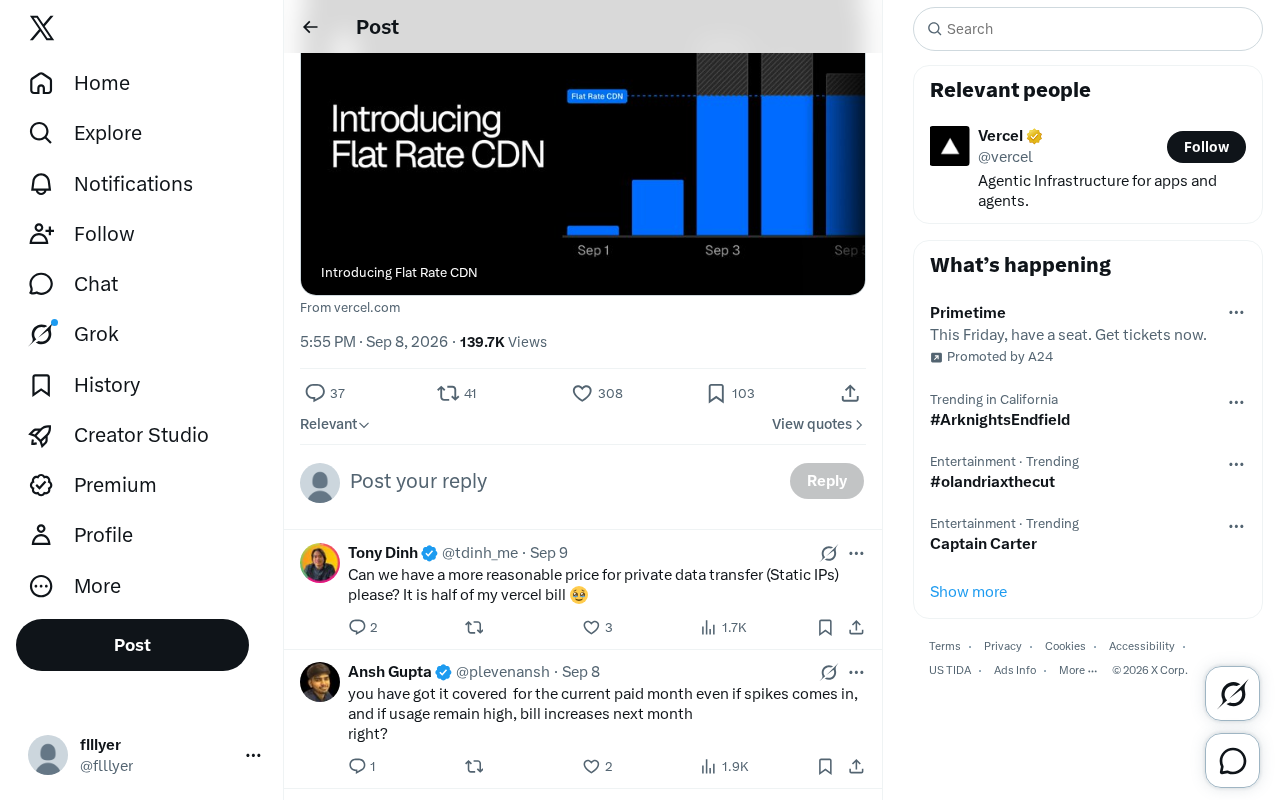
According to the official announcement, the new service focuses on three core value propositions: a fixed monthly fee, premium global network performance, and automatic protection against traffic surges. For teams that need to keep budgets under control, this is a meaningful shift worth paying attention to.
Breaking Down the Three Core Features
Fixed Monthly Fee — Predictable Bills
The biggest headache with traditional CDN billing is uncertainty. A piece of content going viral or a marketing campaign can generate unexpected costs overnight. The flat rate model consolidates these variables into a single predictable bill, making financial planning significantly simpler.
For growing teams, cost predictability often matters more than simply finding the lowest price. A flat rate means fees stay stable regardless of how much traffic fluctuates throughout the month — enabling clearer budget decisions during periods of expansion.
Premium Global Network Performance
Vercel highlights "premium global network performance" as a key selling point. The core value of any CDN lies in its ability to cache content at nodes distributed around the world, placing it closer to end users to reduce latency and improve load times.
For applications serving a global audience, network performance directly impacts user experience and conversion rates. Combining a flat rate with high-performance infrastructure means teams no longer have to choose between cost control and quality.
CDN performance is typically measured by the number of PoPs (Points of Presence) and geographic coverage. When a user requests content, the CDN routes the request to the nearest node, serving it directly from cache rather than reaching back to the origin server each time. This mechanism reduces Time to First Byte (TTFB) and relieves pressure on the origin. Major CDN providers typically operate dozens to hundreds of PoPs worldwide, covering high-traffic regions like North America, Europe, and Asia-Pacific. Vercel's underlying network infrastructure has historically powered its Serverless Functions and static file hosting — Flat Rate CDN now packages that capability as a standalone product, meaning users can leverage it for content distribution outside of Vercel-hosted environments.
Automatic Protection Against Viral Traffic Spikes
The third feature is automatic protection against viral spikes. When a page or piece of content suddenly goes viral, traffic can multiply in a very short window. Under a usage-based billing model, this is simultaneously great news and a potential billing nightmare.
Flat Rate CDN promises to handle these sudden surges automatically, without requiring manual scaling interventions or worrying about runaway costs. This is especially valuable for products that depend on content sharing and may face unpredictable bursts of traffic.
"Viral traffic" places extreme demands on infrastructure at a technical level, often generating requests that are several times — or even tens of times — the normal volume within minutes to hours. Traditional mitigation strategies include manual scaling, over-provisioning capacity, or relying on auto-scaling policies — but these approaches either respond too slowly or introduce their own cost unpredictability. CDNs are naturally well-suited to absorb this kind of traffic shock, since content is already distributed and cached at edge nodes rather than relying on a single origin to handle every request. In this context, the flat rate model eliminates the paradox of "going viral and losing money" — even if a traffic spike far exceeds normal levels, the team won't receive a bill that blows the budget.
What This Means for Teams
From a positioning standpoint, Flat Rate CDN is clearly aimed at Pro-tier team users — not individual developers or enterprise customers. This reflects a common need: mid-sized teams want access to professional-grade network infrastructure while still having cost certainty.
Flat-rate pricing isn't a new concept in cloud services, but applying it to CDN — a domain traditionally dominated by usage-based billing — represents an interesting move toward billing flexibility. For teams that frequently deal with traffic variability, this "all-in-one-price" model lowers both the barrier to entry and the mental overhead of using the service.
Summary
Flat Rate CDN aims to solve the cost uncertainty problem teams face in content delivery, through three key features: a fixed monthly fee, premium global network infrastructure, and automatic protection against viral traffic spikes. Because publicly available information is still limited, the specific pricing tiers, traffic caps, and detailed comparisons with existing plans remain to be seen. Teams with relevant needs can keep an eye on the official documentation to evaluate whether it fits their scale and budget.
Related articles

ChatGPT Space Launches: Team Collaboration and New Pages Features Explained
ChatGPT Space is OpenAI's new team collaboration feature with Pages, real-time collaboration, and Slack/Google Drive sync. We break down its privacy design, multi-platform integration, and the full workflow from conversation to document.

Migrating Apache Spark UDFs to GPU Acceleration with AI Agents
NVIDIA developer blog explains how AI Agents rewrite Apache Spark UDFs for GPU acceleration, covering migration criteria, agent rewriting and verification workflows, plus pitfalls like result consistency and CPU-GPU transfer overhead.

Zed Editor v0.40.4-rc2 Released: Usage Credits Now Available Without Upgrading
Zed editor releases v0.40.4-rc2, allowing users to use usage credits for AI features without upgrading to a paid plan, lowering the trial barrier.