flat.social: A 3D Virtual Social Space Built for Remote Teams
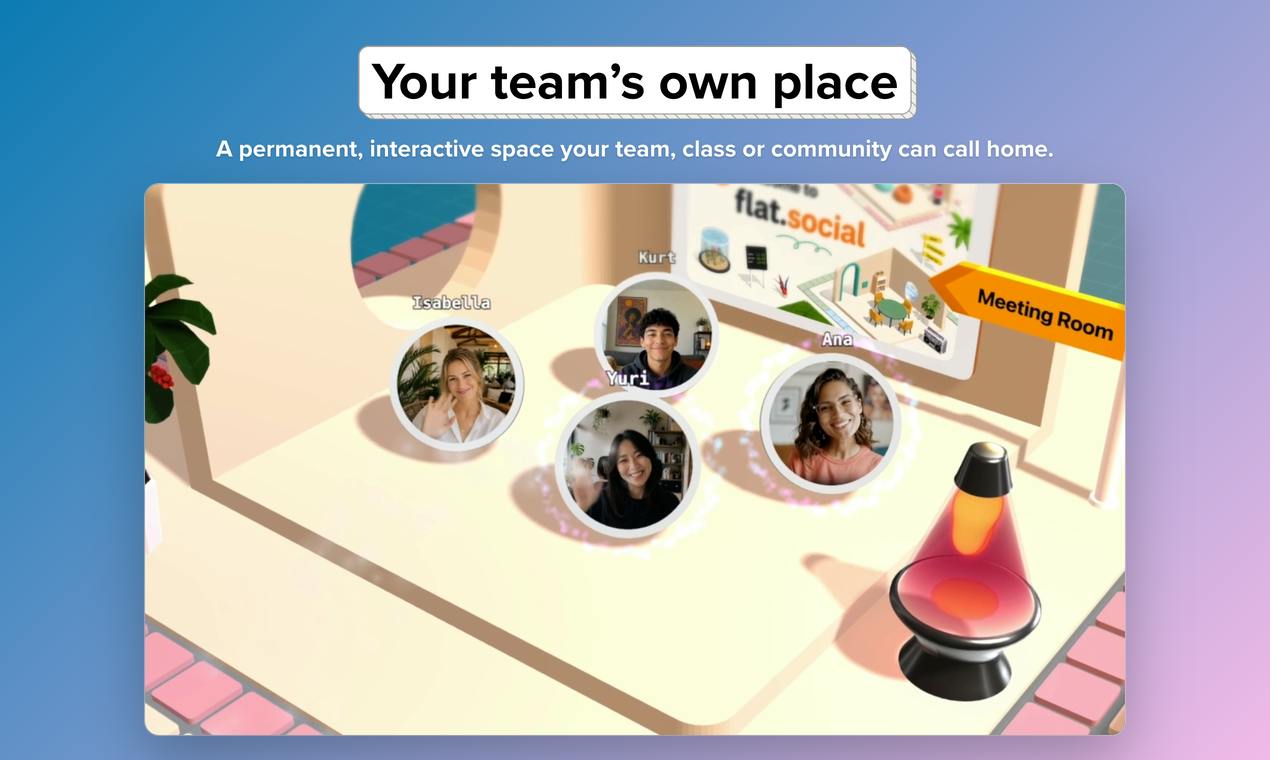
flat.social brings spatial audio and 3D browser spaces to remote team socializing — no downloads required.
flat.social is a browser-based 3D virtual social product for remote teams, built around spatial audio, built-in mini games, and zero installation friction — free for up to 5 users. Its spatial audio system makes voices fade with virtual distance, enabling natural side conversations within a shared room and recreating the feel of a real party. The no-download approach keeps the barrier to organizing informal team activities extremely low. Use cases include team icebreakers, virtual hangouts, online events, and classes — a textbook "metaverse-lite" approach to bridging the emotional gap in remote work.
flat.social: A 3D Virtual Social Space Built for Remote Teams
Remote work has largely solved the productivity problem — there's no shortage of tools for collaboration and communication. But a subtler challenge remains unanswered: how do remote teams maintain genuine human connection? Awkward small talk in video calls and emoji reactions in Slack channels are poor substitutes for the spontaneous, casual interactions that happen naturally in an office. flat.social is trying to fill that gap in a more engaging way.
A Virtual Space Designed for Socializing
flat.social's positioning on Product Hunt is refreshingly honest: "Absurdly delightful 3D spaces where remote teams hang out." It's not another video conferencing tool — it's a virtual space built specifically for team social events, online hangouts, and classes.
Unlike traditional meeting software that emphasizes agendas and efficiency, flat.social puts the focus on being relaxed and fun. Its three core experiences are spatial audio, mini games, and no downloads required. Users can jump into a space directly from their browser, with free access for up to 5 people. This low-friction design is fundamentally about reducing the mental overhead of organizing informal team activities.
Spatial Audio: Recreating the Feel of Real Social Distance
The standout technical feature of flat.social is spatial audio. In a standard video call, everyone's voice is mixed together at the same volume regardless of who's speaking — which works fine for structured meetings, but feels unnatural in a free-form social setting.
Spatial audio simulates how sound works in the real world: the closer your avatar is to someone, the clearer their voice; move away, and it fades. This means multiple side conversations can form organically within the same virtual room — just like people naturally clustering into small groups at a real party. For the first time, remote socializing has a genuine sense of space, rather than forcing everyone into one big group conversation.
On the technical side, spatial audio in the browser relies on the Web Audio API's PannerNode, which dynamically adjusts distance-based attenuation and stereo panning based on the relative positions of avatars in 2D or 3D space. Earlier products like Gather.town and Teamflow pioneered this concept by combining 2D pixel maps with spatial audio, validating that "distance equals volume" has a real positive effect on remote social interaction. Apple has also brought similar head-tracking spatial audio to AirPods Pro and FaceTime, signaling that the technology is rapidly moving from niche to mainstream. flat.social brings this into a browser-based 3D environment without requiring extra hardware — though this raises the bar for network performance. If multi-user position sync lags, the mismatch between audio and avatar location can quickly break immersion.
No Downloads, Just Open a Link and Go
For team tools, the cost of adoption is often the biggest barrier. flat.social runs entirely in the browser with no client installation required. This seemingly simple decision significantly reduces the friction of organizing a team activity — just share a link, everyone clicks in, no worrying about who hasn't installed the app or whose version is out of date.
The free tier supports up to 5 people, covering the basic social needs of small teams. This "try free, pay as you grow" model follows the dominant SaaS growth playbook and lets teams get started with virtually zero commitment.
Use Cases: Not Just Hangouts — Events and Classes Too
Based on flat.social's Product Hunt categories (Events, Meetings, Games), the product's scope extends beyond simple team bonding. In addition to internal social gatherings, it also supports online event hosting and classroom-style teaching.
The addition of mini games makes icebreakers, team-building sessions, and virtual parties feel more participatory. For instructors or event organizers, a 3D space where attendees can freely move around and break into smaller groups is far more immersive than a grid of video tiles. This "metaverse-lite" approach — providing spatial presence without the weight of full VR — is becoming an increasingly explored direction in the remote collaboration space.
The term "metaverse-lite" emerged as a reflection of the industry's course-correction after the 2021 metaverse hype bubble. Heavy-duty platforms like Meta Horizon Worlds suffered from high device requirements and sparse content, leading to poor retention and prompting a wave of lighter-weight alternatives: no VR headsets required, no ray-traced graphics, just enough spatial presence and social immersion to feel different from a standard video call. Products like Gather, SpatialChat, Teamflow, and Remo all take this approach, differing in whether they use 3D rendering, how gamified the experience is, and whether they target enterprise teams or community event organizers. flat.social's choice of a 3D art style rather than pixel/2D tile maps gives it stronger visual identity — at the cost of requiring reasonable WebGL performance, which may cause frame rate issues on lower-end devices.
What the Numbers Say
On Product Hunt, flat.social received 72 upvotes and ranked 14th for the day, developed by Paweł Borkowski. That's a respectable level of attention, though not a breakout hit.
To be fair, the virtual social space category isn't new — products from Gather to Spatial have been competing in this space for a while. flat.social differentiates itself primarily through its playful, low-pressure product personality and minimal friction to get started. Whether it can carve out a durable position in a crowded market ultimately depends on whether teams build a genuine habit around it — rather than treating it as a one-time novelty.
Final Thoughts
flat.social represents an interesting evolutionary direction for remote work tools: shifting the focus from efficiency to experience and emotional connection. Its spatial audio and no-install design genuinely address some real pain points in remote socializing. For small teams looking for an icebreaker format or an online event solution, the free tier offers a low-risk way to find out whether this kind of "3D socializing" fits their team culture.
Related articles

AI Agent Fundamentals: The Three Core Components — Brain, Memory, and Tools
A beginner's guide to AI Agents: covering the three core components (brain, memory, tools), four stages of LLM deployment, and why Agents matter for real business use cases.

Boycotting Software That Doesn't Support Linux: One Developer's Philosophy of Choice
A Linux-only developer shares his philosophy of boycotting non-Linux software — without sacrificing productivity — and explains how coding agents like Claude Code are closing the gap with commercial tools.
Why Do All AI-Generated Projects Look the Same? The Aesthetic Homogenization Problem in Vibe Coding
Why do vibe coding projects all use purple gradients and dark glassmorphism? We break down the technical roots of AI aesthetic homogenization and how to escape it.