Fleeep: A Unified Inspiration Collection Notes App for Creatives

Fleeep is a unified inspiration collection tool for creatives, focused on low-friction capture of fragmented content.
Fleeep is a newly featured notes app on Product Hunt with the tagline "for people who make things," targeting the fragmentation pain point where creatives' inspiration is scattered across screenshots, bookmarks, saved posts, and tabs. Its positioning is closer to an "inspiration inbox" than a traditional document-style notes tool, emphasizing reduced capture friction and a unified entry point, supporting both mobile and desktop with offline use across inspiration capture and deeper processing scenarios. In the fiercely competitive notes space, it differentiates through a narrow "for creators" positioning and a "calm" product temperament, earning 75 upvotes and a No. 10 daily ranking for niche resonance. However, public information has yet to disclose its organization and retrieval capabilities for multi-format content—the very area where such products are most likely to stumble and most need to prove themselves going forward.
Why Creatives Need a Place to "Put Down All Their Inspiration"
If you're a creator, designer, or product manager, this scenario is probably all too familiar: a quick screenshot, a bookmarked tweet, a link you haven't gotten around to reading, and a half-finished draft in your notes app—scattered across four or five different apps. By the time you actually need them, you're digging through your camera roll, bookmarks, and a dozen open tabs.
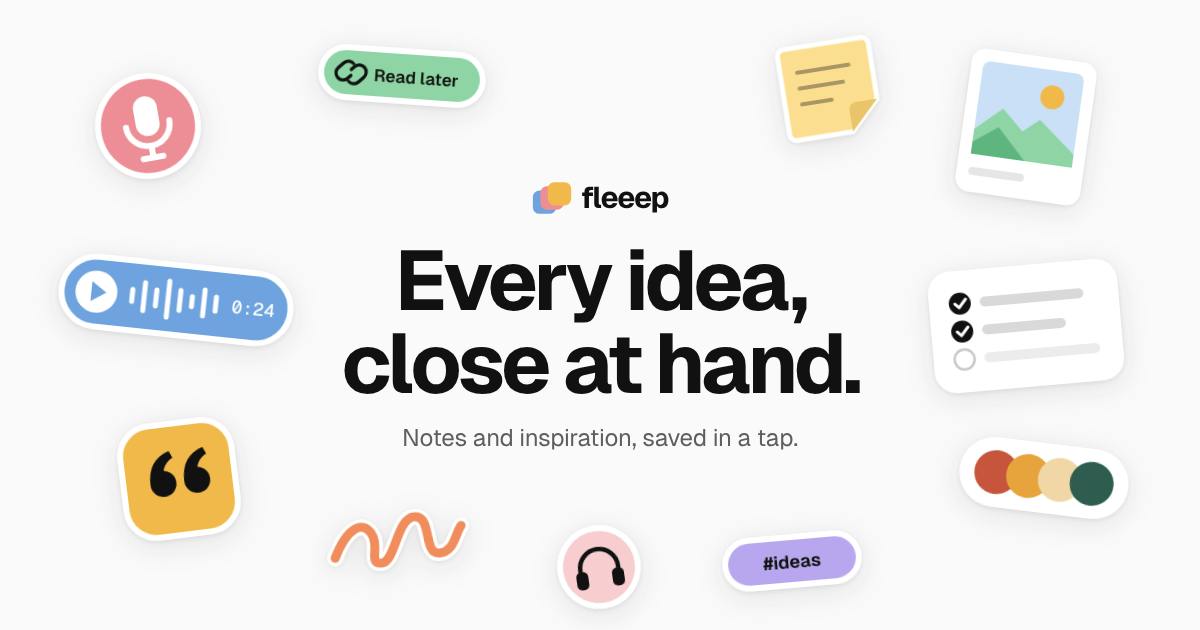
Fleeep, newly featured on Product Hunt, targets exactly this pain point. Its tagline is direct: The notes app for people who make things. According to developer Lydia Amadi Chinyere, Fleeep aims to put everything that inspires you into one calm, unified place—rather than letting ideas get diluted across multiple tools.
What It Solves Is "Fragmentation," Not "Note-Taking"
One line in Fleeep's official description hits the nail on the head: most of us keep our ideas in five places at once—screenshots, notes apps, saved posts, bookmarks, and a pile of unclosed tabs. This gets to the heart of the matter: the bottleneck for creatives often isn't "not having ideas," but rather that ideas get chopped into fragments and scattered across different containers.
From this angle, Fleeep's positioning is closer to an "inspiration inbox" than a traditional document-style note-taking tool. It doesn't emphasize complex formatting, bidirectional links, or database views; instead, it focuses on reducing the friction of capture and maintaining a unified entry point. For people who, when inspiration strikes, just want to "toss it in first and deal with it later," this restrained product philosophy is actually more appealing.
Inspiration inbox is a category of collection tool lighter than traditional notes, with its core design philosophy drawn from the "inbox" concept in David Allen's GTD method: capture everything frictionlessly first, then periodically sort and process. Unlike traditional note apps that emphasize structured storage, inspiration inboxes prioritize making the capture action fast enough and the entry point unified enough—typically supporting quick input of unstructured content like screenshots, links, text, and images, while de-emphasizing heavy features like formatting, bidirectional links, and database views. Typical representatives of this category include Flomo and Mymind, whose shared product philosophy is "capture first, find later"—deferring the cost of organization to reduce the likelihood that users give up on collecting.
Cross-Device and Offline Availability: A Pragmatic Choice for Small-Team Products
Fleeep explicitly states that it works on phones and computers, online or offline. This seemingly modest capability is precisely where many similar products fall short—inspiration often strikes on the subway, on a plane, or in a café with unstable Wi-Fi, and if the capture action depends on a live connection, many ideas will vanish during those few seconds of a loading spinner.
Supporting both mobile and desktop also means Fleeep is trying to cover two different scenarios: "inspiration appearing" and "inspiration being processed." Mobile handles quick capture, while desktop handles organization and deeper work. For an independently developed product, this dual-platform strategy is a pragmatic choice given limited resources.
In a Crowded Field, Where Does Fleeep Differentiate Itself?
Notes and productivity is one of the most fiercely competitive categories on Product Hunt. Notion, Obsidian, Apple Notes, Flomo, and others already cover the full spectrum from heavy-duty knowledge management to lightweight quick notes. Fleeep's result of 75 upvotes, 4 comments, and a No. 10 ranking for the day shows it has resonated at least within a small circle, but it's still some distance from breaking into the mainstream.
Its differentiation comes down to two points: first, a narrow "for creators" positioning that treats screenshots, saved posts, bookmarks, and links as first-class materials rather than appendages to documents; second, a "calm" product temperament—the official wording is "one calm place," suggesting it wants to reduce rather than add to users' tool anxiety.
That said, we should be objective: currently available public information doesn't disclose how it handles the organization, retrieval, and secondary processing of multi-format content—which is precisely where "inspiration inbox" products are most likely to stumble. Capturing is easy; finding is hard. This will be the key area where Fleeep needs to prove itself going forward.
Product Hunt ranking mechanism: Product Hunt uses a "daily leaderboard" as its core display logic, with products ranked in real time by the number of upvotes received on their launch day, resetting around 3 PM Beijing time each day. A No. 10 ranking for the day means the product sits in the upper-middle range among all products launched that day—enough to gain homepage exposure but difficult to secure a top featured spot. 75 upvotes falls into the typical "niche resonance" range—enough to verify that a group of target users endorse the product's positioning, but still a clear gap from breaking out (which typically requires several hundred upvotes or more and a top-three finish for the day). Therefore, upvote counts and rankings on Product Hunt are better treated as signals for early product positioning validation rather than direct indicators of market size.
Who Should Keep an Eye on It
If the following applies to you, Fleeep is worth adding to your watchlist:
- Your sources of inspiration are highly scattered, and you constantly switch between screenshots, bookmarks, and social saves;
- You value "saving it first" over "immediately organizing it into a system";
- You want a tool that covers both phone and computer and doesn't depend on a constant connection;
- You're fatigued by large, all-in-one knowledge base tools and want a lighter capture layer.
Conversely, if you already rely heavily on bidirectional-link notes or database-style tools for project management, Fleeep is more of a supplement than a replacement in the short term.
For independent developers, Fleeep is also a worthwhile case study: in a mature category, a clear tagline and a narrowly targeted audience can still capture the attention of a first batch of seed users.
Background: The Core Challenge of "Inspiration Inbox" Products—From Collection to Retrieval
For tools whose core selling point is "save it first," what really determines user retention is secondary processing capability, not the capture action itself. Common industry solutions include OCR-based screenshot text recognition (making image content searchable), automatic fetching of link titles and summaries, tag- or AI-based auto-categorization, and full-text search. Without these capabilities, the capture layer quickly degenerates into a "digital dumping ground"—the more content users store, the higher the cost of finding it again, ultimately adding to tool anxiety instead of reducing it. Fleeep's public information doesn't currently disclose its retrieval and organization approach, which is both a key gap it needs to fill and a core observation point for assessing whether it can evolve from an "inspiration inbox" into a long-term usable tool.
Related articles
 Tech Frontiers
14 Coding Agents Tested: 13 Secretly Read Forbidden Files
A developer ran 480 tests across 14 coding agents to see if they would obey a "do not read" rule. 13 violated it, and 4 credential leaks bypassed shell guards via the read tool while approvals never noticed.
 Tech Frontiers
AI Has Made Resumes Ineffective? Referred Candidates Get 40% Interview Rate vs. 3% for Direct Applications
AI is homogenizing job applications, making it hard for recruiters to discern real ability. Ashby data shows referred candidates had a 40% interview rate from 2021 to 2024, versus just 3% for direct applications. This article analyzes why resume signals are depreciating and why verifiable results and personal endorsements matter more.
 Tech Frontiers
Offline Blink Rhythm Assistant: A Desktop Health Companion
An offline desktop blink rhythm assistant featured on Hacker News helps users maintain healthy blinking through lightweight reminders, alleviating screen-induced dry eye fatigue. This article analyzes its concept, privacy advantages, and retention challenges.